Persian · Historical association with Persia
Persian: Health
Persian health
Health observations and family records
Keep inherited kidney results separate from current eye and breathing observations. A cat struggling to breathe or breathing with an open mouth needs emergency veterinary care, regardless of whether it was resting or active.
Kidneys and changes at the litter box
Some Persians inherit polycystic kidney disease (PKD). Early on, a cat may look well. Later, a water bowl that empties faster, larger urine clumps or unexplained weight loss can signal kidney trouble. Book an exam for a persistent change in thirst or urination. Go to an emergency vet now if your cat repeatedly strains to pee and passes only drops or no urine, or if they keep straining and you can’t tell whether they’re passing urine normally. Collapse or severe weakness also needs emergency care now. Passing less urine while straining is not the same change as making larger clumps; don’t wait to see if it is kidney disease. Bring recent weights, any actual PKD1 report and older scans or lab results. Ask: “Do we know how well the kidneys are working now? Would an ultrasound help explain what we found? Which tests, including blood pressure, should we repeat and when?” Tell the vet how many cats share the water bowls and boxes if you can’t confirm which cat changed. Make fresh water and litter boxes easy to reach. If the veterinary team asks, track appetite, weight and the size of urine clumps, and keep the recheck plan handy. Ask whether and when a kidney diet is appropriate; call if intake falls instead of trying to force the new food. Don't start fluids or supplements, restrict water or adjust medicines unless your veterinary team has made a plan for your cat.
A sore or partly closed eye
A Persian’s prominent eyes can be vulnerable to injury on the cornea, the clear front surface of the eye. Squinting, rubbing one eye or suddenly holding it closed can mean pain. Contact a veterinarian promptly for a painful eye; do not wait for a routine check.
Noisy or difficult breathing
A Persian with a very short muzzle may have narrow air passages. Breathing that grows noisier while awake, or stopping early during gentle play to catch a breath, deserves attention. Describe what your cat was doing when it happened.
Family history and screening
Check which PKD1 variant each parental report covers. For an adopted adult, request previous kidney findings and records of eye injury or altered breathing. Skull shape, a test result and the cat’s current comfort are different kinds of information.
Questions for your veterinarian
- Which previous kidney and eye records should I bring?
- How should I report a new change in breathing without assuming its cause?
Choosing a kitten? Ask to see both parents’ results, with the animal’s name and the date on each report. If you’re adopting an adult, ask which records come with that individual.
Check the animal’s identity, the test date and the result. Breeders submit these documents. My Breed Atlas does not independently authenticate them.
More from My Breed Atlas
Health sources
- UC Davis veterinary genetic test
- Cornell clinical feline guidance
- primary Persian CT/anatomical study
- Cornell feline clinical guidance
- Cornell clinical feline guidance
- primary UK clinical records study, VetCompass
- Cornell feline clinical guidance
- primary owner-reported respiratory survey
- Lyons et al., exact Persian clinical cases and PKD1
- UC Davis named PKD1 test
- Cornell feline PKD
- Cornell veterinary guidance for lower urinary signs
- Cornell emergency and critical care
Screening evidence and limits
PKD1 testing addresses an inherited form of polycystic kidney disease; it does not rule out every kidney condition. A UK primary-care study identified coat, dental and eye problems as prominent concerns in Persians and discusses risks associated with their flattened facial conformation. The study population does not predict an individual cat’s outcome. Discuss comfortable breathing, eye health, dental assessment and sustainable grooming alongside genetic results.
Rescues & sheltersPrint or citeBreed articles
Other profile sections and family fact sheet
Life with a Persian
Calm companionship
Offer attention and respect the individual’s choice.
Explore home lifeShort, regular play
Offer play and enrichment at a comfortable pace.
Explore daily careDaily grooming
Plan time for the long coat and eye care.
See the brushing routineResearching this breed for school?
Get a family fact sheet or copy a citation for your report.
Print or cite this breed
Persian family fact sheet
Breed-level references are a starting point. Ask about the individual animal’s routine and care needs.
- Adult weight
- 7–14 lb
- Adult build
- Medium-sized
- Lifespan
- 8–11 years
- Coat
- Long, abundant
Company
A calm companion still needs an individual choice about contact and play. Include the daily grooming commitment in the household decision: enjoying the appearance is different from being able to maintain the coat comfortably. Meet the cat and ask how it tolerates the care it receives.
Play & enrichment
A quiet disposition still leaves room for play. Offer opportunities that this cat enjoys and watch its comfort; do not interpret a calm breed description as a requirement to remain inactive.
Coat care
Plan daily coat-care time. The coat demands a substantial grooming commitment; ask to see the actual combing routine and any eye-cleaning needs. Arrange a hands-on demonstration before taking on this coat. Ask which parts need extra attention and how the caregiver manages the face and eyes. Eye discharge or discomfort should be discussed with a veterinarian, rather than treated only as a cosmetic problem.
Everyday responsibilities
Plan food, supplies, routine care and veterinary visits. Agree who handles the everyday jobs and who covers absences.
Adult help
An adult should remain responsible for care, supervise children’s interactions and arrange help when needed.
My Breed Atlas. Persian breed profile. https://mybreedatlas.com/cats/breeds/persian
Read this profile’s sources →Adult ranges and source qualifications
- Female weight
- 7–11 lb
- Male weight
- 9–14 lb
- Adult build reference
- Medium-sized beneath a long, abundant coat
- Origin
- Historical association with Persia; developed in Western Europe
Reference ranges describe a population, not a target or a prediction for an individual.
TICA’s descriptive longevity guidance, not a measured survival estimate or a guarantee. It must not be used to rank health or calculate an individual lifespan.
Daily care
A practical routine for a Persian. Adjust it to the cat’s age, health and comfort.
Play, enrichment & learning
A quiet disposition still leaves room for play. Offer opportunities that this cat enjoys and watch its comfort; do not interpret a calm breed description as a requirement to remain inactive.
Training & communication
Reward a behavior the cat chooses with something it values. Build tasks in small steps, including approaching a carrier or a grooming tool. Stop when the cat is frightened, unwell or in pain; ask your veterinarian about cooperative care.
Grooming the long coat
Plan daily coat-care time. The coat demands a substantial grooming commitment; ask to see the actual combing routine and any eye-cleaning needs. Arrange a hands-on demonstration before taking on this coat. Ask which parts need extra attention and how the caregiver manages the face and eyes. Eye discharge or discomfort should be discussed with a veterinarian, rather than treated only as a cosmetic problem.
Use the individual coat’s condition to guide care. Ask for a hands-on demonstration if you are unsure.
Coat-care sources →Food, time & costs
Set aside daily coat-care time before committing. Include help with difficult grooming and veterinary assessment of eyes, teeth and breathing in the care discussion.
Meals and body condition
Discuss portions and body condition with your veterinarian instead of using the registry weight range as a feeding target. Smaller meals and appropriate food puzzles can support natural feeding behavior. Give each cat a separate feeding station.
Time and costs
Before committing, budget for food, litter, equipment and continuing veterinary care. Agree who handles play, cleaning, grooming and care during absences. Obtain local estimates for the individual’s care instead of relying on an invented breed cost.
Home life
Calm company, individual choices
A calm companion still needs an individual choice about contact and play. Include the daily grooming commitment in the household decision: enjoying the appearance is different from being able to maintain the coat comfortably. Meet the cat and ask how it tolerates the care it receives.
Workdays, children & other animals
Prepare a quiet transition room with food, water, litter, hiding places and scratching options. Introduce resident cats gradually and proceed when both are comfortable. Breed reputation cannot establish compatibility with children, dogs or another cat.
Offer a quiet retreat and let the cat control its distance. Supervise children and introduce resident animals gradually; individual history matters more than a breed reputation.
Make a plan for time apart and changes in the household. Ask about the individual’s previous experiences and introduce new situations gradually.
Personality & care profile
These reference ratings describe breed tendencies. Higher means more of the named tendency, not better, and every animal is an individual.
- Loose hair
- Regular shedding is part of living with this coat.
YOUR EVERYDAY LIFE
How could this breed fit your life?
Explore example care routines or compare this breed with matching preferences you chose to save. Start with the household’s day, then consider the individual animal.
Saved matching preferences stay in this browser, never on your account. They expire after 30 days and are removed the next time this feature reads them. Health answers, children’s ages and free-text notes are not saved. This section does not reproduce those personal care notes.
History & sources
Heritage & appearance
Origins & classification
CFA describes the timing of its arrival in Western Europe as uncertain. Later selective breeding shaped the recognizable long coat and rounded modern appearance.
Appearance
A longhaired cat with a compact body, rounded head and a broad range of colors. CFA organizes Persian competition into multiple divisions, including Himalayan.
Breed names and registry divisions have specific scopes; a related name does not make two profiles interchangeable.
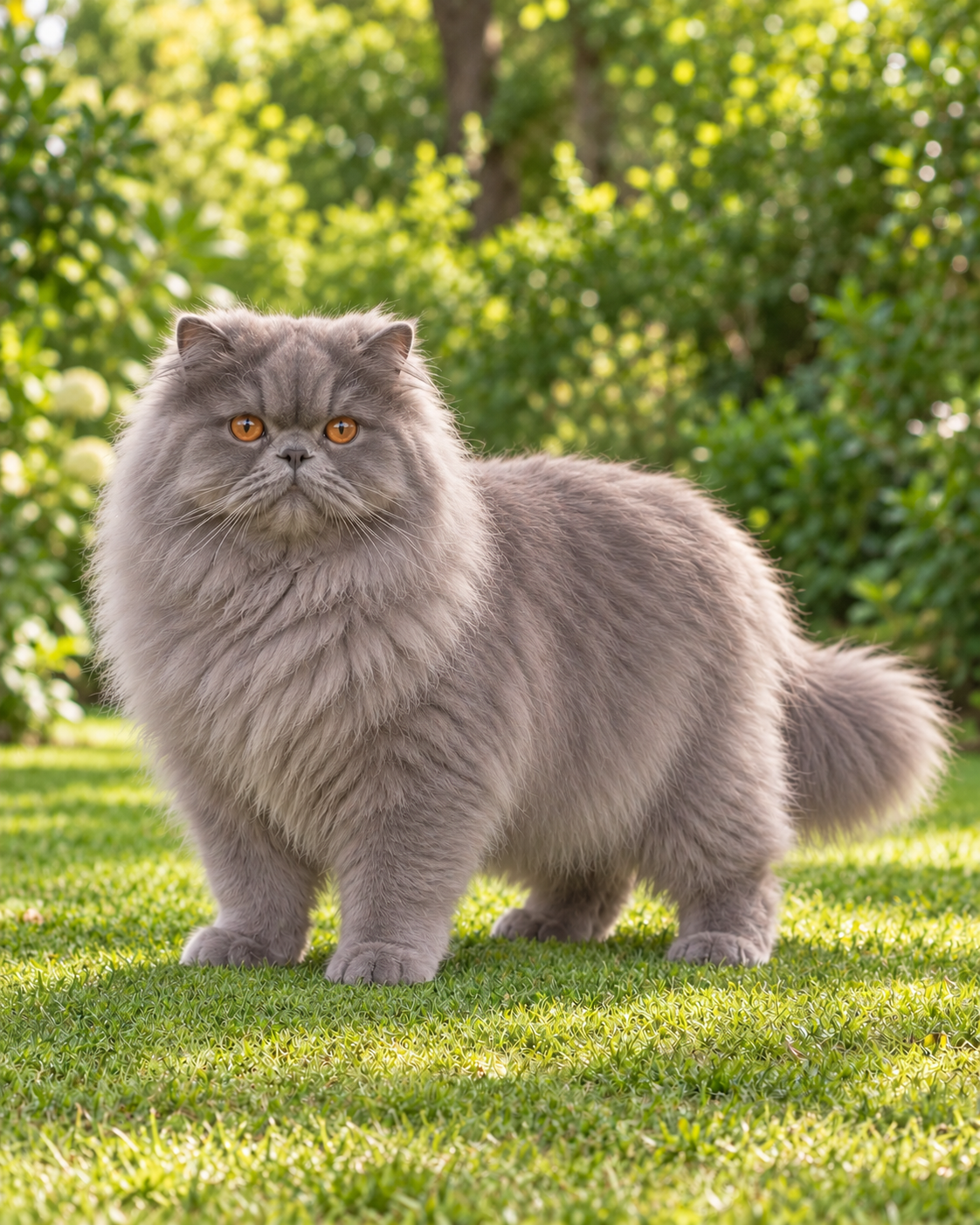
One adult example
Coat, color and markings vary. An illustration does not predict an individual animal’s appearance.
AI-generated breed illustration. Not an actual listed cat.References & editorial notes
Adult-weight sources
Female: 7–11 lb; Male: 9–14 lb
direct: veterinary nutrition breed profile explicitly lists female 7-11 lb and male 9-14 lb; registry standards checked for numerical intervals. Persian-language search completed; cited weight text is English.
Original My Breed Atlas guidance informed by the named breed and care references below. Breed tendencies vary; general education does not replace individual veterinary advice.
- UC Davis Veterinary Genetics Laboratory: Polycystic Kidney Disease (PKD1) · Checked 2026-10-20.
- Cat Fanciers' Association: Persian · Checked 2026-10-20.
- Scientific Reports / Royal Veterinary College: Persian cats under first opinion veterinary care in the UK (O’Neill et al., 2019) · Checked 2026-10-20.
- Cat Fanciers’ Association: CFA 2026–2027 Breed Standards · Checked 2026-10-20.
- FIFe: Recognised breeds · Checked 2026-10-20.
- TICA: Standing Rules Version C, 3 June 2026, section 701.4.1 · Checked 2026-10-20.
- Cat Fanciers’ Association: Fluffy Coats and How to Properly Care For Them · Checked 2026-10-20.
- Feline Veterinary Medical Association: Using Positive Reinforcement to Train and Support Your Cat · Checked 2026-10-20.
- Feline Veterinary Medical Association: Making the Commitment to Adopt a Cat · Checked 2026-10-20.
- Feline Veterinary Medical Association: How to Feed a Cat · Checked 2026-10-20.
- Feline Veterinary Medical Association: Introducing a New Cat Into Your Home · Checked 2026-10-20.
- Feline Veterinary Medical Association: Meeting the Physical and Emotional Needs of Indoor Cats · Checked 2026-10-20.
- TICA: Persian breed introduction · Checked 2026-10-20.
- Purina: Persian adult-weight references
Breeders & rescues
Meet the individual
Open the cat directory with Persian selected. Listings are starting points for your research, not endorsements; confirm current availability directly.
Find Persian breeders →Rescues & shelters
The rescue search includes organizations with different species and breed coverage. Ask each organization whether it works with this breed and what is known about the individual.
Search rescues & shelters →Before you meet a cat
- Can a veterinarian review the PKD1 report and this cat’s breathing, eyes, teeth and coat condition?
- Can the cat breathe comfortably during normal activity?
- What coat maintenance and screening records come with this individual?