Cat breed · New England, United States
Maine Coon: Health
Maine Coon health
Health observations and family records
Maine Coon heart imaging, hip assessments and SMA DNA results answer different questions. Keep the findings and dates separately. Difficult or open-mouth breathing, or sudden loss of use of the back legs, needs emergency veterinary care; crying or being at rest is not a prerequisite.
Heart muscle disease
A Maine Coon with hypertrophic cardiomyopathy (HCM), a thickening of the heart muscle, may not appear ill. The UC Davis Maine Coon HCM DNA test checks only the A31P variant in the MYBPC3 gene; a negative result on that test does not rule out HCM. Keep dated heart ultrasound (echocardiogram) findings for your cat separate from DNA results, and ask about confirmed heart diagnoses in close relatives. A change in breathing at rest is especially important.
Hips and jumping
Hip dysplasia can make landing or jumping uncomfortable. You may first notice your cat taking a chair on the way up to a favorite windowsill, or giving up the jump altogether. A repeated change in how your cat moves is worth a checkup.
Weakness in kittens
Spinal muscular atrophy is an inherited condition in Maine Coons. An affected kitten may start swaying behind or seem unsteady while standing at about three to four months. Arrange an exam if a kitten develops weakness, even if it still wants to play.
A slipped growth plate at the hip
A growth plate is an area where a young animal's bone grows. In a slipped capital femoral epiphysis, or SCFE, the growth plate next to the ball of the hip gives way and the bone shifts. Veterinarians have documented this in young Maine Coons, including cats with no known injury. It is different from hip dysplasia. A young cat may start limping on a back leg, skip familiar jumps or move less. Call your vet promptly for a new or worsening limp, even if you didn't see a fall. Go to an emergency vet immediately if your cat suddenly won't put weight on a leg, is in severe pain, suddenly drags or loses use of one or both back legs, collapses or has trouble breathing. Don't press on the hip or try to make your cat jump to see what happens. Tell your vet when it started, what your cat could still do and any possible injury. Ask: “Could the hip growth plate be involved, or does the exam point to another cause? Should we look at both hips on X-rays? Would an orthopedic specialist help?” After diagnosis, ask for a written plan for movement, pain control and rechecks. If surgery is recommended, ask how to set up a safe recovery room and when steps or jumping are safe again. Put water, food and the litter box where your cat can reach them without climbing. Tell your vet if your cat seems less comfortable or starts favoring the other leg. Follow the clinic's recovery instructions rather than starting exercises on your own.
Family history and screening
Ask for dated heart ultrasound findings as well as the exact MYBPC3 result, and keep hip reports and the SMA result separate. A normal variant result does not evaluate every possible cause of heart disease or a new movement change.
Questions for your veterinarian
- Which reports describe a current clinical examination and which concern a particular DNA variant?
- What records would help you assess a new change in jumping or a kitten’s steadiness?
Choosing a kitten? Ask to see both parents’ results, with the animal’s name and the date on each report. If you’re adopting an adult, ask which records come with that individual.
Health sources
- Cornell clinical feline guidance
- UC Davis test documentation
- primary radiographic screening program cohort
- Cornell clinical feline guidance
- Cornell clinical emergency triage
- UC Davis animal genetics test documentation
- ACVIM cardiology consensus guideline
- Cornell clinical feline guidance
- Borak et al. · Slipped capital femoral epiphysis in 17 Maine Coon cats
- AAHA/AAFP · Feline elimination and accessible box guidance
- ACVS · Postoperative care after surgery
Screening evidence and limits
UC Davis identifies MYBPC3 A31P as an HCM-associated variant in Maine Coons. Cats without that variant can still develop HCM; a negative result does not replace clinical assessment. Cornell describes echocardiography as the diagnostic method. Ask a veterinarian how the family history and existing cardiac reports should shape follow-up.
Rescues & sheltersPrint or citeBreed articles
Other profile sections and family fact sheet
Life with a Maine Coon
Plan the household around the adult cat, with room for its preferred resting and play routines.
Explore home life →Combine interactive toys with brief reward-based learning games.
Explore daily care →Comb through the shaggy coat two or three times weekly, adjusting to the individual texture.
Explore daily care →Print or cite this breed
Maine Coon family fact sheet
Breed-level references are a starting point. Ask about the individual animal’s routine and care needs.
- Build
- Large with a shaggy long coat
- Female
- 12–15 lb
- Male
- 18–22 lb
- Reference lifespan
- 12.5 years or more
- Adult size
- Typical adults (TICA): Female: 12–15 lb; Male: 18–22 lb Typical adult references vary between sources and individuals. See the full source accounts.
Company
Plan the household around the adult cat, with room for its preferred resting and play routines. Ask to see the individual’s response to interaction rather than choosing on size alone. Chirps and trills describe a style of communication, not a guarantee of silence or independence.
Play & enrichment
Combine interactive toys with brief reward-based learning games. Some individuals enjoy fetch; offer choices and let the cat decide which games continue.
Coat care
Comb through the shaggy coat two or three times weekly, adjusting to the individual texture. Ask the caregiver to demonstrate the tools and the places that tangle. Separately registered polydactyl cats need an individual handling and care assessment.
Everyday responsibilities
Plan food, supplies, routine care and veterinary visits. Agree who handles the everyday jobs and who covers absences.
Adult help
An adult should remain responsible for care, supervise children’s interactions and arrange help when needed.
My Breed Atlas. Maine Coon breed profile. https://mybreedatlas.com/cats/breeds/maine-coon
Read this profile’s sources →Adult ranges and source qualifications
- Build
- Large with a shaggy long coat
- Female
- 12–15 lb
- Male
- 18–22 lb
- Reference lifespan
- 12.5 years or more
Reference ranges describe the breed, not a prediction for an individual.
Daily care
Play & enrichment
Combine interactive toys with brief reward-based learning games. Some individuals enjoy fetch; offer choices and let the cat decide which games continue.
More about everyday care
Provide places to retreat, separated resources, chances to play and predictable interaction. These are feline needs, not breed compatibility scores.
Coat, grooming & daily care
Comb through the shaggy coat two or three times weekly, adjusting to the individual texture. Ask the caregiver to demonstrate the tools and the places that tangle. Separately registered polydactyl cats need an individual handling and care assessment.
Training & communication
Reward a behavior the cat chooses with something it values. Build tasks in small steps, including approaching a carrier or a grooming tool. Stop when the cat is frightened, unwell or in pain; ask your veterinarian about cooperative care.
Food, routine & costs
The everyday ownership plan
Planning for this breed
Measure the resting platforms, carrier and grooming space against the adult cat you expect to care for; a kitten-sized setup may not remain useful.
Meals and body condition
Discuss portions and body condition with your veterinarian instead of using the registry weight range as a feeding target. Smaller meals and appropriate food puzzles can support natural feeding behavior. Give each cat a separate feeding station.
Time and costs
Before committing, budget for food, litter, equipment and continuing veterinary care. Agree who handles play, cleaning, grooming and care during absences. Obtain local estimates for the individual’s care instead of relying on an invented breed cost.
Home life
Temperament & companionship
Plan the household around the adult cat, with room for its preferred resting and play routines. Ask to see the individual’s response to interaction rather than choosing on size alone. Chirps and trills describe a style of communication, not a guarantee of silence or independence.
Home life & introductions
Prepare a quiet transition room with food, water, litter, hiding places and scratching options. Introduce resident cats gradually and proceed when both are comfortable. Breed reputation cannot establish compatibility with children, dogs or another cat.
Offer a quiet retreat and let the cat control its distance. Supervise children and introduce resident animals gradually; individual history matters more than a breed reputation.
Personality & care details
Personality & care profile
Breed tendencies vary by individual. Higher means more of the named tendency, not better.
What everyday life tends to involve
These notes describe a tendency for the breed. Every animal is an individual.
- Play
- Play is active and thoughtful. All-day trick sessions are not required.
- Coat care
- Brushing a few times a week fits this coat.
- Loose hair
- Regular shedding is part of living with this coat.
- Company
- A moderate amount of time together is enough, and they will ask for it when you are there.
- Adult size
- Typical adults (TICA): Female: 12–15 lb; Male: 18–22 lb
Typical adult references vary between sources and individuals. See the full source accounts.
YOUR EVERYDAY LIFE
How could this breed fit your life?
See household examples or compare this breed with answers you chose to save. The examples show combinations where this breed appeared among the first five results. Other combinations can work too.
Saved matching preferences stay in this browser, never on your account. They expire after 30 days and are removed the next time this feature reads them. Health answers, children’s ages and free-text notes are not saved. This section does not reproduce those personal care notes.
History & sources
Heritage & appearance
Meet the Maine Coon
Adult ranges are reference examples, not targets or predictions for an individual cat.
Heritage & appearance
The breed developed from the longhaired cats of New England. Its regional history does not establish the colorful raccoon-crossing legends sometimes attached to its name.
More about this breed’s history
What the 1909 register says about Molly Bond
The first bound volume of CFA’s Stud Book and Register, published in 1909, gives a glimpse of how regional cats entered the records. Under Rule 2, a longhaired Maine-type cat born in New England could enter the Register on a sworn statement that both parents were longhaired cats of the same breed, when it was ineligible for the Stud Book. Molly Bond appears under that rule. The entry calls her a tortoiseshell with amber eyes and identifies her parents simply by color. The record preserves a particular cat even though it supplies no named pedigree. (Cat Fanciers’ Association, digitized original: Stud Book and Register, volume I, Register rules; Molly Bond, printed p. 91)
Full breed details
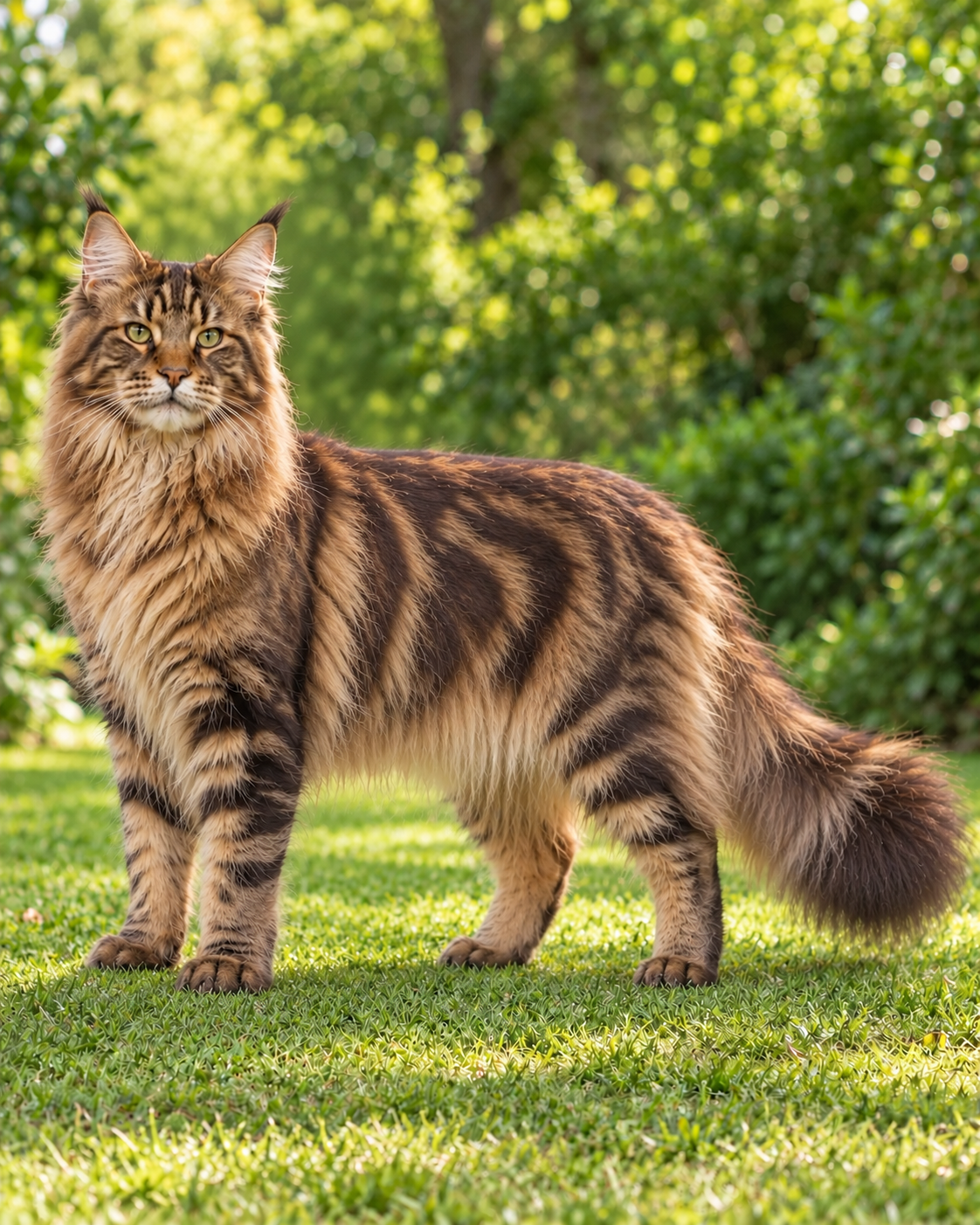
A substantial longhaired cat with a shaggy coat, prominent ears and a long tail. Social interaction accompanied by chirps and trills.
- Adult weight
- TICA typical adult summary: Female: 12–15 lb; Male: 18–22 lb. Full maturity can take four years. | TICA body-text mature averages: Female: 9–13 lb; Male: 13–18 lb. The same page gives a different account here; these are retained separately, never averaged into a consensus range.
View all Maine Coon articles →
View sources and checked dates →References & editorial notes
Adult-weight sources
TICA typical adult summary: Female: 12–15 lb; Male: 18–22 lb. TICA states full maturity can take four years. | TICA body-text mature averages: Female: 9–13 lb; Male: 13–18 lb. The same page gives a different account here; these are retained separately, never averaged into a consensus range.
direct: TICA typical adult summary; typical-adult-summary. TICA states full maturity can take four years.
- Hypertrophic Cardiomyopathy in Maine Coons
- Maine Coon
- Hypertrophic Cardiomyopathy
- CFA 2026–2027 Breed Standards
- Recognised breeds
- Standing Rules Version C, 3 June 2026, section 701.4.1
- Using Positive Reinforcement to Train and Support Your Cat
- Making the Commitment to Adopt a Cat
- How to Feed a Cat
- Introducing a New Cat Into Your Home
- Meeting the Physical and Emotional Needs of Indoor Cats
- Maine Coon breed introduction
- Hypertrophic Cardiomyopathy in Maine Coons Checked 2026-10-20.
- Maine Coon Checked 2026-10-20.
- Hypertrophic Cardiomyopathy Checked 2026-10-20.
- CFA 2026–2027 Breed Standards Checked 2026-10-20.
- Recognised breeds Checked 2026-10-20.
- Standing Rules Version C, 3 June 2026, section 701.4.1 Checked 2026-10-20.
- Using Positive Reinforcement to Train and Support Your Cat Checked 2026-10-20.
- Making the Commitment to Adopt a Cat Checked 2026-10-20.
- How to Feed a Cat Checked 2026-10-20.
- Introducing a New Cat Into Your Home Checked 2026-10-20.
- Meeting the Physical and Emotional Needs of Indoor Cats Checked 2026-10-20.
- Maine Coon breed introduction Checked 2026-10-20.
References
Breeders & rescues
Maine Coon listings in TexasQuestions to bring
- Are the Maine Coon A31P test and family cardiac examination records available, with dates?
- How large are the mature relatives?
- Which cardiac examinations accompany the genetic results?