Cat breed
Himalayan: Health
Himalayan health
Health observations and family records
The conventional PKD1 variant has been documented in Himalayans, including in Japanese genetic research. A result for this variant does not measure today’s kidney function or predict the individual cat’s course.
An available test is different from a recommendation to use it. Ask which records are relevant to this individual; neither a test listing nor a screening recommendation tells you how often illness occurs.
Describe changes in drinking or appetite
Let your veterinarian know about more drinking or urine, reduced appetite or weight loss. Cornell describes these as possible signs of kidney illness in cats generally, not signs that identify a particular inherited cause. Bring the genetic report as history rather than using it to explain the change yourself.
A painful dark patch on the eye
A corneal sequestrum is a damaged patch of tissue on the clear front of the eye. The patch can look amber, brown or black. It can hurt, and a deeper lesion can threaten vision. Veterinary ophthalmologists have documented it in Himalayans as well as other cats. This does not tell us how likely a particular Himalayan is to develop it. A dark spot may be the first thing you see, or the eye might water, squint, look cloudy, or be rubbed more than usual. Call your vet promptly about a new spot or persistent squint. For sudden eye pain or loss of sight, call a vet now for an immediate exam. If your clinic cannot see your cat right away, go to an emergency vet. A known serious eye injury also needs immediate care. You cannot tell depth or cause by looking at a photo. Do not try to wipe the spot off or reuse old eye drops. Tell the clinic which eye changed, when it started, whether there has been an injury or earlier eye problem, and what drops or ointments your cat recently received. Ask: “Is the clear surface damaged? Are the lids or nearby hairs irritating it? Would an ophthalmologist help assess how deep this is? What should send us back before the scheduled recheck?” The vet may use an eye stain to look for damage on the surface. Some cats need a procedure to remove the damaged patch. Your vet will decide how to protect the eye while it heals and when to recheck it. Follow the written plan, including a protective collar if your vet prescribes one. Make sure every caregiver knows the plan so drops or rechecks are not missed. Call the clinic if your cat starts rubbing or closing the eye again instead of waiting for the next scheduled appointment. Ask whether the other eye also needs monitoring.
Family history and screening
Ask for the exact PKD1 reports and clinically diagnosed kidney findings in close relatives. Keep the sampled genetic findings separate from the family’s own examination and laboratory records.
Questions for your veterinarian
- Which variant does the report cover?
- What clinical kidney findings, if any, are documented for this family?
Choosing a kitten? Ask to see both parents’ results, with the animal’s name and the date on each report. If you’re adopting an adult, ask which records come with that individual.
Health sources
- primary Japanese insured and genotyped cohorts
- UC Davis veterinary genetics lab test documentation
- Cornell clinical guidance
- Exact Himalayan clinical case
- ACVO recovery and complications
- University of Sydney ophthalmology
- Cornell corneal exam
- University of Tennessee ophthalmology: protection during corneal healing
- Cornell · Sudden blindness
Screening evidence and limits
UC Davis explicitly lists Himalayan for PKD1 testing, a dominant renal-cyst disorder. TICA advises assessment of respiratory and eye problems. Discuss the individual cat’s breathing, eyes and renal screening with a veterinarian; no Himalayan-specific prevalence is claimed.
Preventive care
Arrange an individual veterinary prevention plan, including vaccination and parasite assessment. Prefer indoor living with enrichment or secure, supervised outdoor access over roaming. Request existing veterinary and screening records before bringing a cat home.
Screening limits
No evidence found is not evidence of no risk. A DNA result addresses its tested variant and cannot certify general health. Ask a veterinarian which examinations or tests fit the individual’s ancestry, family history and findings.
Rescues & sheltersPrint or citeBreed articles
Other profile sections and family fact sheet
Life with a Himalayan
Quiet affection and preference for calm, gentle handling.
Explore home life →Usually described as sedate, but still enjoys toys; maintain regular comfortable play.
Explore daily care →Long undercoat can mat.
Explore daily care →Print or cite this breed
Himalayan family fact sheet
Breed-level references are a starting point. Ask about the individual animal’s routine and care needs.
- Build
- Medium
- Female
- 7–11 lb
- Male
- 9–14 lb
- Reference lifespan
- 8–11 years
- Adult size
- Adult weight often falls around 7 to 14 pounds.
Company
Quiet affection and preference for calm, gentle handling.
Play & enrichment
Usually described as sedate, but still enjoys toys; maintain regular comfortable play.
Coat care
Long undercoat can mat. Daily brushing/combing and careful regular facial cleaning.
Everyday responsibilities
Plan food, supplies, routine care and veterinary visits. Agree who handles the everyday jobs and who covers absences.
Adult help
An adult should remain responsible for care, supervise children’s interactions and arrange help when needed.
My Breed Atlas. Himalayan breed profile. https://mybreedatlas.com/cats/breeds/himalayan
Read this profile’s sources →Adult ranges and source qualifications
- Build
- Medium
- Female
- 7–11 lb
- Male
- 9–14 lb
- Reference lifespan
- 8–11 years
Reference ranges describe the breed, not a prediction for an individual.
Daily care
Play & enrichment
Usually described as sedate, but still enjoys toys; maintain regular comfortable play.
More about everyday care
Provide places to retreat, separated resources, chances to play and predictable interaction. These are feline needs, not breed compatibility scores.
Coat, grooming & daily care
Long undercoat can mat. Daily brushing/combing and careful regular facial cleaning.
Training & communication
Reward a behavior the cat chooses with something it values. Build tasks in small steps, including approaching a carrier or a grooming tool. Stop when the cat is frightened, unwell or in pain; ask your veterinarian about cooperative care.
Food, routine & costs
The everyday ownership plan
Planning for this breed
Choose for comfort and function, and be ready for daily grooming and individual eye/airway assessment.
Meals and body condition
Discuss portions and body condition with your veterinarian instead of using the registry weight range as a feeding target. Smaller meals and appropriate food puzzles can support natural feeding behavior. Give each cat a separate feeding station.
Time and costs
Before committing, budget for food, litter, equipment and continuing veterinary care. Agree who handles play, cleaning, grooming and care during absences. Obtain local estimates for the individual’s care instead of relying on an invented breed cost.
Individual variation
Temperament statements are registry tendencies, not guarantees or quiz scores. Evaluate the individual cat’s history, behavior, health and introductions.
Environment
Provide a secure retreat, separate food/water/toileting/resting/scratching resources, opportunities to play and express hunting behavior, predictable positive interaction and respect for scent. In multi-cat homes, provide genuine choices and enough resources for each cat.
Nutrition
Choose a complete, balanced life-stage diet and fresh water. Adjust portions using veterinary assessment of body condition, not a breed weight chart. Do not infer a need for raw or grain-free feeding from appearance or ancestry.
Ownership budget
Plan for daily care, veterinary visits, emergency costs and lifelong housing arrangements. Ask about documented health history and socialization rather than treating registry membership as a health guarantee.
Home life
Temperament & companionship
Quiet affection and preference for calm, gentle handling.
Home life & introductions
Prepare a quiet transition room with food, water, litter, hiding places and scratching options. Introduce resident cats gradually and proceed when both are comfortable. Breed reputation cannot establish compatibility with children, dogs or another cat.
Offer a quiet retreat and let the cat control its distance. Supervise children and introduce resident animals gradually; individual history matters more than a breed reputation.
Personality & care details
Personality & care profile
Breed tendencies vary by individual. Higher means more of the named tendency, not better.
What everyday life tends to involve
These notes describe a tendency for the breed. Every animal is an individual.
- Play
- Short play sessions can be enough on a busy day.
- Coat care
- Brushing is a daily job for this coat.
- Loose hair
- Loose hair is heavy.
- Company
- Many like to stay close.
- Adult size
- Adult weight often falls around 7 to 14 pounds.
YOUR EVERYDAY LIFE
How could this breed fit your life?
See household examples or compare this breed with answers you chose to save. The examples show combinations where this breed appeared among the first five results. Other combinations can work too.
Saved matching preferences stay in this browser, never on your account. They expire after 30 days and are removed the next time this feature reads them. Health answers, children’s ages and free-text notes are not saved. This section does not reproduce those personal care notes.
History & sources
Heritage & appearance
Meet the Himalayan
Adult ranges are reference examples, not targets or predictions for an individual cat.
Heritage & appearance
TICA traces experimental development to Cobb and Keeler in 1931, followed by further North American breeding in the 1950s.
More about this breed’s history
An experiment and two registry decisions
In 1931 Virginia Cobb and Clyde Keeler began an experiment to produce a longhaired cat with Siamese points. Their kitten Newton’s Debutante demonstrated that the two visible traits could occur together. The pair published their work in the Journal of Heredity in 1936. Other breeders later worked toward a show population, including Ben Borrett in Canada in the 1950s. Britain’s Governing Council of the Cat Fancy recognized the cats as Colourpoint Longhairs in 1955, before CFA’s separate 1957 decision in the United States. (The International Cat Association: Himalayan history; Journal of Heredity / Oxford Academic: Siamese-Persian Cats; CFA: Himalayan history)
Full breed details
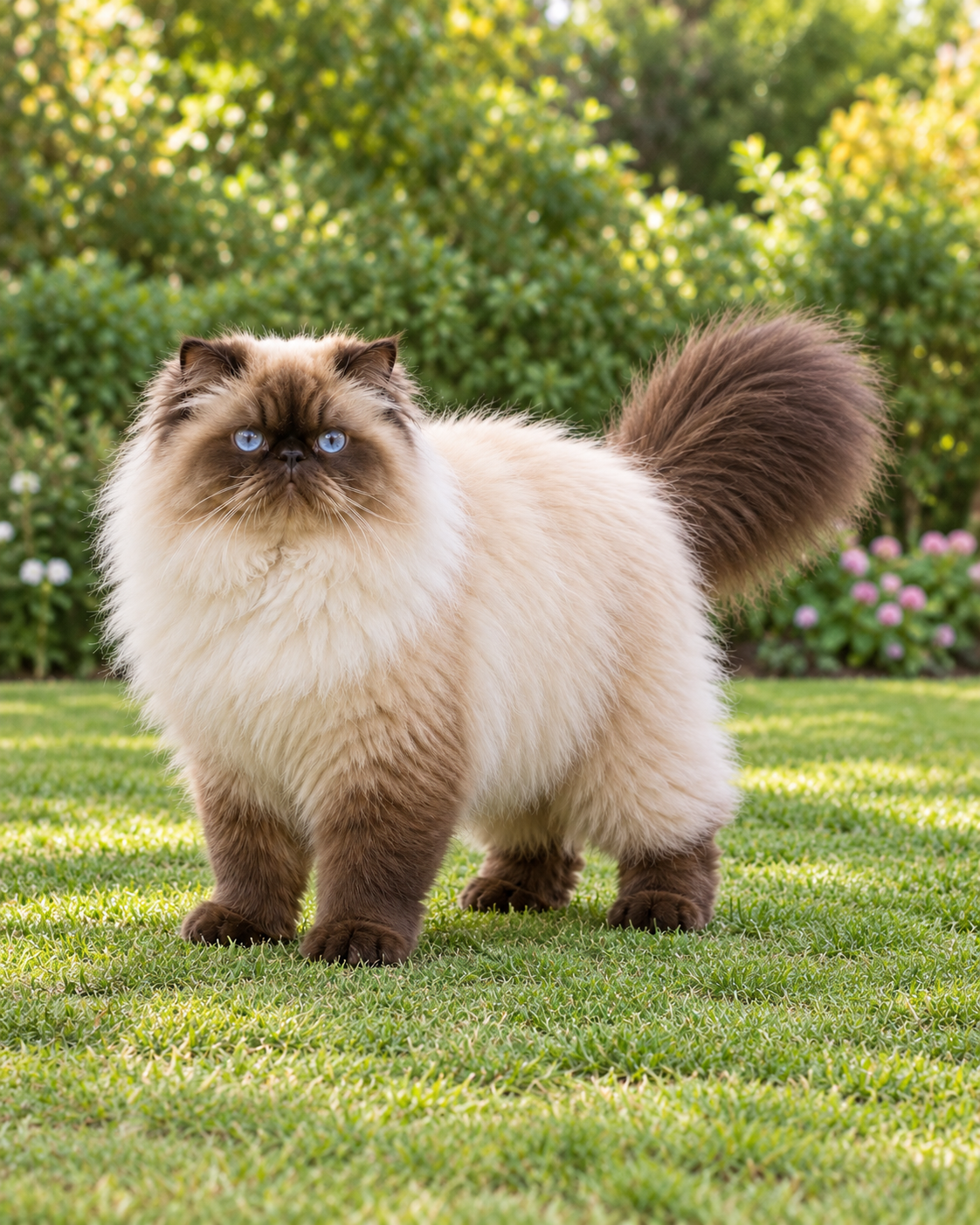
A longhaired, blue-eyed colorpoint cat in the Persian group.
- Adult build
- Medium in overview; medium to large in descriptive text
References & editorial notes
Adult-weight sources
Female: 7–11 lb; Male: 9–14 lb
direct: veterinary nutrition breed profile explicitly lists female 7-11 lb and male 9-14 lb; registry standards checked for numerical intervals.
- CFA 2026–2027 Breed Standards
- Using Positive Reinforcement to Train and Support Your Cat
- Making the Commitment to Adopt a Cat
- How to Feed a Cat
- Introducing a New Cat Into Your Home
- Meeting the Physical and Emotional Needs of Indoor Cats
- TICA: Himalayan
- TICA Standing Rules, Version C, 3 June 2026
- UC Davis VGL: Polycystic Kidney Disease (PKD1)
- Cornell: Feeding Your Cat
- Cornell: What To Expect
- FelineVMA 2025: Meeting the Physical and Emotional Needs of Indoor Cats
- Cornell: Hypertrophic Cardiomyopathy
- UC Davis VGL: Sphynx and Devon Rex Congenital Myasthenic Syndrome
- UC Davis VGL: Erythrocyte Pyruvate Kinase Deficiency
- CFA 2026–2027 Breed Standards Checked 2026-10-20.
- Using Positive Reinforcement to Train and Support Your Cat Checked 2026-10-20.
- Making the Commitment to Adopt a Cat Checked 2026-10-20.
- How to Feed a Cat Checked 2026-10-20.
- Introducing a New Cat Into Your Home Checked 2026-10-20.
- Meeting the Physical and Emotional Needs of Indoor Cats Checked 2026-10-20.
- TICA: Himalayan Checked 2026-10-20.
- TICA Standing Rules, Version C, 3 June 2026 Checked 2026-10-20.
- UC Davis VGL: Polycystic Kidney Disease (PKD1) Checked 2026-10-20.
- Cornell: Feeding Your Cat Checked 2026-10-20.
- Cornell: What To Expect Checked 2026-10-20.
- FelineVMA 2025: Meeting the Physical and Emotional Needs of Indoor Cats Checked 2026-10-20.
- Cornell: Hypertrophic Cardiomyopathy Checked 2026-10-20.
- UC Davis VGL: Sphynx and Devon Rex Congenital Myasthenic Syndrome Checked 2026-10-20.
- UC Davis VGL: Erythrocyte Pyruvate Kinase Deficiency Checked 2026-10-20.
Breeders & rescues
Questions to bring
- What veterinary records and family health history are available?
- How does this individual cat’s coat and activity fit the care described here?
- Which screening findings and individual needs should I discuss with my veterinarian?