Himalayan cat size: weight, shape and growth
Understand Himalayan cat size with current adult weight ranges, compact body proportions, coat volume and a careful distinction between weight and growth.
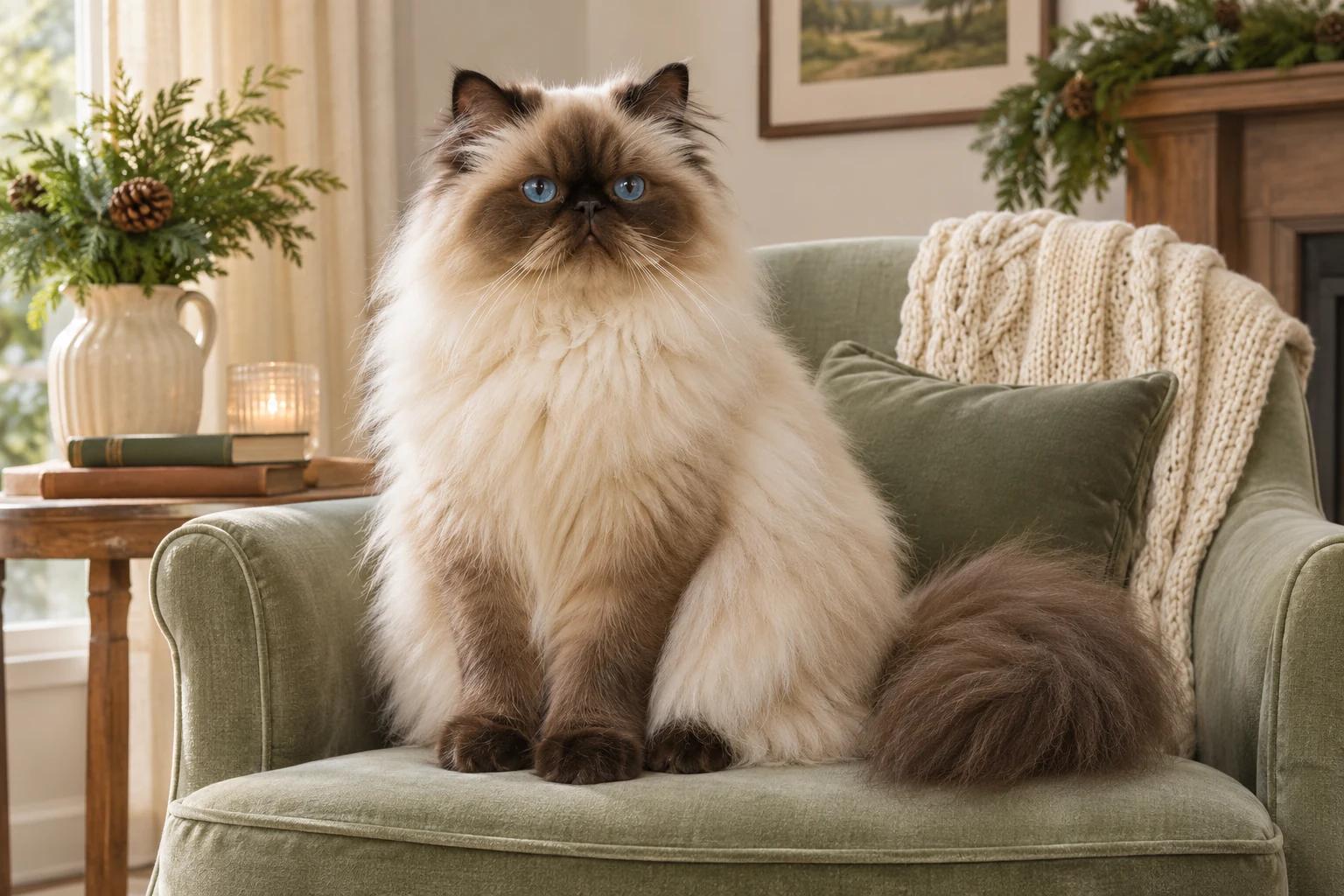
Himalayan cat size starts with two adult ranges: one for females and another for males. Keeping those categories separate gives a clearer answer than quoting a single maximum or assuming every adult will reach it.
Himalayan cat size: adult females and males
The current Himalayan breed profile lists adult females at 7–11 pounds and adult males at 9–14 pounds. In rounded metric terms, that is about 3.2–5.0 kilograms for females and 4.1–6.4 kilograms for males.
Keep the qualifiers attached when answering “how big do Himalayan cats get?” The combined span is 7–14 pounds, but quoting only that combined span discards information. Fourteen pounds is the upper end of the listed male range, not the upper end of the female range.
There is also an overlap. A ten-pound adult falls within both listed ranges, so Himalayan cat weight alone cannot tell you whether a cat is male or female. Nor does a larger figure establish the cat's age. These are adult reference ranges, not a sequence of milestones through which every kitten must pass.
For a concrete comparison, a nine-pound female and a twelve-pound male both fall within their respective listed ranges. That does not make the twelve-pound animal a better example of the breed. The numbers describe different individuals; they are not a competition to approach the largest value.
A compact torso has breadth as well as length
The LOOF standard reproduced by the official-linked Persian breed club describes a cobby, substantial body with rounded shoulders and hips of equal width. The back is straight, the chest broad, and the rib cage and abdomen rounded. Short, strong, straight legs end in substantial round feet.
This describes a compact arrangement of body parts, not simply a scaled-down version of a long-legged cat. When looking at a Himalayan, distinguish the torso's breadth from the length of the legs underneath it. Two animals with similar overall mass need not distribute that mass in the same outline.
LOOF also describes a short tail that is thick at its base, rounded at its end and proportionate to body length. The Persian coat covers the whole body, including the shoulders; abundant undercoat adds volume, while the developed ruff continues between the front legs and beneath the belly.
That makes the visible outer outline different from the frame underneath. The ruff and tail furnishing contribute to the impression of fullness without being additional skeletal length. Consider the body, legs and coat together rather than treating the widest part of the fur as a body measurement.
Rounded features are part of the proportions
The WCF Persian–Colourpoint standard describes a round, substantial head proportionate to the body, with full cheeks and a domed forehead. The neck is short and strong. Small, rounded ears sit low and widely apart, while large, round eyes are also widely spaced. Colourpoints have blue eyes.
Those features help explain why an isolated face portrait does not answer a size question. The rounded head and its relationship to the neck are aspects of proportion, not a scale reading. Small ears do not establish a small adult body, and large eyes do not establish that an animal is still a kitten.
For someone looking specifically for Himalayan cat height, the more useful distinction is between an actual measurement and an impression created by facial proportions. A close view of the head contains no measurement of the distance from the ground to the shoulders.
Keep descriptions literal: round refers to shape, widely spaced refers to placement, and proportionate refers to a relationship between parts. None of those terms supplies a number of inches. They help you understand the recognizable form without pretending that a breed portrait is a measuring instrument.
Growing heavier and growing longer are different measurements
A published growth-study abstract by Salomon and colleagues describes following 38 British Shorthairs and 49 Exotic Shorthairs. The researchers assessed body mass alongside externally defined skeletal length and width measurements. They found differences between males and females early in growth that persisted during the growing period.
This was not a Himalayan study. Its useful contribution here is the separation of measurements, not a borrowed prediction for when your Himalayan will finish growing. A record of mass and a record of body dimensions answer different questions. The abstract does not provide a Himalayan-specific adult birthday or a formula for forecasting this breed's final weight.
For a kitten, therefore, do not translate “now weighs as much as a small adult” into “has completed structural growth.” Equally, a change in weight does not by itself say which body dimension changed. Ask your veterinarian to interpret the individual's development rather than applying another breed's growth curve as a promise. The distinction keeps an adult reference range useful without turning it into an unsupported developmental schedule.
Use the cat breed quiz to explore broader ownership preferences. The separate Himalayan hot-weather article addresses a different aspect of living with this breed.
Frequently asked questions
What is the listed adult female Himalayan cat weight?
Adult female Himalayan cats are listed at 7–11 pounds, approximately 3.2–5.0 kilograms, on the current breed profile.
What is the listed adult male Himalayan cat weight?
Adult male Himalayan cats are listed at 9–14 pounds, approximately 4.1–6.4 kilograms, on the current breed profile.
Can a ten-pound Himalayan be within either adult range?
Yes. A ten-pound adult Himalayan falls within both the listed female and male ranges. Weight alone does not identify the cat's sex.
Sources behind this article
- LOOF Persian standard, reproduced by ABC du Persan et de l’Exotic ↗
- WCF Persian–Colourpoint standard ↗
- Salomon and colleagues: postnatal feline growth, published abstract ↗
Article source checked: November 16, 2026. Source checked 2026-11-16
Keep reading

American Bobtail cat temperament
Read article →