Himalayan vs Ragdoll: size, shape and coat differences
Compare Himalayan and Ragdoll cats through current adult weights, body proportions, pointed markings and the practical differences in their coats.
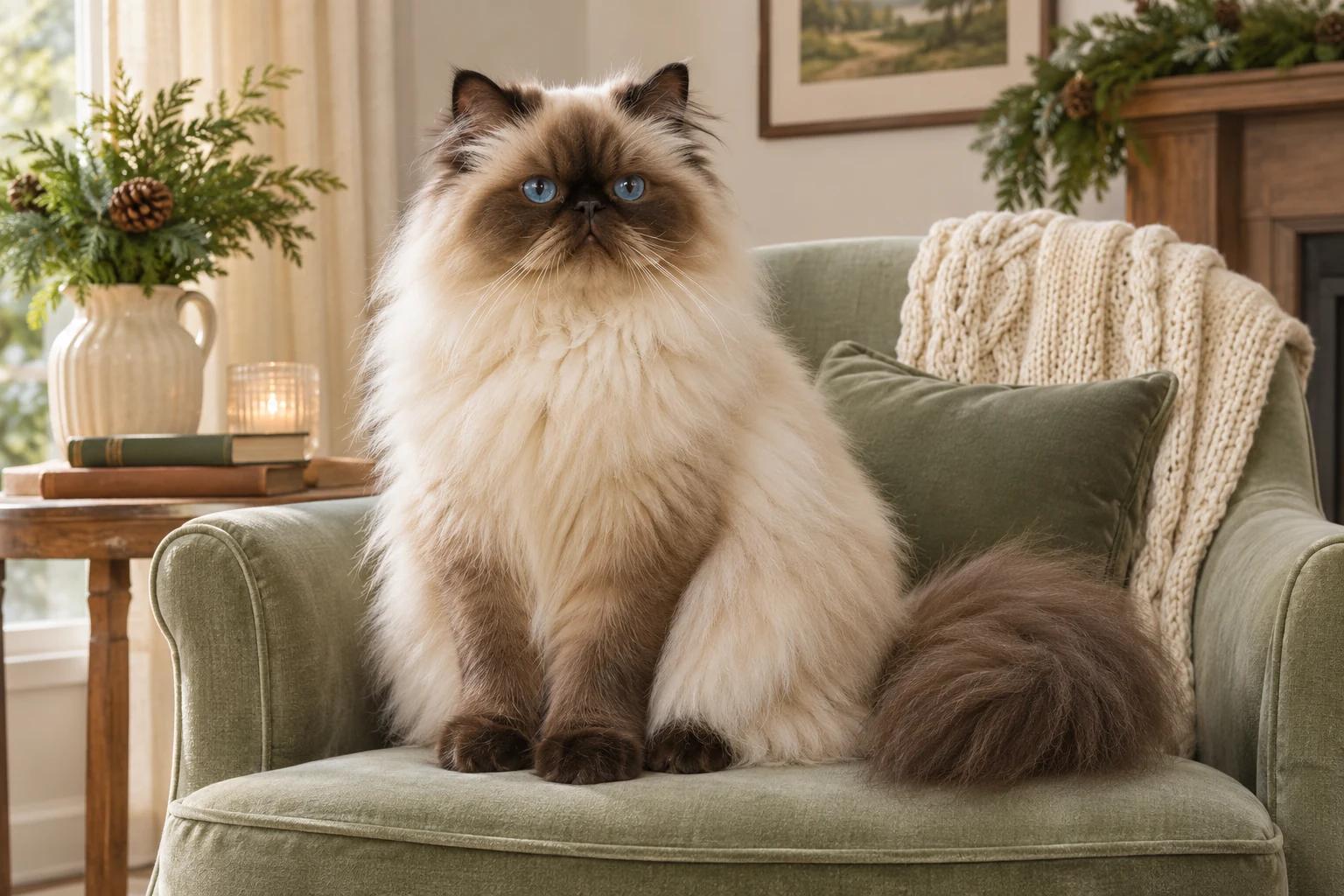
A Himalayan vs Ragdoll comparison benefits from separating three questions: how much the adult weighs, how its frame is proportioned and what its coat requires. The current Himalayan profile lists females at 7–11 pounds and males at 9–14 pounds. The Ragdoll profile lists females at 10–15 pounds and males at 15–20 pounds. Those ranges are a useful starting point, not an exact prediction for an individual kitten.
Himalayan vs Ragdoll: read the adult figures by sex
A Ragdoll vs Himalayan comparison has more meaning when equivalent groups are placed together. The female ranges overlap at ten and eleven pounds; the male ranges listed here do not overlap. Consequently, saying that every Ragdoll must outweigh every Himalayan would go beyond the figures. A female Ragdoll and a male Himalayan can occupy the same part of their respective ranges.
These are adult references. Do not read the highest number as the eventual destination of every youngster, or treat the midpoint as a measured breed average. A particular adult's weight is something that can be measured directly. If you are considering a kitten, the reference describes the adult context rather than a deadline or a growth chart.
When choosing a Himalayan or Ragdoll, keep those sex labels attached to the numbers. An overall seven-to-fourteen-pound Himalayan range combines information that becomes more useful when separated. The same applies to the Ragdoll's combined ten-to-twenty-pound range. Neither number supplies a shoulder height or a body length.
Similar coloring does not make them the same breed
TICA's Himalayan account explains the pointed appearance: a lighter body contrasts with darker areas on the face, ears, legs, feet and tail. Blue eyes accompany that identity. The points can occur in several colors and patterns, so the breed is not confined to one dark mask on an otherwise pale cat.
TICA traces experimental work toward a longhaired colorpoint cat to Virginia Cobb and Clyde Keeler in 1931, followed by further breeding programs in the 1950s. That history explains why identifying a Himalayan involves more than noticing a pointed coat. A color arrangement and a breed name are different kinds of information.
For someone looking at photographs, the practical distinction is to avoid using the darkest part of the face as the sole deciding feature. Note the distribution of color, but then move on to the animal's structure. A familiar pattern can attract your attention without answering the full comparison.
The Himalayan has a compact frame
VCA's Himalayan description identifies a heavily boned, compact body with short, sturdy legs, round paws and a proportionately short tail. The face and eyes are rounded, with small ears that have rounded tips. These are relationships among body parts, not simply another way to say that the cat has a lot of hair.
Look at a standing side view as well as a portrait. The relationship between legs, torso and tail is easier to understand when the entire animal is visible, rather than when only its face fills the frame.
The Ragdoll carries its size differently
The CFA Ragdoll account describes a long, muscular body with a broad chest and substantial bone. Its head is a broad modified wedge, with oval blue eyes, rather than a description built around roundness throughout. A long, plumed tail continues the outline behind the body.
CFA describes slow physical maturation, with full size and weight around four years. That is a Ragdoll developmental account, not a timetable to transfer to the Himalayan. Comparing a young Ragdoll with a fully mature adult can therefore obscure part of the breed's eventual build.
Its semi-long coat has abundant outer hairs and relatively little woolly undercoat. This helps explain why “longhaired” is an incomplete comparison by itself. Look at how the hair lies over the torso and at the tail's plume, not just at the longest strand. The difference between Himalayan and Ragdoll is a difference in the complete silhouette: frame, proportions and coat together. None of those features tells you whether a particular cat wants to be held.
Understand the Ragdoll's pattern and maintenance together
GCCF's Ragdoll guide distinguishes colorpointed, mitted and bicolor patterns. The mitted pattern includes white feet and white underbody areas; the bicolor pattern has an inverted white V on the face as well as other white areas. A white marking can therefore be part of the pattern rather than evidence that the animal lacks points altogether.
These markings are not a grooming shortcut. GCCF calls for regular weekly maintenance, with additional attention during moulting, and explicitly notes that an unattended Ragdoll coat can mat. The practical choice is not between caring for a coat and ignoring it. It is whether you are prepared to work through the individual cat's coat consistently and adjust when more loose hair is coming away.
A clean-looking white bib or a smooth back does not establish that every area has been maintained. Examine the coat as a whole instead of judging the routine from its most visible marking. A striking pattern is something to enjoy alongside care, not in place of it.
Use the cat breed quiz for broader household matching. The Himalayan hot-weather care article addresses a separate ownership situation. Ask your veterinarian about individual care concerns.
Frequently asked questions
What are the current female adult ranges?
Himalayan females are listed at 7–11 pounds; Ragdoll females at 10–15 pounds. The ranges overlap, so they do not establish that every Ragdoll female is heavier.
What are the current male adult ranges?
Himalayan males are listed at 9–14 pounds and Ragdoll males at 15–20 pounds. These are adult references, not targets for individual cats.
Does a kitten need to reach the top of its breed's range?
A Himalayan or Ragdoll kitten should not be assigned the upper endpoint as a guaranteed adult destination. The ranges describe adult expectations, not an individual growth schedule.
Sources behind this article
Article source checked: November 16, 2026. Source checked 2026-11-16
Keep reading

Abyssinian vs Somali: Coat, Size and Everyday Company
Read article →