Cat breed · Britain; longhair development associated with historical Persian crosses
British Longhair: Health
British Longhair health
Health observations and family records
UC Davis lists British Longhair for a test of the conventional feline PKD1 variant. That is one inherited cause of kidney cysts; test availability alone does not establish how often kidney disease occurs in British Longhairs.
An available test is different from a recommendation to use it. Ask which records are relevant to this individual; neither a test listing nor a screening recommendation tells you how often illness occurs.
Changes in drinking and litter habits are current information
Tell your veterinarian about noticeably increased drinking, more urine or a change in appetite or weight. Cornell describes these as possible signs of kidney illness in cats generally, with other explanations needing assessment. A DNA result does not measure present kidney function. The thick coat can hide a gradual loss of body condition. If kidney disease is diagnosed, ask the clinic to show you how to track weight and body condition and when it wants an update about a change in appetite. Bring the last clinic weight and any reliable home weights to rechecks. Keep drinking water available rather than cutting back to try to reduce trips to the box.
Family history and screening
Ask what the individual PKD1 report covers and whether any close relative had kidney cysts clinically diagnosed. Keep that history distinct from coat descriptions or an assumption based on ancestry.
Questions for your veterinarian
- Does the document identify the conventional PKD1 variant?
- What clinical kidney records are available for this family?
Choosing a kitten? Ask to see both parents’ results, with the animal’s name and the date on each report. If you’re adopting an adult, ask which records come with that individual.
Health sources
- UC Davis veterinary genetics lab test documentation
- Cornell clinical guidance
- World Cat Federation breed standard
- IRIS · Chronic kidney disease
Screening evidence and limits
UC Davis lists British Longhair among breeds appropriate for its PKD1 test. The dominant variant is associated with kidney cysts, with variable severity. A negative variant result does not rule out every kidney condition. Review the report and any family renal history with a veterinarian.
Rescues & sheltersPrint or citeBreed articles
Other profile sections and family fact sheet
Life with a British Longhair
An initially reserved cat that often prefers nearby company.
Explore home life →Invite brief games and allow downtime.
Explore daily care →TICA specifically recommends daily combing for the long coat.
Explore daily care →Print or cite this breed
British Longhair family fact sheet
Breed-level references are a starting point. Ask about the individual animal’s routine and care needs.
- Build
- Medium to large
- Female
- 8–11 lb
- Male
- 10–16 lb
- Reference lifespan
- 12–20 years
- Adult size
- Adult weight often falls around 7 to 18 pounds.
Company
An initially reserved cat that often prefers nearby company. Ask how it approaches unfamiliar people and allow it to choose contact.
Play & enrichment
Invite brief games and allow downtime. A calmer adult may still enjoy occasional energetic play; calm behavior does not establish how often a cat vocalizes.
Coat care
TICA specifically recommends daily combing for the long coat. Its activity account describes generally quiet cats with occasional playful bursts.
Everyday responsibilities
Plan food, supplies, routine care and veterinary visits. Agree who handles the everyday jobs and who covers absences.
Adult help
An adult should remain responsible for care, supervise children’s interactions and arrange help when needed.
My Breed Atlas. British Longhair breed profile. https://mybreedatlas.com/cats/breeds/british-longhair
Read this profile’s sources →Adult ranges and source qualifications
- Build
- Medium to large
- Female
- 8–11 lb
- Male
- 10–16 lb
- Reference lifespan
- 12–20 years
Reference ranges describe the breed, not a prediction for an individual.
Daily care
Play & enrichment
Invite brief games and allow downtime. A calmer adult may still enjoy occasional energetic play; calm behavior does not establish how often a cat vocalizes.
More about everyday care
Provide places to retreat, separated resources, chances to play and predictable interaction. These are feline needs, not breed compatibility scores.
Coat, grooming & daily care
TICA specifically recommends daily combing for the long coat. Its activity account describes generally quiet cats with occasional playful bursts.
Training & communication
Reward a behavior the cat chooses with something it values. Build tasks in small steps, including approaching a carrier or a grooming tool. Stop when the cat is frightened, unwell or in pain; ask your veterinarian about cooperative care.
Food, routine & costs
The everyday ownership plan
Planning for this breed
Daily combing is a practical commitment for the dense long coat. Arrange a demonstration and a plan for care during absences; the British Shorthair’s routine is not a substitute.
Meals and body condition
Discuss portions and body condition with your veterinarian instead of using the registry weight range as a feeding target. Smaller meals and appropriate food puzzles can support natural feeding behavior. Give each cat a separate feeding station.
Time and costs
Before committing, budget for food, litter, equipment and continuing veterinary care. Agree who handles play, cleaning, grooming and care during absences. Obtain local estimates for the individual’s care instead of relying on an invented breed cost.
Home life
Temperament & companionship
An initially reserved cat that often prefers nearby company. Ask how it approaches unfamiliar people and allow it to choose contact.
Home life & introductions
Prepare a quiet transition room with food, water, litter, hiding places and scratching options. Introduce resident cats gradually and proceed when both are comfortable. Breed reputation cannot establish compatibility with children, dogs or another cat.
Offer a quiet retreat and let the cat control its distance. Supervise children and introduce resident animals gradually; individual history matters more than a breed reputation.
Personality & care details
Personality & care profile
Breed tendencies vary by individual. Higher means more of the named tendency, not better.
What everyday life tends to involve
These notes describe a tendency for the breed. Every animal is an individual.
- Play
- Short play sessions can be enough on a busy day.
- Coat care
- Everyday brushing fits this coat.
- Loose hair
- Regular shedding is part of living with this coat.
- Company
- Many like to stay close or keep some time to themselves.
- Adult size
- Adult weight often falls around 7 to 18 pounds.
- Time alone
- Long stretches alone are a poor fit. They want company nearby.
YOUR EVERYDAY LIFE
How could this breed fit your life?
See household examples or compare this breed with answers you chose to save. The examples show combinations where this breed appeared among the first five results. Other combinations can work too.
Saved matching preferences stay in this browser, never on your account. They expire after 30 days and are removed the next time this feature reads them. Health answers, children’s ages and free-text notes are not saved. This section does not reproduce those personal care notes.
History & sources
Heritage & appearance
Meet the British Longhair
Adult ranges are reference examples, not targets or predictions for an individual cat.
Heritage & appearance
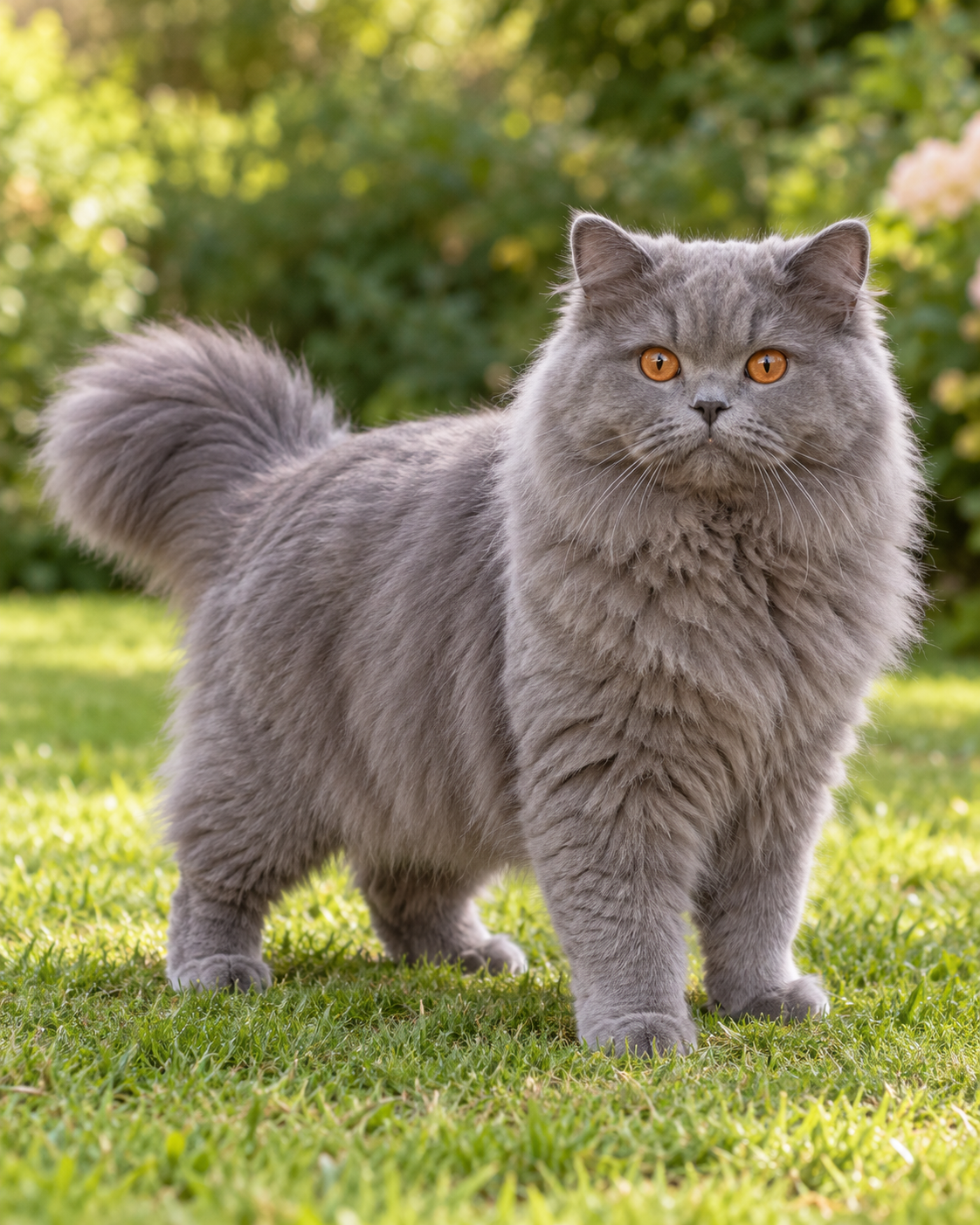
TICA connects longhair development to Persian crosses in British breeding programs and records British Longhair championship recognition from May 2009.
More about this breed’s history
British Longhairs gain their own GCCF record
For many years, British breeders often placed longhaired kittens in pet homes. Some breeders wanted the cats to be judged in their own right and formed a club to pursue recognition. On February 15, 2017, Britain’s Governing Council of the Cat Fancy recognized the British Longhair name. The cats then appeared in assessment classes, where their merit awards counted toward advancement. Championship status followed in November 2021. (GCCF: British, History; GCCF: British SH variants / British Longhairs)
The change also affected how kittens were recorded. After a July 2022 meeting, the British Shorthair Group Committee asked for the old British Shorthair variant option to be removed from the GCCF registration system. The new breed name now had a practical consequence for the people registering a litter. (GCCF: British SH variants / British Longhairs)
Full breed details
A medium-to-large cat with a dense long coat, a gentle disposition and initially reserved behavior.
- Adult build
- Medium to large; dense long coat and substantial build
- Adult weight
- Females: 8–11 lb; males: 10–16 lb.
View all British Longhair articles →
View sources and checked dates →References & editorial notes
Adult-weight sources
Female: 8–11 lb; Male: 10–16 lb
educated: TICA female 8-11/male 10-16 lb lies centrally within GCCF female 7-12/male 9-17 lb at https://www.gccfcats.org/getting-a-cat/choosing/cat-breeds/british/; choose the published central TICA intervals rather than heavier club/food-company estimates.
- Using Positive Reinforcement to Train and Support Your Cat
- Making the Commitment to Adopt a Cat
- How to Feed a Cat
- Introducing a New Cat Into Your Home
- Meeting the Physical and Emotional Needs of Indoor Cats
- Polycystic Kidney Disease (PKD1)
- British Longhair
- Recognised breeds
- Standing Rules Version C, 3 June 2026, section 701.4.1
- Using Positive Reinforcement to Train and Support Your Cat Checked 2026-10-20.
- Making the Commitment to Adopt a Cat Checked 2026-10-20.
- How to Feed a Cat Checked 2026-10-20.
- Introducing a New Cat Into Your Home Checked 2026-10-20.
- Meeting the Physical and Emotional Needs of Indoor Cats Checked 2026-10-20.
- Polycystic Kidney Disease (PKD1) Checked 2026-10-20.
- British Longhair Checked 2026-10-20.
- Recognised breeds Checked 2026-10-20.
- Standing Rules Version C, 3 June 2026, section 701.4.1 Checked 2026-10-20.
Breeders & rescues
Explore British Longhair breeders →
Questions to bring
- Can I see the PKD1 report and learn whether the family has a history of kidney disease?
- Can the current caregiver demonstrate this individual’s usual grooming and play routine?
- How does this cat signal that it wants to end contact or rest alone?