British Longhair cat size
British Longhair cat size explained with current male and female weights, body proportions, coat genetics and practical carrier-fit considerations.
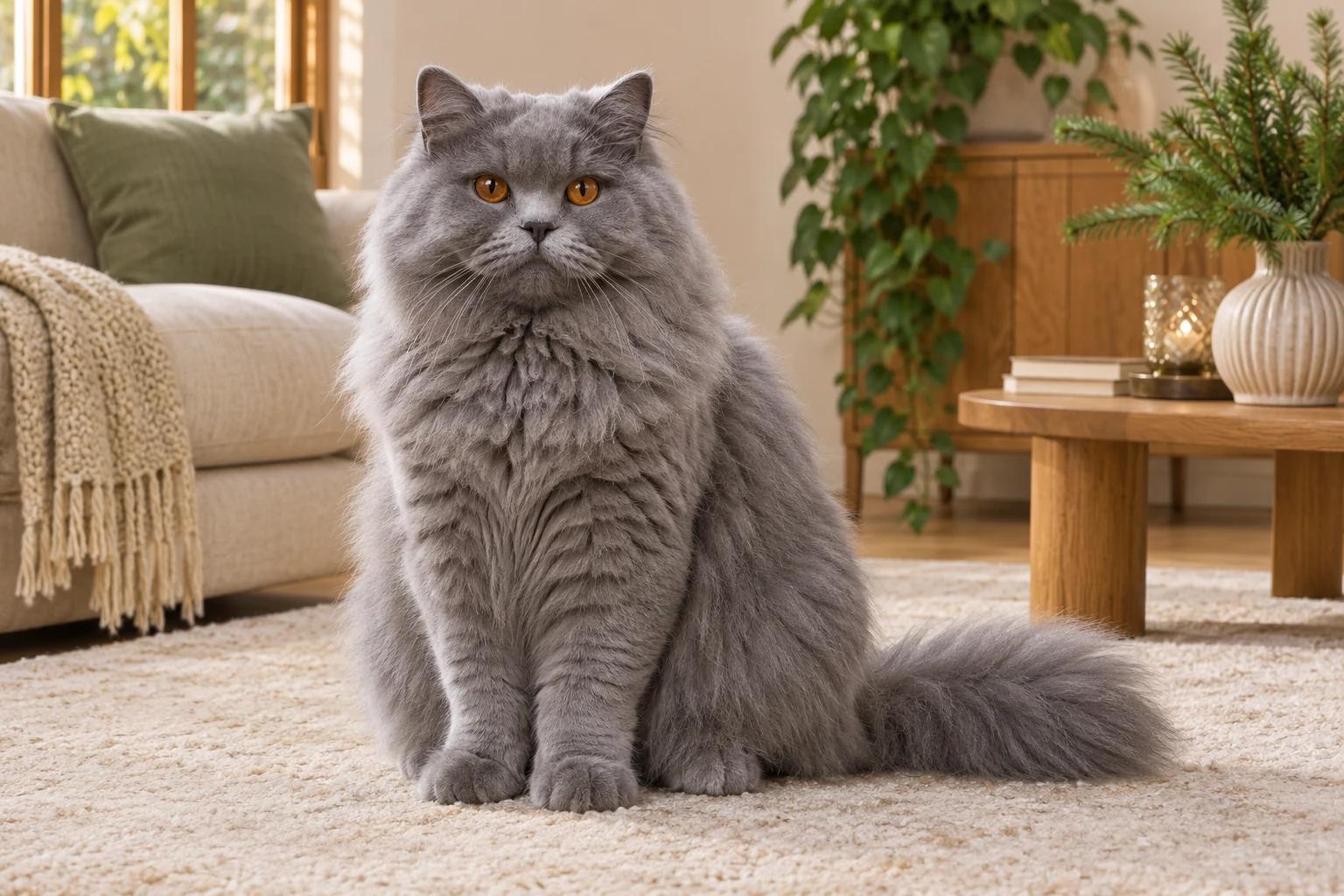
British Longhair cat size is best described with a sex-qualified adult weight and an understanding of the individual animal's dimensions. The current British Longhair profile gives 8–11 pounds for females and 10–16 pounds for males. Those figures are references for adults, not targets for every cat and not a prediction of what a particular kitten will eventually weigh.
British Longhair cat size: read the ranges without averaging away sex
The female and male ranges overlap at ten and eleven pounds. That overlap matters: a male does not have to outweigh every female to fit the current references. At the same time, quoting only a combined eight-to-sixteen-pound range removes useful information about the two adult groups.
If you are comparing possible companions, keep the actual individual's sex and age beside its weight. “Eleven pounds” is an incomplete description if you do not know whether it refers to an adult or a growing youngster. It is also worth distinguishing a measured weight from someone's visual estimate.
British Longhair cat weight should not become a competition to reach sixteen pounds. The upper male reference does not provide an appropriate goal for an eight-pound female, and the midpoint of the combined range is not an individualized recommendation. Questions about a specific cat's body condition belong with its veterinarian. The breed reference helps describe scale; it does not assess the animal in front of you.
A broad body carried on strong legs
The FIFe British standard describes a muscular, cobby body with a broad chest and solid shoulders and back. Strong legs end in round, firm paws. A broad, rounded head sits on a short, well-developed neck, with widely set eyes contributing to the face's open appearance.
“Cobby” concerns a compact, substantial shape rather than a long, narrow outline. It is not another word for any cat that happens to be heavy. The relationships among chest, back, neck and legs explain more than the scale reading alone.
For someone asking how big do British Longhair cats get, this is the useful second part of the answer. Two cats with the same weight can occupy differently shaped spaces. Look at the whole body, not just a close portrait of the face. The breed's width and proportions are part of its physical presence, but they cannot be converted into an exact height from a photograph. Neither a large-looking head nor a leg in that image supplies a reliable measurement without scale.
Long hair is an inherited coat trait, not a weight class
UC Davis Veterinary Genetics Laboratory explains that variants in the FGF5 gene are associated with long hair in cats. Long hair is recessive, and shorthaired cats can carry a longhair variant. The laboratory also notes that hair length varies between breeds and between individuals within breeds.
This helps separate two questions that are often mixed together: why the cat has long hair, and how much that particular animal weighs. A description of coat inheritance does not provide an adult-weight forecast. Nor does a shorthaired relative make a longhaired kitten's appearance inexplicable.
For an owner, the useful conclusion is not that every companion needs a coat test. It is that a coat label and a size measurement describe different things. A genetic result about hair length should not be presented as proof that a kitten will reach the top of the male weight range. Establishing the animal's appearance, background and actual physical measurements requires keeping those questions separate, rather than treating one attractive inherited feature as a prediction of the whole adult body.
Height, length and weight answer different questions
British Longhair cat height means a vertical measurement; pounds measure mass. One cannot be calculated from the other. The adult weight reference therefore should not be converted into an invented inch figure or used to claim that two equally heavy cats must be equally tall.
Be clear about endpoints when discussing dimensions. A body-length measurement that excludes the tail cannot be compared directly with a nose-to-tail-tip measurement. Similarly, the highest point of an upright ear is not the same endpoint as the shoulder. Different methods can produce different numbers without either person having measured the same thing incorrectly.
A carrier needs usable access as well as capacity
VCA's carrier guidance recommends a carrier suited to the individual cat's size, with a large opening and an easily removable top. Access matters because getting the animal in and out should not require a struggle. A removable top can also let the veterinary team examine a cat while it remains in the lower section.
For a British Longhair, compare the actual entrance and interior rather than relying only on a product's size name. Two carriers labeled “medium” need not offer the same opening or usable floor area. A stated carrying capacity and a convenient entrance answer separate questions; satisfying one does not automatically satisfy the other.
VCA advises separate carriers for separate cats. The adult breed ranges should not be added together to justify transporting two animals in one compartment. Choose for the individual who will occupy it, including how it can enter and leave, rather than assuming that enough nominal weight capacity settles every aspect of fit.
For professional coat-care arrangements, see the British Longhair groomer-questions guide. The cat quiz covers broader ownership preferences.
FAQ
What is the current adult female weight reference?
Adult female British Longhairs have a current weight reference of eight to eleven pounds. It describes the adult group, not a required target for an individual female.
What is the current adult male weight reference?
Adult male British Longhairs have a current weight reference of ten to sixteen pounds. A particular male does not need to reach the upper end to fit that reference.
Can an eleven-pound adult be male or female?
An eleven-pound adult British Longhair fits both female and male weight ranges; weight alone does not identify sex.
Sources behind this article
Article source checked: November 16, 2026. Source checked 2026-11-16
Keep reading
British Longhair cat temperament
Read article →