Cat breed · New York, United States
American Wirehair: Daily care
Daily care
Play & enrichment
An athletic cat that can become absorbed in interactive games. Let the caregiver demonstrate a favorite game and offer pauses rather than assuming endless play is welcome.
More about everyday care
Provide places to retreat, separated resources, chances to play and predictable interaction. These are feline needs, not breed compatibility scores.
Coat, grooming & daily care
TICA discourages routine brushing or combing because it can damage the wiry coat; heavy shedding is the stated exception. Heavy shedding is TICA’s exception to avoiding brushing or combing; no fixed tool-use interval is given. TICA describes regular bathing to remove oil and loose hooked hairs, without specifying a numerical interval. CFA describes bathing occasionally as potentially helpful for shedding; it does not give a numerical interval. CFA describes occasional bathing, followed by towel drying and warmth until the coat is dry; blow-drying is described as unnecessary. Ask for a demonstration suited to the individual texture. The wire coat varies between cats, so avoid copying another breed’s grooming routine.
Training & communication
Reward a behavior the cat chooses with something it values. Build tasks in small steps, including approaching a carrier or a grooming tool. Stop when the cat is frightened, unwell or in pain; ask your veterinarian about cooperative care.
Food, routine & costs
The everyday ownership plan
Planning for this breed
Confirm whether the individual has the wire coat or a straight coat. This account concerns the wire-coated scope; a straight-coated relative does not automatically inherit its grooming description.
Meals and body condition
Discuss portions and body condition with your veterinarian instead of using the registry weight range as a feeding target. Smaller meals and appropriate food puzzles can support natural feeding behavior. Give each cat a separate feeding station.
Time and costs
Before committing, budget for food, litter, equipment and continuing veterinary care. Agree who handles play, cleaning, grooming and care during absences. Obtain local estimates for the individual’s care instead of relying on an invented breed cost.
More practical reading
Rescues & sheltersPrint or citeBreed articles
Other profile sections and family fact sheet
Life with a American Wirehair
Ask how the cat responds to handling and when it seeks active play.
Explore home life →An athletic cat that can become absorbed in interactive games.
Explore daily care →TICA discourages routine brushing or combing because it can damage the wiry coat; heavy shedding is the stated exception.
Explore daily care →Print or cite this breed
American Wirehair family fact sheet
Breed-level references are a starting point. Ask about the individual animal’s routine and care needs.
- Build
- Medium to large
- Female
- 8–12 lb
- Male
- 12–15 lb
- Adult size
- Adult weight often falls around 8 to 15 pounds.
Company
Ask how the cat responds to handling and when it seeks active play. An even-tempered companion, but observe the individual’s preferences before planning a busy household around that description.
Play & enrichment
An athletic cat that can become absorbed in interactive games. Let the caregiver demonstrate a favorite game and offer pauses rather than assuming endless play is welcome.
Coat care
TICA discourages routine brushing or combing because it can damage the wiry coat; heavy shedding is the stated exception. Heavy shedding is TICA’s exception to avoiding brushing or combing; no fixed tool-use interval is given. TICA describes regular bathing to remove oil and loose hooked hairs, without specifying a numerical interval. CFA describes bathing occasionally as potentially helpful for shedding; it does not give a numerical interval. CFA describes occasional bathing, followed by towel drying and warmth until the coat is dry; blow-drying is described as unnecessary. Ask for a demonstration suited to the individual texture. The wire coat varies between cats, so avoid copying another breed’s grooming routine.
Everyday responsibilities
Plan food, supplies, routine care and veterinary visits. Agree who handles the everyday jobs and who covers absences.
Adult help
An adult should remain responsible for care, supervise children’s interactions and arrange help when needed.
My Breed Atlas. American Wirehair breed profile. https://mybreedatlas.com/cats/breeds/american-wirehair
Read this profile’s sources →Adult ranges and source qualifications
- Build
- Medium to large
- Female
- 8–12 lb
- Male
- 12–15 lb
Reference ranges describe the breed, not a prediction for an individual.
Home life
Temperament & companionship
Ask how the cat responds to handling and when it seeks active play. An even-tempered companion, but observe the individual’s preferences before planning a busy household around that description.
Home life & introductions
Prepare a quiet transition room with food, water, litter, hiding places and scratching options. Introduce resident cats gradually and proceed when both are comfortable. Breed reputation cannot establish compatibility with children, dogs or another cat.
Offer a quiet retreat and let the cat control its distance. Supervise children and introduce resident animals gradually; individual history matters more than a breed reputation.
Personality & care details
Personality & care profile
Breed tendencies vary by individual. Higher means more of the named tendency, not better.
What everyday life tends to involve
These notes describe a tendency for the breed. Every animal is an individual.
- Play
- Several play sessions through the day fit this cat.
- Coat care
- TICA discourages routine brushing or combing because it can damage the wiry coat; heavy shedding is the stated exception. Heavy shedding is TICA’s exception to avoiding brushing or combing; no fixed tool-use interval is given. TICA describes regular bathing to remove oil and loose hooked hairs, without specifying a numerical interval. CFA describes bathing occasionally as potentially helpful for shedding; it does not give a numerical interval.
CFA describes occasional bathing, followed by towel drying and warmth until the coat is dry; blow-drying is described as unnecessary. Ask for a demonstration suited to the individual texture. The wire coat varies between cats, so avoid copying another breed’s grooming routine.
- Bathing and skin care
- TICA describes regular bathing to remove oil and loose hooked hairs, without specifying a numerical interval. CFA describes bathing occasionally as potentially helpful for shedding; it does not give a numerical interval.
- Loose hair
- Loose hair tends to stay light.
- Company
- Many like to share the room without constant contact.
- Adult size
- Adult weight often falls around 8 to 15 pounds.
YOUR EVERYDAY LIFE
How could this breed fit your life?
See household examples or compare this breed with answers you chose to save. The examples show combinations where this breed appeared among the first five results. Other combinations can work too.
Saved matching preferences stay in this browser, never on your account. They expire after 30 days and are removed the next time this feature reads them. Health answers, children’s ages and free-text notes are not saved. This section does not reproduce those personal care notes.
American Wirehair health
Health observations and family records
Researchers identified rdAc carriers in a small American Wirehair sample. Those DNA findings do not tell us how many American Wirehairs develop retinal disease or make every later eye problem inherited.
An available test is different from a recommendation to use it. Ask which records are relevant to this individual; neither a test listing nor a screening recommendation tells you how often illness occurs.
Keep an eye examination separate from a panel summary
A CEP290 result names one inherited variant. It cannot describe every part of the eye. Mention new difficulty finding a familiar bowl or navigating furniture to your veterinarian even when a genetic report is available.
Family history and screening
Ask which individual was tested and what the actual rdAc category was. If a family eye problem is mentioned, request the examination findings as a separate record rather than accepting a general statement that the panel was clear.
Questions for your veterinarian
- Which exact variant did the laboratory examine?
- Was the relative’s eye concern clinically investigated?
Choosing a kitten? Ask to see both parents’ results, with the animal’s name and the date on each report. If you’re adopting an adult, ask which records come with that individual.
Health sources
- Primary genotype survey and ophthalmic study, Menotti-Raymond et al., Tables 1–2
- UC Davis laboratory assay
- Cornell veterinary owner guidance
Screening evidence and limits
UC Davis lists American Wirehair among breeds appropriate for rdAc testing. The recessive variant concerns one form of progressive retinal degeneration. A negative result does not establish freedom from every eye disorder, and a one-copy carrier is not affected by that variant.
History & sources
Heritage & appearance
Meet the American Wirehair
Adult ranges are reference examples, not targets or predictions for an individual cat.
Heritage & appearance
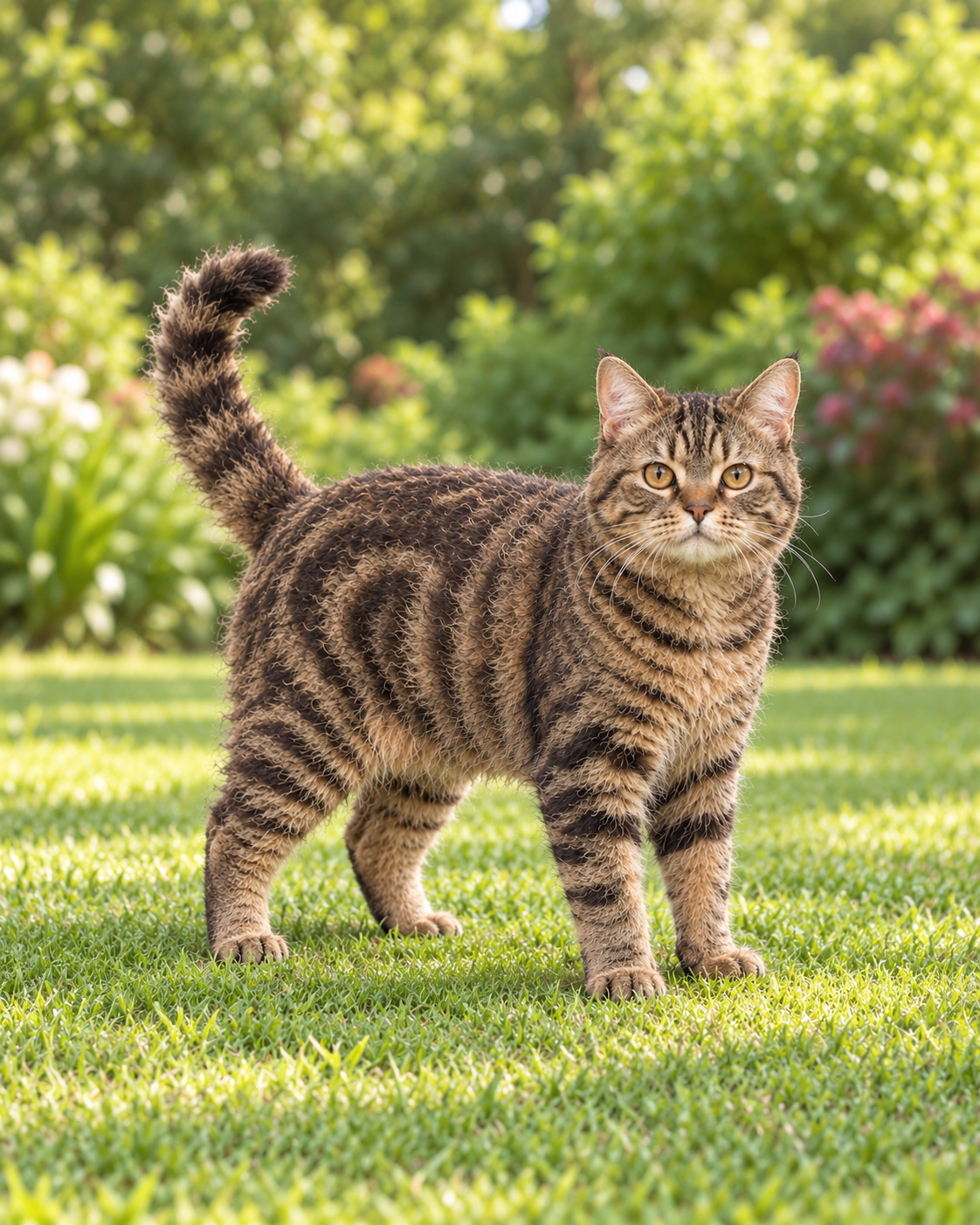
The breed began with a kitten in a 1966 barn-cat litter in upstate New York. CFA championship recognition followed in 1978.
More about this breed’s history
What Adam’s early litters showed
TICA’s history recounts how breeder Joan O’Shea first paired Adam with a female from the same New York farm. Some kittens inherited his wiry coat. A second pairing, with an unrelated female, also produced wirehaired kittens. That result gave breeders evidence that one wirehaired parent could pass on the trait. O’Shea also sent hair samples to British geneticists. Roy Robinson reported that several kinds of hair were twisted, with hooks at the tips of the awn hairs. (The International Cat Association: American Wirehair)
Full breed details
The American Wirehair has a springy, crimped short coat and crimped whiskers. An even-tempered companion; coat texture can vary.
- Adult build
- Medium to large; muscular, athletic build
View all American Wirehair articles →
View sources and checked dates →References & editorial notes
Adult-weight sources
Female: 8–12 lb; Male: 12–15 lb
direct: veterinary nutrition breed profile explicitly lists female 8-12 lb and male 12-15 lb; registry standards checked for numerical intervals.
- Using Positive Reinforcement to Train and Support Your Cat
- Making the Commitment to Adopt a Cat
- How to Feed a Cat
- Introducing a New Cat Into Your Home
- Meeting the Physical and Emotional Needs of Indoor Cats
- Progressive Retinal Atrophy (PRA-rdAc)
- American Wirehair
- CFA 2026–2027 Breed Standards
- Standing Rules Version C, 3 June 2026, section 701.4.1
- American Wirehair
- Using Positive Reinforcement to Train and Support Your Cat Checked 2026-10-20.
- Making the Commitment to Adopt a Cat Checked 2026-10-20.
- How to Feed a Cat Checked 2026-10-20.
- Introducing a New Cat Into Your Home Checked 2026-10-20.
- Meeting the Physical and Emotional Needs of Indoor Cats Checked 2026-10-20.
- Progressive Retinal Atrophy (PRA-rdAc) Checked 2026-10-20.
- American Wirehair Checked 2026-10-20.
- CFA 2026–2027 Breed Standards Checked 2026-10-20.
- Standing Rules Version C, 3 June 2026, section 701.4.1 Checked 2026-10-20.
- American Wirehair Checked 2026-10-20.
References
Breeders & rescues
Explore American Wirehair breeders →
Questions to bring
- Does the laboratory report name rdAc specifically, and how does it relate to the family’s eye history?
- Can the current caregiver demonstrate this individual’s usual grooming and play routine?
- How does this cat signal that it wants to end contact or rest alone?