American Wirehair vs European Shorthair
Compare American Wirehair vs European Shorthair through coat texture, adult size, physical outline and breed identity before choosing a companion.
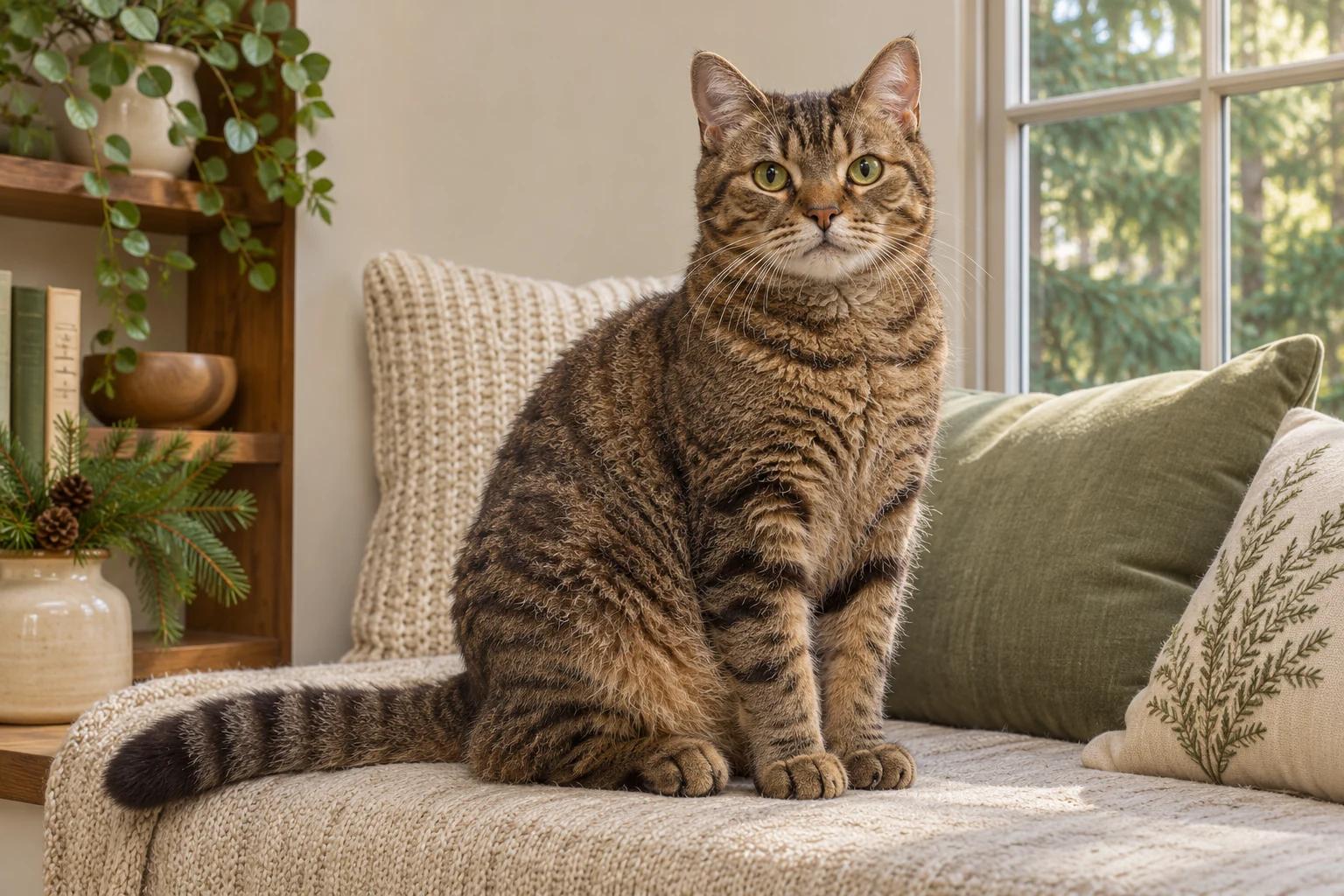
American Wirehair vs European Shorthair is not a simple choice between a large and a small cat. The current American Wirehair profile and European Shorthair profile both describe medium-to-large adults. Their overlapping weights, different coat descriptions and distinct breed identities make a more useful starting comparison than a photograph alone.
American Wirehair vs European Shorthair: adult size first
The current Wirehair page lists females at 8–12 pounds and males at 12–15 pounds. The European page lists females at 11–13 pounds and males at 13–15 pounds. The female and male categories both overlap between breeds. A twelve-pound female or fourteen-pound male could fall within either breed's corresponding reference range.
The difference between American Wirehair and European Shorthair is not a clean division by weight. That overlap matters when choosing equipment or thinking about the physical companion you want. Neither name gives you the individual animal's body length, standing height or preferred sleeping position. Compare the actual adult, not the smallest number from one breed with the largest number from the other.
If you are looking at kittens, keep the adult reference separate from the kitten's present dimensions. A product that fits today may not fit later, but buying solely from a maximum breed weight is not a substitute for checking usable space. Ask a veterinarian about the individual's appropriate weight rather than treating the top of either range as a target to reach.
Texture is the Wirehair's conspicuous distinction
The wired coat is not merely a rough version of a smooth finish. CFA's description explains that individual hairs can be crimped, hooked or bent, including the whiskers. Texture varies between cats, from softer and denser to harder and sparser.
A photograph may not show that variation clearly. Learn the individual coat's natural character rather than assuming every Wirehair feels alike or trying to make it resemble a straight-coated cat. This comparison concerns the wire-coated scope, not every possible relative with a different coat.
The European has a preservation history of its own
The FIFe European profile explains the wish to preserve original Nordic cats as the cat fancy developed. Its account places those efforts in the early twentieth century. The aim was not to produce the most extreme head or body, but to maintain the recognizable type of those original cats.
That helps explain why a pedigreed European can look familiar rather than conspicuously unusual. Familiarity does not make the breed a catch-all term for every shorthaired cat found in Europe. Breed identity and geographic location are separate matters.
FIFe also describes moderate activity, curiosity and an ability to occupy itself with toys. Those are tendencies, not instructions to leave the cat without interaction. For a prospective owner, the useful question is how this individual combines investigation, activity and rest. A preservation history does not produce identical behavior in every descendant, and a balanced description should not be read as a guarantee that a new home will require no adjustment.
Color is not a shortcut to ancestry
The European Shorthair Cat Club in Finland describes solid, patterned and bicolor groups within the breed. It also explains that pointed, lilac and chocolate are not accepted under the standard it follows. Long hair is not an accepted breed trait, even though it can occur in the wider original population.
These distinctions make a useful point when considering European Shorthair vs American Wirehair: a familiar tabby pattern is not enough to identify a pedigree. Coat pattern can be shared by animals with very different documented backgrounds. Nor does one unusual color automatically establish a particular alternative breed.
The club describes breeding concentrated in the Nordic countries and a type intended to avoid extremes or indications of other breeds. For an owner, this is background to understanding the name, not a reason to value an individual companion less if its ancestry is unknown. Describe what is documented and what is visible separately. A domestic cat can be an excellent companion without needing a pedigree identity inferred from its markings.
Look beyond a rounded face
The WCF Celtic/European standard describes a strong, muscular but supple body that is not excessively compact. Its round, developed rib cage is carried on solid legs of medium length, narrowing toward rounded paws. The tail has a broad base and tapers toward a rounded tip.
The head gives a rounded impression while remaining slightly longer than wide. The nose is straight and of even width, and the eyes are open, rounded and set at a slight angle. These details help distinguish a complete physical description from the vague claim that a cat simply looks ordinary.
When meeting a European, view the whole animal rather than focusing exclusively on the face. A standing side view reveals the relationship between body, legs and tail; a front view makes the spacing of facial features easier to see. Neither view should become a home judging exercise. The purpose is to understand the construction of the companion you are considering, not to rank pets against a show ideal.
Choosing the individual companion
When deciding on American Wirehair or European Shorthair, consider the actual cat's established experience as well as its appearance. Both current profiles treat introductions to other animals as individual. Neither name can tell you that a resident cat will welcome the newcomer immediately.
The cat quiz can help clarify your preferences. The American Wirehair gentle coat-care guide explores its separate care topic in more detail.
FAQ
Is a European Shorthair necessarily heavier than an American Wirehair?
European Shorthairs are not necessarily heavier than American Wirehairs. Current female ranges overlap at 11–12 pounds, and the male ranges overlap at 13–15 pounds. Those references do not predict the exact size of an individual.
Is a product labeled medium automatically suitable for either breed?
A medium product label does not establish suitability for an American Wirehair or European Shorthair. Compare usable dimensions with the individual. Category labels do not tell you how much interior space a carrier or resting area provides.
Does either breed name guarantee compatibility with a resident pet?
Neither American Wirehair nor European Shorthair identity guarantees pet compatibility. The profiles emphasize individual experience and gradual introductions. A comparison can identify useful questions, but it cannot decide the relationship between two animals before they meet.
Sources behind this article
- CFA American Wirehair ↗
- FIFe European breed profile ↗
- European Shorthair Cat Club Finland ↗
- WCF Celtic European standard ↗
Article source checked: November 16, 2026. Source checked 2026-11-16
Keep reading

Abyssinian vs Somali: Coat, Size and Everyday Company
Read article →