American Wirehair cat temperament
Explore American Wirehair cat temperament through social interest, play preferences, useful indoor spaces and respect for the individual cat.
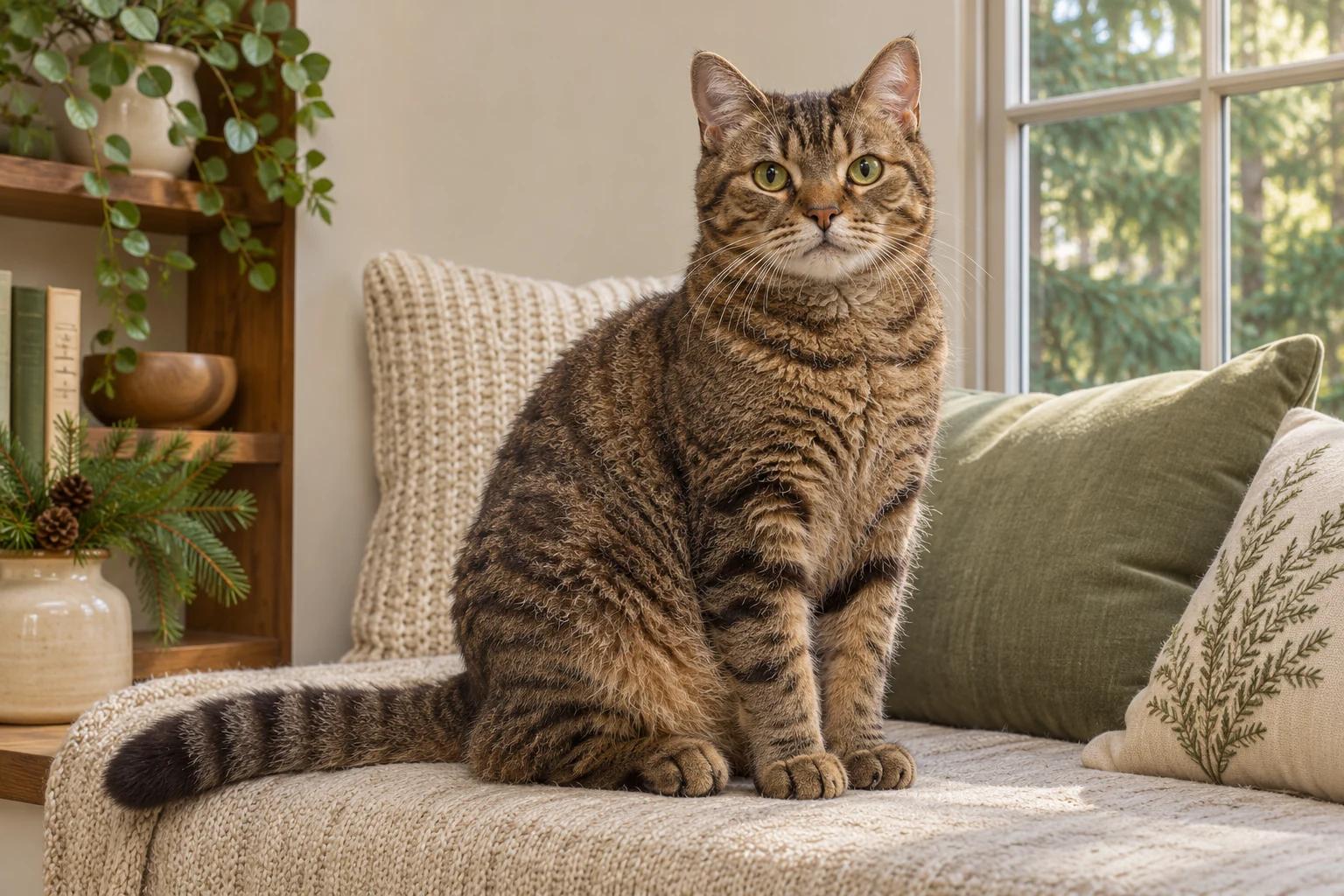
American Wirehair cat temperament should be explored through the individual animal, not inferred from an unusual-looking coat. The current American Wirehair profile asks owners to consider handling preferences and the particular cat's interests. That is a useful approach for an established breed whose members still bring different experiences into a household.
American Wirehair cat temperament: interested, not always involved
An interest in people can include watching rather than joining every activity. CFA's Wirehair account describes that distinction, alongside possible head-butting greetings and enthusiasm for interactive games. A cat can choose to observe from nearby without needing to be brought into the middle of what someone is doing. Its participation does not have to take the form the person originally expected.
Shared play is not the same as shared petting
A game can be an enjoyable interaction even for a cat that does not want much touching. Battersea's play guidance explains the difference between games with people and independent play. A wand toy lets the person operate the moving object at a distance while the cat stalks, pursues and catches it.
Use brief movements with pauses rather than keeping the toy in continuous frantic motion. Allow an actual catch. A game that only offers an endlessly escaping object is different from one in which the cat completes the pursuit. Keep hands and feet out of the prey role, and avoid reaching in to stroke the cat while it is absorbed in the game.
Put string and fishing-rod toys away after supervised use. The practical aim is an activity both participants can enjoy, not testing how excited the animal can become. A Wirehair's willingness to play does not make it sensible to ignore the distinction between the toy, the person operating it and the moment when handling is welcome.
Find out which movement matters
Toy preferences can be surprisingly specific. Ohio State's prey-preference exercise suggests comparing the qualities of toys resembling birds, mice and insects. The useful observations are how a cat responds to objects moving through the air versus objects moving along the ground, and which qualities hold its attention.
For an American Wirehair, try a suitable feather-type toy and then put it away before offering a furry floor-level toy. Compare the actual responses rather than deciding that a cat ignoring the first option is uninterested in all play. A preference for one movement is information you can use, not a failure of the other toy to be sufficiently expensive.
Once you understand the appealing qualities, look for another safe toy with similar features. Variety can preserve the kind of movement the cat enjoys without presenting exactly the same object indefinitely. This is a practical way to distinguish a general reputation for playfulness from the individual animal's choices. You are finding what works for this participant, not assigning it a permanent personality category.
Make room for observation and climbing
An indoor space can offer more than objects on the floor. VCA's enrichment guidance recommends safe resting places with interesting views and climbing structures in areas where people spend time. A tree hidden in a seldom-used room may offer less to the cat than a well-positioned resting place near everyday activity.
Consider the view from a platform and how the cat reaches it. An elevated place can be somewhere to rest while observing, not merely the top of an exercise obstacle. Secure equipment and provide a non-slip resting surface appropriate to the location. The cat should also be able to move around the home without being chased.
For a Wirehair, this gives the individual a choice of position within household life. Being on a perch does not necessarily mean it wants to be isolated. It may be choosing a comfortable viewpoint. Let that location serve its purpose rather than repeatedly removing the cat to a place that is more convenient for a person to touch it.
Do not turn appearance into a temperament test
American Wirehair cat characteristics can be striking, but an illustration cannot tell you whether the individual welcomes a visitor, knows a particular routine or has lived with another animal. The current profile explicitly separates breed reputation from compatibility. Its recommendation is gradual introduction with a quiet retreat, not an assumption that an even-tempered description guarantees an effortless first meeting.
The current adult reference is 8–12 pounds for females and 12–15 pounds for males. American Wirehair cat personality is not determined by where an individual sits within those ranges. A twelve-pound female and a twelve-pound male can have different experiences even though their scale readings match. Neither weight nor sex tells you which cat will settle more readily into a particular household.
American Wirehair cat behavior also reflects its experience. Home layout matters in practical, individual ways. A cat that has only known one quiet room has different experience from one familiar with a larger, busier house. That is not a judgment about its suitability as a companion. It is information about the transition you are asking it to make. Keep the actual background separate from an imagined breed-wide history.
The cat quiz can help you consider the relationship you want. The American Wirehair gentle coat-care guide addresses the separate practical question of caring for the coat without trying to change its natural character.
FAQ
Does the Wirehair name tell me how the cat will respond to a new home?
The American Wirehair name identifies a breed, not its response to a new home. Learn about the individual animal's previous surroundings and give the transition appropriate attention.
Is adult weight a useful personality measure?
American Wirehair adult weight describes physical scale, not personality. It does not establish confidence, preferred contact or experience with unfamiliar people and animals.
Can an even-tempered description guarantee compatibility with another pet?
An even-tempered American Wirehair description does not guarantee pet compatibility; the profile recommends individual assessment and gradual introductions. The breed description cannot decide how two particular animals will respond to one another.
Sources behind this article
- CFA American Wirehair ↗
- Battersea playing with cats ↗
- Ohio State prey preferences ↗
- VCA indoor enrichment ↗
Article source checked: November 16, 2026. Source checked 2026-11-16
Keep reading
American Wirehair cat size
Read article →