American Wirehair cat size
Understand American Wirehair cat size through current female and male weights, body proportions, development and individual body-condition assessment.
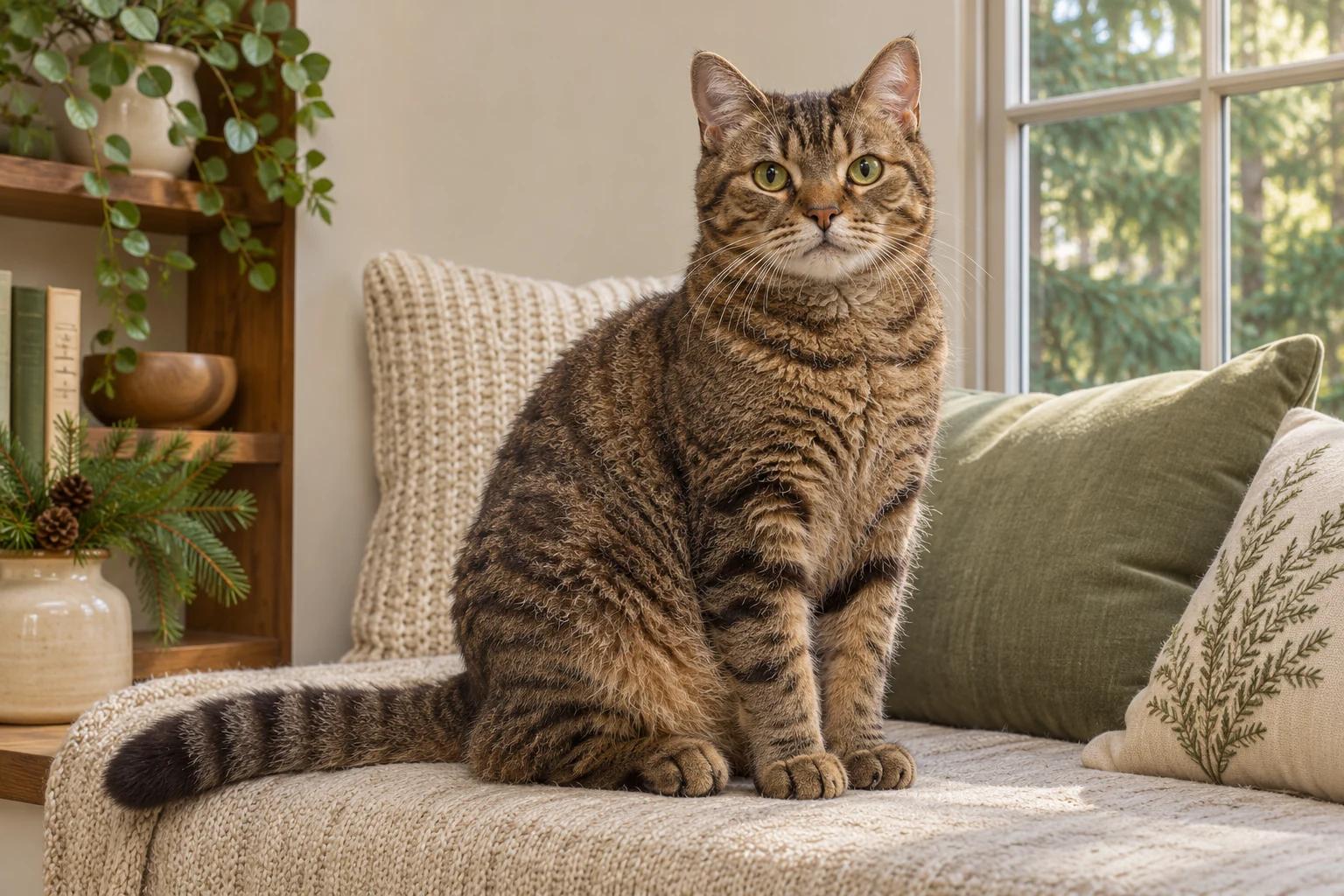
American Wirehair cat size is medium to large in the current American Wirehair profile. Adult females are listed at 8–12 pounds and males at 12–15 pounds. Those sex-qualified figures are reference ranges, not a prediction of where every kitten will finish or a goal that every adult should reach.
American Wirehair cat size: what the weight range means
The female and male ranges meet at twelve pounds. That does not make a twelve-pound female unusually masculine or a twelve-pound male incomplete. A number on a scale does not describe the whole animal. It is one measurement that belongs alongside the individual's frame, age and veterinary assessment.
American Wirehair cat weight also needs a clear age label. An adult reference cannot be applied directly to a growing kitten, and the largest adult figure is not a milestone a youngster should be pushed toward. If you are comparing two cats, use their actual ages and recorded weights rather than mixing a kitten's present weight with another animal's adult range.
The practical value of the published figures is orientation. They tell you that you are considering a substantial domestic cat, while leaving individual measurements to answer questions about equipment and fit. For example, two twelve-pound cats need not have identical body lengths or occupy exactly the same space when they curl up.
The frame underneath the coat
A developed chest, a muscular body and balanced proportions are central to the Canadian Cat Association's Wirehair standard. The neck is short and proportionate. Legs are medium in length, with firm bone and substantial musculature; rounded paws finish the outline. The tail is thick at its base and gradually narrows toward a rounded end.
The head is broad, with developed cheeks and a squarish muzzle. The description allows females to be less massive than males while still having correct overall balance. That is important: a smaller female should not be interpreted as an unfinished version of a male.
Taken together, these features explain why size is not just weight. Look at the relationship between chest, legs, head and tail, rather than searching for the biggest individual in a group. The standard describes proportion and construction, not a competition to maximize every dimension. An owner can use that distinction without treating a companion as a show exhibit.
Adult appearance develops over time
TICA's American Wirehair account describes a balanced cat without exaggerated features and notes that the breed's mature appearance can take around three or four years to develop. This refers to the finishing of the overall breed picture, not a requirement for continuous weight gain throughout that period.
A youngster may therefore look different from a fully developed adult even after its earliest rapid growth. Compare animals of similar ages when trying to understand the adult outline. A photograph of a mature male should not become a demand that a younger female acquire the same mass or facial development.
The account emphasizes balance rather than one oversized feature. For someone asking how big do American Wirehair cats get, that is useful context alongside the current weight figures. Think about a mature, proportionate individual rather than a single maximum number. The breed description cannot tell you the exact final measurements of a particular kitten, and it should not replace the veterinary assessment of that animal's development.
Maturity is not one universal birthday
Growth is influenced by more than the breed name. VCA's discussion of kitten maturity considers physical factors including weight and height and recommends veterinary help in judging the individual's stage of development. A general age estimate does not answer every question for every cat.
For a Wirehair owner, distinguish three ideas: present measurements, the adult reference range and the individual's development. They are related, but they are not interchangeable. Reaching a certain number on the scale does not tell you everything about physical maturity, and a breed's slow finishing does not authorize feeding toward a heavier number.
Ask your veterinarian to interpret the actual animal rather than assigning a schedule from photographs. This is especially useful when deciding which life-stage care is appropriate. The decision should reflect the individual, not an assumption that every cat carrying the same breed name reaches each milestone on precisely the same date. Keep the breed information as context, with the veterinary assessment doing the individual interpretation.
Body condition adds information that pounds cannot
The WSAVA feline body-condition chart considers the overall proportions, ribs, waist and abdominal area rather than using body weight alone. Its ideal example includes a visible but not pronounced waist and only a slight fat covering over the ribs. This is a separate assessment from identifying the breed's frame.
For an American Wirehair, a muscular description should not be taken to mean that any heavier body is desirable. Equally, a cat near the lower end of a breed range should not automatically be fed toward its upper end. The same scale reading can have a different meaning for differently built individuals.
Ask your veterinary team to assess body condition and explain how it relates to this cat's measurements. Do not use a photograph or a breed chart to prescribe food changes. Understanding the distinction between size and condition makes the published range more useful: it becomes background information rather than a substitute for evaluating the actual animal.
Height and usable space
American Wirehair cat height is most useful when you are solving a specific fit question. Measure the individual standing naturally, without stretching or positioning it to reach an imagined breed ideal. A photograph beside furniture is unreliable because perspective and posture change the impression.
For a carrier, check the internal dimensions rather than only the advertised exterior measurements. For a bed or raised platform, check the usable surface rather than the total footprint including posts and decorative edges. The relevant question is whether this cat fits, not whether a manufacturer has attached a small, medium or large label.
The cat quiz can help you consider the companion you want to live with. For the separate subject of its distinctive coat, see the American Wirehair gentle coat-care guide.
FAQ
What adult weights does the current profile list?
Adult American Wirehair females are listed at 8–12 pounds and males at 12–15 pounds. Keep those qualifiers attached to the figures instead of treating the combined range as a precise prediction for every cat.
Can a twelve-pound Wirehair be either female or male?
A twelve-pound American Wirehair can fit either sex-qualified range. Twelve pounds lies at the meeting point of the current female and male reference ranges. Weight alone does not identify sex or explain the individual's complete build.
Should equipment be chosen from a breed-size label?
Choose American Wirehair equipment using its usable dimensions and the actual cat, not a breed-size label. A product's category name and exterior measurements do not establish how much room is available inside or on top.
Sources behind this article
- CCA American Wirehair standard ↗
- TICA American Wirehair ↗
- VCA kitten maturity ↗
- WSAVA feline body condition ↗
Article source checked: November 16, 2026. Source checked 2026-11-16
Keep reading
American Wirehair cat temperament
Read article →