Terrier Group · United States
American Staffordshire Terrier: Daily care
Back to American Staffordshire Terrier
Daily care
A practical routine for an AmStaff. Adjust it to the dog’s age, health and comfort.
Exercise & training
About an hour of active time fits the described day. Mix outings, play and short learning sessions, with opportunities to settle between activities.
Training & communication
Expect learning to depend on motivation and consistent practice. Work on small skills in easy environments before adding distractions.
Brushing the short coat
AKC describes a soft-bristle brushing once a week as usually sufficient. PetMD describes brushing every few weeks as sufficient for ordinary coat maintenance.
Use the individual coat’s condition to guide care. Ask for a hands-on demonstration if you are unsure.
Coat-care sources →More coat-care context
The shedding rating is at the lower end of the scale. This does not guarantee that a dog will be suitable for someone with allergies.
Food, time & costs
Plan meals, exercise, supplies and veterinary care. Agree who handles the routine during workdays, travel and unexpected absences.
More practical reading
Rescues & sheltersPrint or citeBreed articles
Other profile sections and family fact sheet
Life with an AmStaff
Likes to stay close
Plan shared time with the household.
Explore home lifeAbout an hour a day
Mix active outings with play and learning.
Explore daily careLight brushing
A soft brush usually handles the short coat.
See the brushing routineResearching this breed for school?
Get a family fact sheet or copy a citation for your report.
Print or cite this breed
American Staffordshire Terrier family fact sheet
These breed notes are a starting point. Ask about this dog’s own routine and care needs.
- Adult weight
- 40–70 lb
- Adult height
- 17–19 in
- Lifespan
- 12–16 years
- Coat
- Short, smooth
Company
AmStaffs tend to enjoy time with their family. Plan shared activities and company each day.
Activity & learning
About an hour of active time fits the described day. Mix outings, play and short learning sessions, with quiet time to settle between activities.
Coat care
AKC describes a soft-bristle brushing once a week as usually sufficient. PetMD describes brushing every few weeks as sufficient for ordinary coat maintenance.
Name & history
The AKC first recognized this breed as the Staffordshire Terrier in 1936. In 1972, its AKC name became American Staffordshire Terrier.
AKC: American Staffordshire Terrier naming historyEveryday responsibilities
Plan food, supplies, everyday care and vet visits. Decide who does each job and who helps when someone is away.
Adult help
An adult is responsible for care, supervises children with the dog and arranges help when needed.
My Breed Atlas. American Staffordshire Terrier breed profile. https://mybreedatlas.com/breeds/american-staffordshire-terrier
Read this profile’s sources →Adult ranges and source qualifications
- Female weight
- 40–55 lb
- Male weight
- 55–70 lb
- Height by sex
- 18–19 in (male), 17–18 in (female)
Reference ranges describe a population, not a target or a prediction for an individual.
Home life
Company & companionship
The reference points to a strong interest in family interaction. Make room for shared activities and company in the daily routine.
Workdays, children & other animals
Compatibility with children depends on the individual dog, experience, and the household routine. A middle rating is a research starting point, not an assurance.
Other-dog compatibility is individual. Discuss past experience, space, and introductions with the breeder or caregiver.
Make a plan for time apart and changes in the household. Ask about the individual’s previous experiences and introduce new situations gradually.
Personality & care profile
These reference ratings describe breed tendencies. Higher means more of the named tendency, not better, and every animal is an individual.
- Family affection
- 5 / 5
- Interaction with children
- 3 / 5
- Interaction with other dogs
- 3 / 5
- Openness to new people
- 4 / 5
- Playfulness
- 3 / 5
- Watchfulness
- 5 / 5
- Adaptability
- 3 / 5
- Responsiveness to training
- 3 / 5
- Activity needs
- 3 / 5
- Mental engagement
- 3 / 5
- Vocal tendency
- 3 / 5
- Shedding
- 2 / 5
- Grooming frequency
- 1 / 5
- Drooling
- 1 / 5
- Loose hair
- Loose hair tends to stay light.
- Voice
- Barking tends to stay occasional.
YOUR EVERYDAY LIFE
How could this breed fit your life?
Explore example care routines or compare this breed with matching preferences you chose to save. Start with the household’s day, then consider the individual animal.
Saved matching preferences stay in this browser, never on your account. They expire after 30 days and are removed the next time this feature reads them. Health answers, children’s ages and free-text notes are not saved. This section does not reproduce those personal care notes.
American Staffordshire Terrier health
Health observations and family records
Keep current skin and movement observations separate from parental screening. The AmStaff ARSG/NCL-A test concerns a particular inherited coordination disorder; it cannot explain every change in balance. Sudden collapse or inability to stand needs emergency veterinary care.
Itchy skin and sore ears
An AmStaff with allergies may repeatedly lick its feet, rub its face or scratch at its ears. Look for red skin between the toes or sore patches where the dog has been chewing. Recurring itch deserves an exam, especially when it interrupts sleep. If your vet diagnoses atopic dermatitis, use a short log to track itch and sore ears and note what helped last time. Follow the plan for everyday care, flares and rechecks. Ask which skin or ear products to use and how to apply them. Don’t reuse old ear drops or give human itch medicines unless your vet says to.
Hips and everyday movement
Hip dysplasia can make rising from the floor or climbing into the car uncomfortable. A change that keeps happening, such as pushing up slowly after a nap or hopping with both back legs when running, is worth discussing at an appointment. If your vet confirms hip dysplasia, ask what body condition to aim for and what low-impact activity is safe. Give your dog good traction on the routes it uses most. Keep track of how easily it gets up, walks and settles, and bring those notes to rechecks so your vet can adjust the plan.
Gradual loss of balance
One inherited condition in AmStaffs, cerebellar ataxia, affects coordination. An adult dog may begin stumbling on turns or lose its footing when it shakes its head. Have new balance problems assessed promptly. A video of ordinary walking can help show what changed. If your vet confirms this form of ataxia, give your dog a non-slip route to food, water and bedding and block stairs it can’t navigate safely. Note falls and when your dog needs help getting up. Ask at rechecks whether a support harness would be safe and how to track comfort and independence.
Family history and screening
Ask for the actual hip evaluation and exact ARSG/NCL-A result. Keep the method and examination date with the hip report rather than treating different schemes as interchangeable. If relatives had balance problems, request the confirmed diagnosis and age at which signs began.
Questions for your veterinarian
- Which findings are new in this dog, and what does the named family test actually address?
- Which hip report is preliminary or final under the scheme that issued it?
Choosing a puppy? Ask to see both parents’ results, with the animal’s name and the date on each report. If you’re adopting an adult, ask which records come with that individual.
Screenings listed in this profile
- Hip Evaluation
- Cardiac Exam
- Thyroid Evaluation
- Neuronal Ceroid Lipofuscinosis 4A (NCL, NCL4A) - DNA Test
Check the animal’s identity, the test date and the result. Breeders submit these documents. My Breed Atlas does not independently authenticate them.
Health sources
- Read about common AmStaff health concerns
- Breed health screening statement
- NC State testing guidance
- Cornell hospital emergency guidance
- official breed-club screening recommendation
- Cornell veterinary guidance
- Cornell veterinary guidance
- Cornell veterinary guidance
- ICADA · Canine atopic dermatitis management
- ACVS · Hip dysplasia
- AAHA · Mobility accommodations
Screening evidence and limits
The recorded screening items are questions to discuss with a breeder and veterinarian, not a diagnosis, an individual testing schedule or assurance that a dog is healthy.
History & sources
Heritage & appearance
Origins & classification
The breed reference lists United States and the Terrier Group, and records 1936 as the AKC recognition year. Recognition is different from the date a breed first developed. Explore the parent club and current standard for detailed historical accounts.
Appearance
Recorded coat: Short, Smooth. Colors recorded in the reference: Black, White, Brown, Blue, Fawn Sable, Blue Fawn, Red Brindle, Blue Fawn Brindle, Liver, Black Brindle, Fawn Brindle, Blue Brindle, Liver Brindle, Fawn, Red, Seal Brown, Red Sable, Brown Brindle. Recorded markings: White Markings, Spotted, Black Mask, Patched, Blue Mask, Tan Points, Brindle Points, White Mask, Spotted Or Patched. Appearance varies; color alone does not establish identity, health or quality.
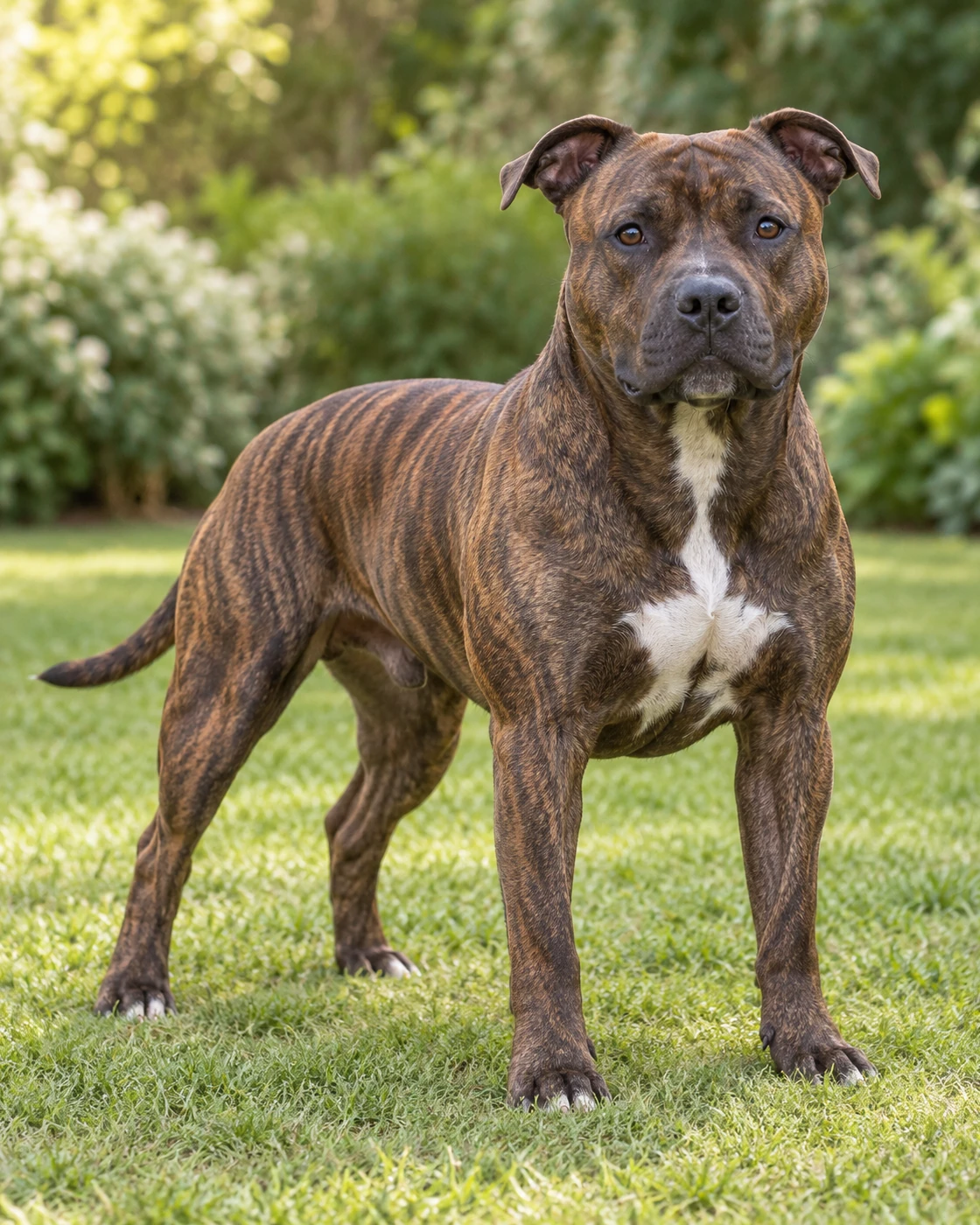
Brindle coat with small white chest; natural rose ears
One representative adult appearance. Coat, markings, grooming, size and ear/tail presentation vary; depicted presentation is not a recommendation for procedures.
AI-generated breed illustration. Not an actual listed dog.More about this breed’s history
Two separate AKC votes in 1936
Two votes on June 10, 1936, set the American registry on its course. First the AKC board admitted the Staffordshire Terrier to the studbook. It then approved the standard already adopted by the breed club. That document called for a dog that combined strength for its size with agility. One decision opened the register; the other gave judges a common description to use. (AKC: 1936 board minutes; AKC: Official American Staffordshire Terrier standard)
References & editorial notes
Adult-weight sources
Female: 40–55 lb; Male: 55–70 lb
direct: AKC publishes this adult female range in pounds.
direct: AKC publishes this adult male range in pounds.
Original My Breed Atlas guidance informed by the named breed and care references below. Breed tendencies vary; general education does not replace individual veterinary advice.
- American Kennel Club: American Staffordshire Terrier · Checked 2026-10-12.
- PetMD american staffordshire terrier · Checked 2026-11-18.
- Staffordshire Terrier Club of America
- AKC breed standard
- Breed health screening statement
Breeders & rescues
Meet the individual
Open the dog directory with American Staffordshire Terrier selected. Listings are starting points for your research, not endorsements; confirm current availability directly.
Find American Staffordshire Terrier breeders →Rescues & shelters
The rescue search includes organizations with different species and breed coverage. Ask each organization whether it works with this breed and what is known about the individual.
Search rescues & shelters →Before you meet a dog
- What are the parents like in everyday life?
- How are puppies introduced to new experiences?
- Which screening records can I review?
- What does the contract cover, including return arrangements?
- What support is available after the dog comes home?