Cat breed · Canada, with later United States foundation cats
Sphynx
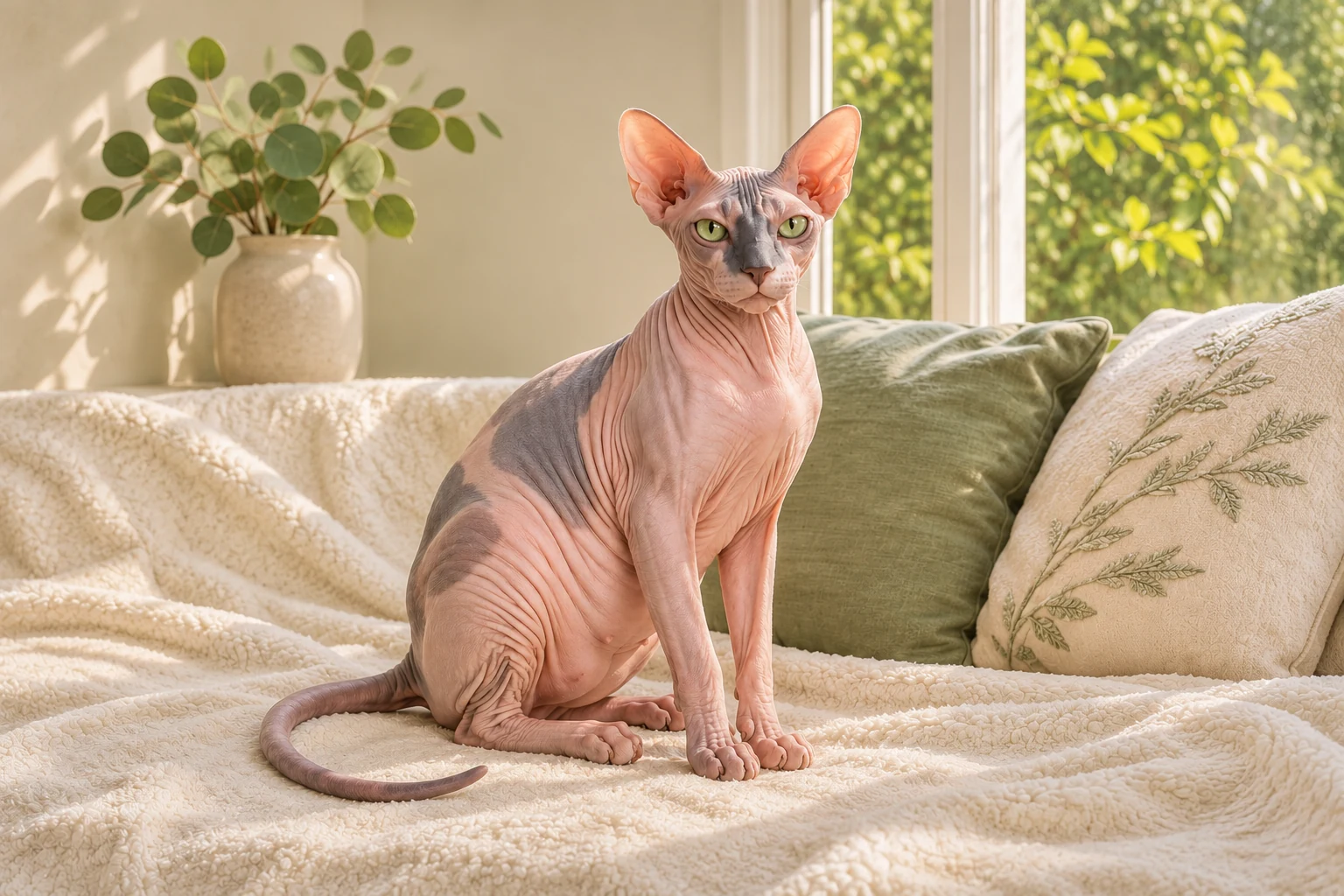
A nearly hairless cat with variable residual hair and a substantial body.
- Adult weight
- Female: 7–10 lb (TICA adult reference); Male: 8–12 lb (TICA adult reference)Typical adult references vary between sources and individuals. See the full source accounts.
- Build
- Medium-sized, substantial
- Reference lifespan
- 7–15 years
Life with a Sphynx
- Company
- Consider whether you enjoy frequent interaction and hands-on care.
- Play & enrichment
- An active, attention-seeking cat.
- Coat care
- Oily skin and regular bathing, while also noting that residual hair varies.
Most of the body has little hair.
Health to keep in mind
Health topics include “A gene label does not replace the heart examination”. Read the owner observations, questions for your veterinarian and advice on when to seek help. Read the full Health guide.
Rescues & sheltersPrint or citeBreed articles
Read the complete profile and family fact sheet
Life with a Sphynx
Consider whether you enjoy frequent interaction and hands-on care.
Explore home life →An active, attention-seeking cat.
Explore daily care →Oily skin and regular bathing, while also noting that residual hair varies.
Explore daily care →Print or cite this breed
Sphynx family fact sheet
Breed-level references are a starting point. Ask about the individual animal’s routine and care needs.
- Build
- Medium-sized, substantial
- Female
- 7–10 lb (TICA adult reference)
- Male
- 8–12 lb (TICA adult reference)
- Reference lifespan
- 7–15 years
- Adult size
- Female: 7–10 lb (TICA adult reference); Male: 8–12 lb (TICA adult reference) Typical adult references vary between sources and individuals. See the full source accounts.
Company
Consider whether you enjoy frequent interaction and hands-on care. Ask about the cat’s actual contact preferences and established skin routine. A nearly hairless appearance should not be mistaken for an absence of grooming work or for a guarantee that an allergic person will tolerate the cat.
Play & enrichment
An active, attention-seeking cat. Combine opportunities to play with contact it chooses; discuss how its daily social needs will be met when household members are away.
Coat care
Oily skin and regular bathing, while also noting that residual hair varies. Establish an individual skin-care routine with the caregiver and veterinarian rather than choosing an arbitrary bathing interval. The profile makes no low-allergen claim.
Everyday responsibilities
Plan food, supplies, routine care and veterinary visits. Agree who handles the everyday jobs and who covers absences.
Adult help
An adult should remain responsible for care, supervise children’s interactions and arrange help when needed.
My Breed Atlas. Sphynx breed profile. https://mybreedatlas.com/cats/breeds/sphynx
Read this profile’s sources →Adult ranges and source qualifications
- Build
- Medium-sized, substantial
- Female
- 7–10 lb (TICA adult reference)
- Male
- 8–12 lb (TICA adult reference)
- Reference lifespan
- 7–15 years
Reference ranges describe the breed, not a prediction for an individual.
Daily care
Play & enrichment
An active, attention-seeking cat. Combine opportunities to play with contact it chooses; discuss how its daily social needs will be met when household members are away.
More about everyday care
Provide places to retreat, separated resources, chances to play and predictable interaction. These are feline needs, not breed compatibility scores.
Coat, grooming & daily care
Oily skin and regular bathing, while also noting that residual hair varies. Establish an individual skin-care routine with the caregiver and veterinarian rather than choosing an arbitrary bathing interval. The profile makes no low-allergen claim.
Training & communication
Reward a behavior the cat chooses with something it values. Build tasks in small steps, including approaching a carrier or a grooming tool. Stop when the cat is frightened, unwell or in pain; ask your veterinarian about cooperative care.
Food, routine & costs
The everyday ownership plan
Planning for this breed
Account for regular skin care and frequent social contact. Arrange a demonstration of the individual’s bathing routine; minimal visible fur does not remove daily care responsibilities.
Meals and body condition
Discuss portions and body condition with your veterinarian instead of using the registry weight range as a feeding target. Smaller meals and appropriate food puzzles can support natural feeding behavior. Give each cat a separate feeding station.
Time and costs
Before committing, budget for food, litter, equipment and continuing veterinary care. Agree who handles play, cleaning, grooming and care during absences. Obtain local estimates for the individual’s care instead of relying on an invented breed cost.
Home life
Temperament & companionship
Consider whether you enjoy frequent interaction and hands-on care. Ask about the cat’s actual contact preferences and established skin routine. A nearly hairless appearance should not be mistaken for an absence of grooming work or for a guarantee that an allergic person will tolerate the cat.
Home life & introductions
Prepare a quiet transition room with food, water, litter, hiding places and scratching options. Introduce resident cats gradually and proceed when both are comfortable. Breed reputation cannot establish compatibility with children, dogs or another cat.
Offer a quiet retreat and let the cat control its distance. Supervise children and introduce resident animals gradually; individual history matters more than a breed reputation.
Personality & care details
Personality & care profile
Breed tendencies vary by individual. Higher means more of the named tendency, not better.
What everyday life tends to involve
These notes describe a tendency for the breed. Every animal is an individual.
- Play
- This cat stays involved through the day. No minute quota is set.
- Bathing and skin care
- There is little coat to brush. Daily skin care and regular baths are the routine.
- Loose hair
- Most of the body has little hair. A little can still grow on the nose, ears, or tail.
- Company
- This cat follows people and will settle against someone for warmth.
- Adult size
- Female: 7–10 lb (TICA adult reference); Male: 8–12 lb (TICA adult reference)
Typical adult references vary between sources and individuals. See the full source accounts.
- Hairless care
- This is a hairless breed. Skin care matters more than brushing.
- Time alone
- Long stretches alone are a poor fit. They want company nearby. A second cat is one way households cover a long stretch.
YOUR EVERYDAY LIFE
How could this breed fit your life?
See household examples or compare this breed with answers you chose to save. The examples show combinations where this breed appeared among the first five results. Other combinations can work too.
Saved matching preferences stay in this browser, never on your account. They expire after 30 days and are removed the next time this feature reads them. Health answers, children’s ages and free-text notes are not saved. This section does not reproduce those personal care notes.
Sphynx health
Health observations and family records
Cardiologist ultrasound examinations documented HCM in a recruited New Zealand Sphynx cohort. The proposed ALMS1 variant was not associated with HCM in that study. A separate COLQ variant concerns an inherited muscle-weakness condition, not the same heart disorder.
A gene label does not replace the heart examination
If you are offered an ALMS1 DNA result, ask what it is claimed to show. A study following Sphynx cats in New Zealand did not find an association between the tested ALMS1 variant and HCM, a thickening of the heart muscle. That study does not support using the result to rule HCM out. Bring dated heart ultrasound findings and confirmed heart diagnoses in close relatives so the veterinarian can discuss your cat’s evaluation. Difficulty or open-mouth breathing needs emergency veterinary care.
Ordinary activity becomes harder
Tell the clinic about a kitten that repeatedly tires during normal activity or has difficulty supporting its usual posture. The COLQ-associated condition can cause generalized weakness, but these observations do not diagnose it. Do not make the kitten exercise to demonstrate fatigue. Call promptly if your kitten repeatedly tires after a little normal play, lowers their head and neck unusually, has trouble reaching a place they normally climb, or coughs or gags while eating. Don’t test endurance or offer extra food to recreate a swallowing concern. Go to an emergency vet now if your cat is choking, struggling to breathe, breathing with an open mouth, collapsing or suddenly unable to stand. Don’t wait for a DNA result. Describe the cat’s posture, when they tire and what happens during a normal meal, without provoking symptoms. Ask: “Does the exam localize this to muscles or nerves? How will we check whether swallowing is safe? Could any other condition explain the signs, and would a specialist help?” Bring the actual COLQ result or examined family records if available. Ask the team to write down an individual feeding, activity and emergency plan. Leave safe, easy access to bedding and a litter box, put good traction on normal routes and avoid falls from high places. Monitor eating and ordinary movement as advised and call about new coughing or a decline in ability. Don’t force-feed or experiment with meal posture or consistency. Ask the clinician what is safe.
Family history and screening
Keep heart imaging and COLQ reports separate, with the named cat, date and exact test. Mention relatives with documented heart disease or examined muscle weakness rather than assuming either explains every episode of tiredness.
Questions for your veterinarian
- Which evidence supports the interpretation of this particular test?
- How should we assess the heart records separately from a possible muscle problem?
Choosing a kitten? Ask to see both parents’ results, with the animal’s name and the date on each report. If you’re adopting an adult, ask which records come with that individual.
Health sources
- Primary prospective New Zealand Sphynx cohort
- UC Davis assay
- Cornell clinical guidance
- Cornell Feline Health Center · Difficulty breathing
- Gandolfi et al., COLQ clinical and variant study
- UC Davis COLQ assay and phenotype
- Cornell emergency and critical care
Screening evidence and limits
UC Davis describes a recessive congenital myasthenic syndrome in Sphynx and Devon Rex cats that causes muscle weakness. Its test concerns that condition only. Cornell also lists Sphynx among breeds with greater HCM occurrence and describes diagnosis by echocardiography. Discuss cardiac examinations and the limits of genetic screening with a veterinarian rather than treating one negative result as comprehensive clearance.
History & sources
Heritage & appearance
Meet the Sphynx
Adult ranges are reference examples, not targets or predictions for an individual cat.
Heritage & appearance
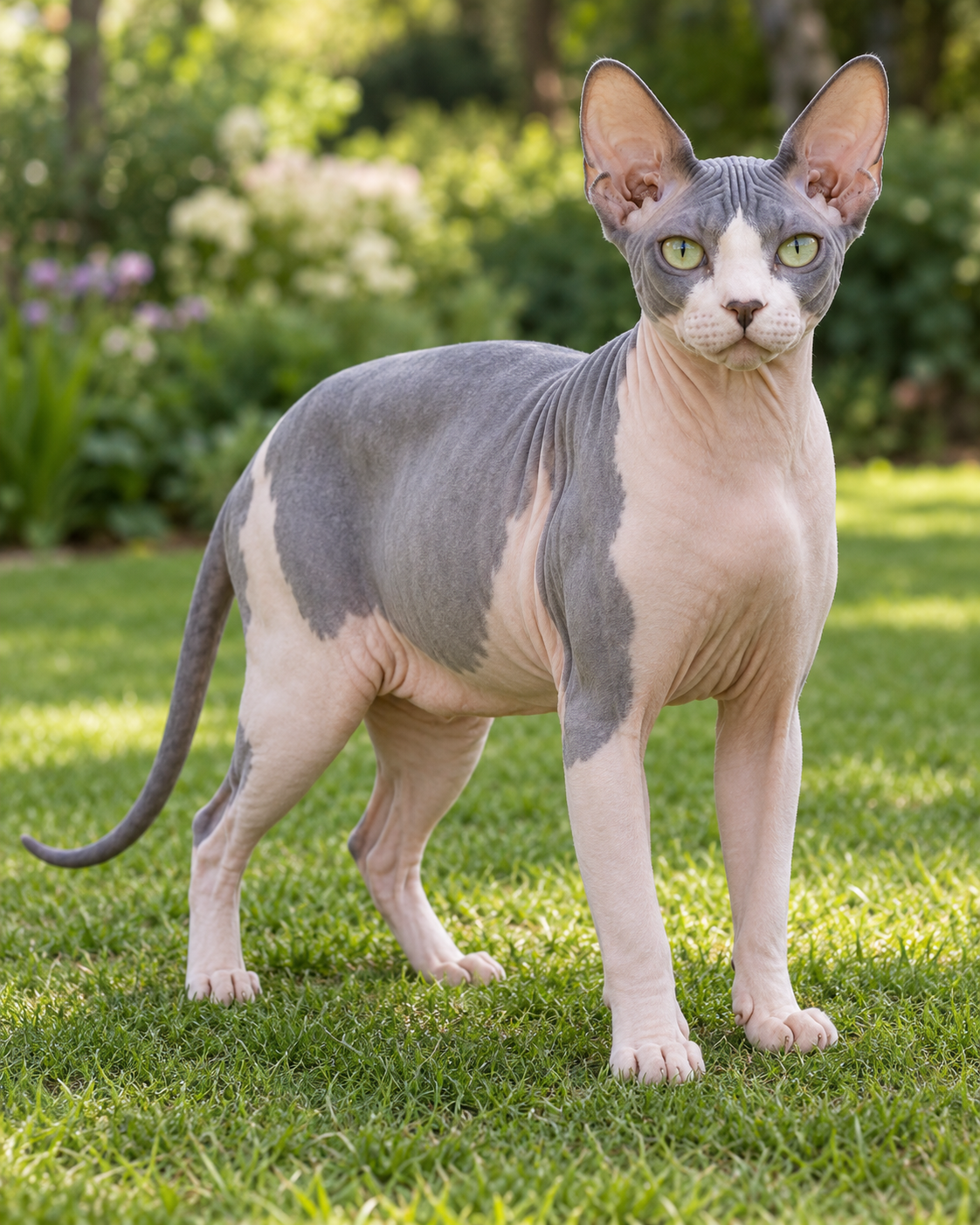
A hairless kitten born in Toronto in 1966 and later Minnesota cats incorporated into breed development. These origins do not make Donskoy the same breed.
Full breed details
A nearly hairless cat with variable residual hair and a substantial body. An outgoing companion that seeks attention and communicates frequently.
- Adult build
- Medium-sized, substantial; variable residual hair
- Adult weight
- TICA adult reference: Female: 7–10 lb; Male: 8–12 lb. Use the labelled female and male intervals; the separate combined summary is not a numerical sex split.
References & editorial notes
Adult-weight sources
TICA adult reference: Female: 7–10 lb; Male: 8–12 lb. Use the labelled female and male intervals; the separate combined summary is not a numerical sex split.
direct: TICA adult reference; published-sex-reference. Use the labelled female and male intervals; the separate combined summary is not a numerical sex split.
- Sphynx and Devon Rex Congenital Myasthenic Syndrome
- Sphynx
- Hypertrophic Cardiomyopathy
- CFA 2026–2027 Breed Standards
- Recognised breeds
- Standing Rules Version C, 3 June 2026, section 701.4.1
- Using Positive Reinforcement to Train and Support Your Cat
- Making the Commitment to Adopt a Cat
- How to Feed a Cat
- Introducing a New Cat Into Your Home
- Meeting the Physical and Emotional Needs of Indoor Cats
- Sphynx breed introduction
- Sphynx and Devon Rex Congenital Myasthenic Syndrome Checked 2026-10-20.
- Sphynx Checked 2026-10-20.
- Hypertrophic Cardiomyopathy Checked 2026-10-20.
- CFA 2026–2027 Breed Standards Checked 2026-10-20.
- Recognised breeds Checked 2026-10-20.
- Standing Rules Version C, 3 June 2026, section 701.4.1 Checked 2026-10-20.
- Using Positive Reinforcement to Train and Support Your Cat Checked 2026-10-20.
- Making the Commitment to Adopt a Cat Checked 2026-10-20.
- How to Feed a Cat Checked 2026-10-20.
- Introducing a New Cat Into Your Home Checked 2026-10-20.
- Meeting the Physical and Emotional Needs of Indoor Cats Checked 2026-10-20.
- Sphynx breed introduction Checked 2026-10-20.
References
Breeders & rescues
Questions to bring
- What dated cardiac examinations and CMS genetic results are available, and what skin-care plan suits this cat?
- What skin-care routine is established for this cat?
- What CMS and cardiac screening documentation is available?