Cat breed · California, United States
Ragdoll: Daily care
Daily care
Play & enrichment
Moderate play can fit alongside quiet company. Ask which interactive games this cat returns to; do not substitute prolonged holding for an opportunity to play.
More about everyday care
Provide places to retreat, separated resources, chances to play and predictable interaction. These are feline needs, not breed compatibility scores.
Coat, grooming & daily care
Combing once or twice weekly to remove loose hair and tangles. Ask for a demonstration that reaches through the coat rather than only smoothing the surface, and discuss how to adapt the routine if tangles develop. The practical commitment is regular hands-on care, not a promise that a semi-long coat will stay tangle-free.
Training & communication
Reward a behavior the cat chooses with something it values. Build tasks in small steps, including approaching a carrier or a grooming tool. Stop when the cat is frightened, unwell or in pain; ask your veterinarian about cooperative care.
Food, routine & costs
The everyday ownership plan
Planning for this breed
Make space for a substantial adult and choose a carrier, resting places and grooming setup that remain comfortable as it grows.
Meals and body condition
Discuss portions and body condition with your veterinarian instead of using the registry weight range as a feeding target. Smaller meals and appropriate food puzzles can support natural feeding behavior. Give each cat a separate feeding station.
Time and costs
Before committing, budget for food, litter, equipment and continuing veterinary care. Agree who handles play, cleaning, grooming and care during absences. Obtain local estimates for the individual’s care instead of relying on an invented breed cost.
More practical reading
Rescues & sheltersPrint or citeBreed articles
Other profile sections and family fact sheet
Life with a Ragdoll
Make time for play even when a cat is content to sit nearby.
Explore home life →Moderate play can fit alongside quiet company.
Explore daily care →Combing once or twice weekly to remove loose hair and tangles.
Explore daily care →Print or cite this breed
Ragdoll family fact sheet
Breed-level references are a starting point. Ask about the individual animal’s routine and care needs.
- Build
- Large, semi-longhaired
- Female
- 10–15 lb
- Male
- 15–20 lb
- Reference lifespan
- Mid to late teens
- Adult size
- Adult weight often falls around 10 to 20 pounds.
Company
Make time for play even when a cat is content to sit nearby. Before choosing a kitten or adult, observe how it responds when approached and when play ends. Ask its caregiver what kind of contact it seeks; a calm breed description is not permission to carry or restrain a reluctant individual.
Play & enrichment
Moderate play can fit alongside quiet company. Ask which interactive games this cat returns to; do not substitute prolonged holding for an opportunity to play.
Coat care
Combing once or twice weekly to remove loose hair and tangles. Ask for a demonstration that reaches through the coat rather than only smoothing the surface, and discuss how to adapt the routine if tangles develop. The practical commitment is regular hands-on care, not a promise that a semi-long coat will stay tangle-free.
Everyday responsibilities
Plan food, supplies, routine care and veterinary visits. Agree who handles the everyday jobs and who covers absences.
Adult help
An adult should remain responsible for care, supervise children’s interactions and arrange help when needed.
My Breed Atlas. Ragdoll breed profile. https://mybreedatlas.com/cats/breeds/ragdoll
Read this profile’s sources →Adult ranges and source qualifications
- Build
- Large, semi-longhaired
- Female
- 10–15 lb
- Male
- 15–20 lb
- Reference lifespan
- Mid to late teens
Reference ranges describe the breed, not a prediction for an individual.
Home life
Temperament & companionship
Make time for play even when a cat is content to sit nearby. Before choosing a kitten or adult, observe how it responds when approached and when play ends. Ask its caregiver what kind of contact it seeks; a calm breed description is not permission to carry or restrain a reluctant individual.
Home life & introductions
Prepare a quiet transition room with food, water, litter, hiding places and scratching options. Introduce resident cats gradually and proceed when both are comfortable. Breed reputation cannot establish compatibility with children, dogs or another cat.
Offer a quiet retreat and let the cat control its distance. Supervise children and introduce resident animals gradually; individual history matters more than a breed reputation.
Personality & care details
Personality & care profile
Breed tendencies vary by individual. Higher means more of the named tendency, not better.
What everyday life tends to involve
These notes describe a tendency for the breed. Every animal is an individual.
- Play
- Play is moderate. They enjoy it and do not insist on more.
- Coat care
- Brushing a few times a week fits this coat.
- Loose hair
- Shedding follows the seasons. Less undercoat means less loose hair and fewer mats.
- Company
- They come to greet you and stay nearby, without pushing for constant contact.
- Adult size
- Adult weight often falls around 10 to 20 pounds.
YOUR EVERYDAY LIFE
How could this breed fit your life?
See household examples or compare this breed with answers you chose to save. The examples show combinations where this breed appeared among the first five results. Other combinations can work too.
Saved matching preferences stay in this browser, never on your account. They expire after 30 days and are removed the next time this feature reads them. Health answers, children’s ages and free-text notes are not saved. This section does not reproduce those personal care notes.
Ragdoll health
Health observations and family records
One MYBPC3 variant has been associated with HCM in Ragdolls. HCM changes the heart muscle and can be present before obvious illness. The Ragdoll-associated variant is distinct from the commonly discussed Maine Coon variant.
Read the scan beside the genetic result
A DNA report concerns the named variant; an ultrasound examines heart structure at that time. Keep both records when available. A clear variant result cannot exclude every cause of HCM, and a previous normal scan does not guarantee that no later change can occur. Your cat can look well even if the heart has changed. If your cat is breathing comfortably now but you’ve noticed a repeated change in their usual sleeping breathing rate, call your vet promptly. Go to an emergency vet now if your cat breathes unusually fast at rest, struggles to breathe, breathes with their mouth open, collapses, or suddenly drags or can’t use one or both back legs. Don’t wait to count breaths or let an earlier normal result delay care. Bring the actual R820W report and the dates and findings of past heart ultrasounds. The DNA result does not show how your cat’s heart looks or works now. Tell the vet about confirmed HCM in relatives and report unexplained sudden deaths separately. Ask: “Would an ultrasound help assess my cat now? What does it say about the size of the chambers and whether we should recheck? Could something else cause the thickening?” Ask whether your cat needs monitoring only or a treatment plan now. If the vet asks you to track breathing in sleep, ask them to show you how and say which change is worth a call. Keep a record of normal activity, appetite and any reported symptoms alongside the recheck schedule. Don’t change prescribed medicines from home readings. A breathing emergency or sudden loss of leg use still overrides the plan.
Family history and screening
Ask for the exact Ragdoll MYBPC3 result and dated heart ultrasound findings. Tell the veterinarian about relatives with confirmed HCM or unexplained sudden death, identifying which history is confirmed and which is uncertain.
Questions for your veterinarian
- Does this report name the Ragdoll-associated variant?
- How do the family findings affect whether an ultrasound would be useful for my cat?
Choosing a kitten? Ask to see both parents’ results, with the animal’s name and the date on each report. If you’re adopting an adult, ask which records come with that individual.
Health sources
- Primary Ragdoll genetics study
- Cornell clinical guidance
- UC Davis assay
- Borgeat et al., 236-Ragdoll outcomes
- UC Davis Ragdoll HCM assay
- ACVIM feline cardiomyopathy consensus §§4–6
- Penn Vet cardiology, clot signs and emergency breathing
- Cornell feline dyspnea
- AAHA Recognizing Respiratory Distress
Screening evidence and limits
The Ragdoll-associated MYBPC3 R820W variant is an inherited risk factor for hypertrophic cardiomyopathy (HCM), a heart-muscle disease. It is a different test from the Maine Coon A31P variant. A DNA result is not a lifetime heart-health certificate. Review the actual laboratory report and family history with a veterinarian; Cornell identifies echocardiography as the diagnostic test for HCM.
History & sources
Heritage & appearance
Meet the Ragdoll
Adult ranges are reference examples, not targets or predictions for an individual cat.
Heritage & appearance
Ann Baker developed the breed in Riverside during the 1960s from domestic longhaired cats. Its modern registry identity is narrower than every cat historically described as a Ragdoll.
More about this breed’s history
Four early NCFA registration records
The Ragdoll Historical Society’s registry transcriptions list four cats that the National Cat Fanciers’ Association registered on December 30, 1966: Daddy Warbucks, Tiki, Kyoto and Fugianna. Ann Baker is listed as the owner of all four. The society’s account lists Baker as both breeder and owner of Tiki and Kyoto and names Daddy Warbucks and Buckwheat as their parents. The society’s transcriptions list Merle Pennel as breeder of Daddy Warbucks and Fugianna. (Ragdoll Historical Society: Ragdoll History: The Beginning, registry transcriptions 66-0577-6 through 66-0580-6)
Full breed details
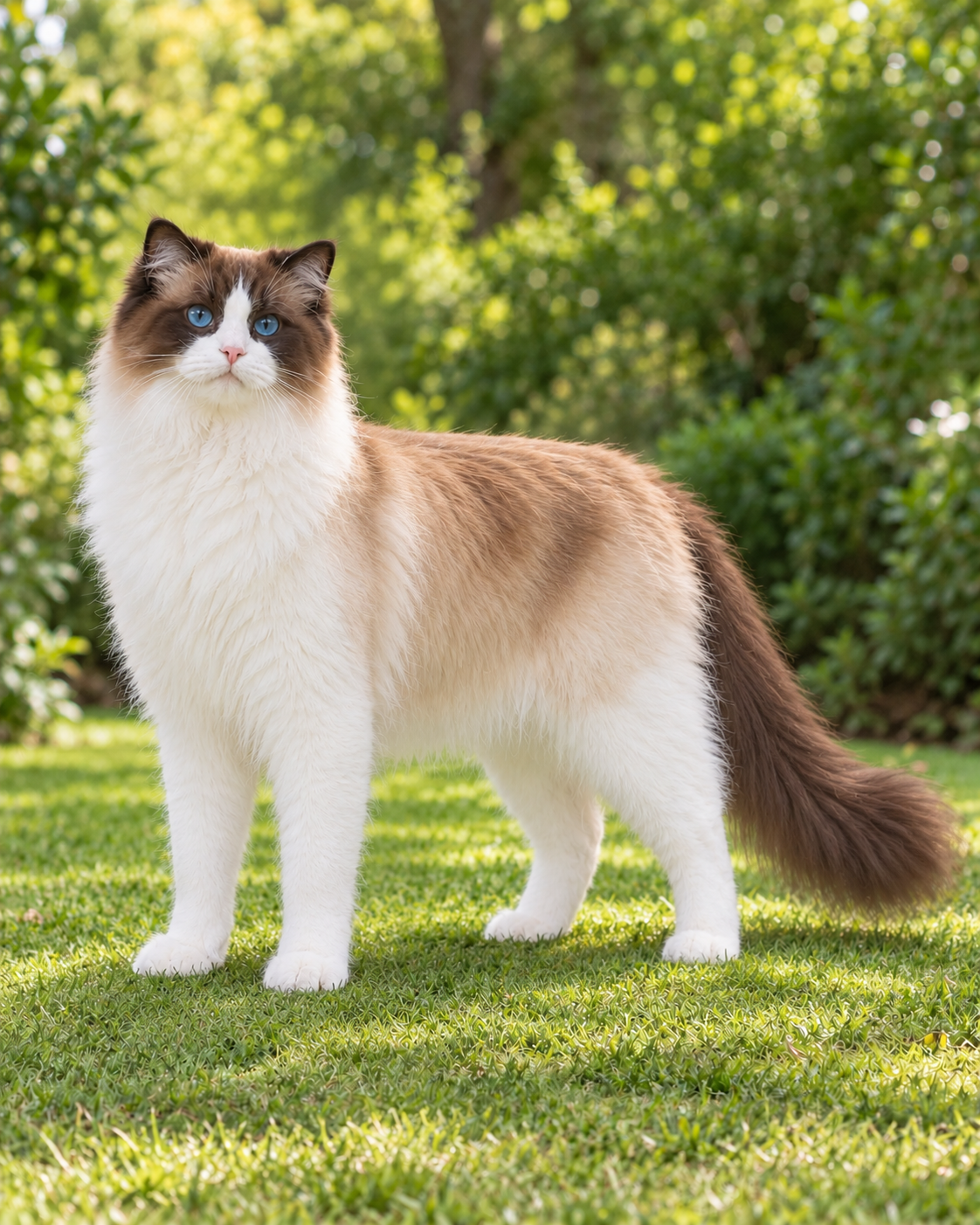
A large, blue-eyed pointed cat with a semi-long coat. A calm, affectionate companion whose activity is usually moderate.
- Adult build
- Large, semi-longhaired; blue-eyed and pointed
- Adult weight
- Females: 10–15 lb; males: 15–20 lb.
References & editorial notes
Adult-weight sources
Female: 10–15 lb; Male: 15–20 lb
direct: TICA explicitly gives mature female 10-15 lb and male 15-20 lb; full size may take 3-4 years; veterinary population medians are not full healthy-adult reference intervals.
- Hypertrophic Cardiomyopathy in Ragdolls
- Ragdoll
- Hypertrophic Cardiomyopathy
- CFA 2026–2027 Breed Standards
- Recognised breeds
- Standing Rules Version C, 3 June 2026, section 701.4.1
- Using Positive Reinforcement to Train and Support Your Cat
- Making the Commitment to Adopt a Cat
- How to Feed a Cat
- Introducing a New Cat Into Your Home
- Meeting the Physical and Emotional Needs of Indoor Cats
- Ragdoll breed introduction
- Hypertrophic Cardiomyopathy in Ragdolls Checked 2026-10-20.
- Ragdoll Checked 2026-10-20.
- Hypertrophic Cardiomyopathy Checked 2026-10-20.
- CFA 2026–2027 Breed Standards Checked 2026-10-20.
- Recognised breeds Checked 2026-10-20.
- Standing Rules Version C, 3 June 2026, section 701.4.1 Checked 2026-10-20.
- Using Positive Reinforcement to Train and Support Your Cat Checked 2026-10-20.
- Making the Commitment to Adopt a Cat Checked 2026-10-20.
- How to Feed a Cat Checked 2026-10-20.
- Introducing a New Cat Into Your Home Checked 2026-10-20.
- Meeting the Physical and Emotional Needs of Indoor Cats Checked 2026-10-20.
- Ragdoll breed introduction Checked 2026-10-20.
Breeders & rescues
Questions to bring
- Which Ragdoll-specific HCM result and cardiac examinations are documented for this cat’s family?
- What does this cat do when it wants a break from contact?
- Can I see the dated heart-screening and genetic-test records?