Manx group
Cymric: Health
Cymric health
Health observations and family records
The Cymric is the longhaired member of the Manx breed group. Selected Manx clinical research describes lower-spine abnormalities and bladder, bowel or hind-leg difficulties. Separate Cymric clinical evidence is limited; those Manx-group findings do not establish an individual Cymric’s condition or a disease rate for Cymrics.
Explain what is happening under the coat
If the hindquarters repeatedly become wet or soiled, tell the veterinarian whether you saw leakage, straining or difficulty reaching the litter box. Mention a new change in walking as well. These are observations to assess, not a home diagnosis of a spinal problem. Repeated efforts to urinate with little or no urine require emergency veterinary care. If the veterinarian finds a lasting movement or toileting problem, ask what a normal day should look like for your cat and what changes to call about. A litter tray with a low entrance can be easier to reach for a cat with reduced mobility. Ask the team how to keep the long coat clean and how to recognize irritation that needs a check. Keep watching for actual urine output rather than assuming repeated trips are a mobility problem.
Family history and screening
Ask what the caregiver has observed about comfortable movement and bladder and bowel control. Where a problem has already been reported, request the examination findings rather than assuming it is explained by the tail or long coat.
Questions for your veterinarian
- Could you assess the movement and litter-box changes together?
- Which previous examination records would help distinguish leakage from difficulty passing urine?
Choosing a kitten? Ask to see both parents’ results, with the animal’s name and the date on each report. If you’re adopting an adult, ask which records come with that individual.
Health sources
- TICA breed classification
- primary clinical, imaging and histopathology work
- Cornell clinical feline guidance
- c_cymgen
- AAFP/IAAHPC feline hospice and palliative care guidelines
Screening evidence and limits
Cymric is the longhaired Manx-group form. In affected Manx cats, developmental spinal abnormalities can impair hind limbs, bladder or bowel function. Request assessment of mobility and elimination history; not every tailless or short-tailed cat is affected. No prevalence estimate or blanket healthy-tail rule is asserted.
Preventive care
Arrange an individual veterinary prevention plan, including vaccination and parasite assessment. Prefer indoor living with enrichment or secure, supervised outdoor access over roaming. Request existing veterinary and screening records before bringing a cat home.
Screening limits
No evidence found is not evidence of no risk. A DNA result addresses its tested variant and cannot certify general health. Ask a veterinarian which examinations or tests fit the individual’s ancestry, family history and findings.
Rescues & sheltersPrint or citeBreed articles
Other profile sections and family fact sheet
Life with a Cymric
Often affectionate and even-tempered.
Explore home life →Provide daily chasing and interactive games; adjust jumping opportunities to the cat’s actual mobility.
Explore daily care →Comb weekly; adjust to coat condition and shedding.
Explore daily care →Print or cite this breed
Cymric family fact sheet
Breed-level references are a starting point. Ask about the individual animal’s routine and care needs.
- Female
- 8–10 lb
- Male
- 10–12 lb
- Build
- Medium, compact
- Coat
- Long
- Breed family
- Manx group
- Tail length
- Varies
- Adult size
- Adult weight often falls around 7.9 to 11.9 pounds.
Company
Often affectionate and even-tempered. Some bond especially closely with one person; long periods without company may not suit every individual.
Play & enrichment
Provide daily chasing and interactive games; adjust jumping opportunities to the cat’s actual mobility.
Coat care
Comb weekly; adjust to coat condition and shedding.
Everyday responsibilities
Plan food, supplies, routine care and veterinary visits. Agree who handles the everyday jobs and who covers absences.
Adult help
An adult should remain responsible for care, supervise children’s interactions and arrange help when needed.
My Breed Atlas. Cymric breed profile. https://mybreedatlas.com/cats/breeds/cymric
Read this profile’s sources →Adult ranges and source qualifications
- Female
- 8–10 lb
- Male
- 10–12 lb
- Build
- Medium, compact
- Coat
- Long
- Breed family
- Manx group
- Tail length
- Varies
Reference ranges describe the breed, not a prediction for an individual.
Daily care
Play & enrichment
Provide daily chasing and interactive games; adjust jumping opportunities to the cat’s actual mobility.
More about everyday care
Provide places to retreat, separated resources, chances to play and predictable interaction. These are feline needs, not breed compatibility scores.
Coat, grooming & daily care
Comb weekly; adjust to coat condition and shedding.
Litter areas and daily routine
Training & communication
Reward a behavior the cat chooses with something it values. Build tasks in small steps, including approaching a carrier or a grooming tool. Stop when the cat is frightened, unwell or in pain; ask your veterinarian about cooperative care.
Food, routine & costs
The everyday ownership plan
Planning for this breed
Ask specifically about normal walking, toileting and prior neurological or bowel/bladder concerns; adapt resources for any established mobility needs.
Meals and body condition
Discuss portions and body condition with your veterinarian instead of using the registry weight range as a feeding target. Smaller meals and appropriate food puzzles can support natural feeding behavior. Give each cat a separate feeding station.
Time and costs
Before committing, budget for food, litter, equipment and continuing veterinary care. Agree who handles play, cleaning, grooming and care during absences. Obtain local estimates for the individual’s care instead of relying on an invented breed cost.
Individual variation
Temperament statements are registry tendencies, not guarantees or quiz scores. Evaluate the individual cat’s history, behavior, health and introductions.
Environment
Provide a secure retreat, separate food/water/toileting/resting/scratching resources, opportunities to play and express hunting behavior, predictable positive interaction and respect for scent. In multi-cat homes, provide genuine choices and enough resources for each cat.
Nutrition
Choose a complete, balanced life-stage diet and fresh water. Adjust portions using veterinary assessment of body condition, not a breed weight chart. Do not infer a need for raw or grain-free feeding from appearance or ancestry.
Ownership budget
Plan for daily care, veterinary visits, emergency costs and lifelong housing arrangements. Ask about documented health history and socialization rather than treating registry membership as a health guarantee.
Home life
Temperament & companionship
Often affectionate and even-tempered. Some bond especially closely with one person; long periods without company may not suit every individual.
Home life & introductions
Prepare a quiet transition room with food, water, litter, hiding places and scratching options. Introduce resident cats gradually and proceed when both are comfortable. Breed reputation cannot establish compatibility with children, dogs or another cat.
Offer a quiet retreat and let the cat control its distance. Supervise children and introduce resident animals gradually; individual history matters more than a breed reputation.
Personality & care details
Personality & care profile
Breed tendencies vary by individual. Higher means more of the named tendency, not better.
What everyday life tends to involve
These notes describe a tendency for the breed. Every animal is an individual.
- Play
- Several play sessions through the day fit this cat.
- Coat care
- Comb weekly; adjust to coat condition and shedding.
- Loose hair
- Expect a lot of loose hair, including heavy shedding seasons.
- Company
- Many like to stay close.
- Adult size
- Adult weight often falls around 7.9 to 11.9 pounds.
YOUR EVERYDAY LIFE
How could this breed fit your life?
See household examples or compare this breed with answers you chose to save. The examples show combinations where this breed appeared among the first five results. Other combinations can work too.
Saved matching preferences stay in this browser, never on your account. They expire after 30 days and are removed the next time this feature reads them. Health answers, children’s ages and free-text notes are not saved. This section does not reproduce those personal care notes.
History & sources
Heritage & appearance
Meet the Cymric
Adult ranges are reference examples, not targets or predictions for an individual cat.
Heritage & appearance
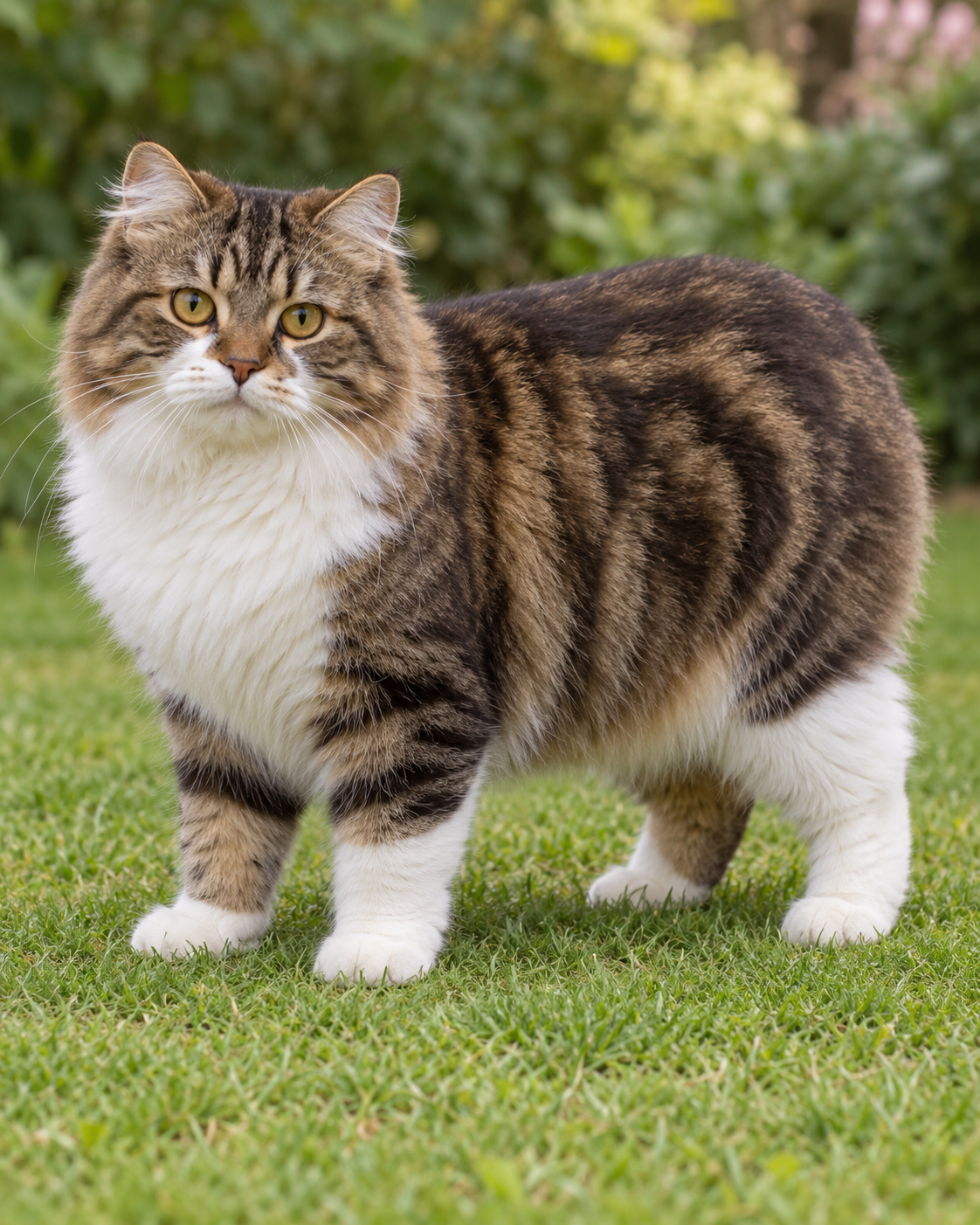
The Manx group originates from the Isle of Man. TICA recognizes Cymric and, in its current roster, Cymric Tailed.
More about this breed’s history
Championship recognition and a Canadian coin
TICA dates championship recognition of both Cymric and Manx to June 1979. In its breed introduction, it distinguishes the longhaired Cymric from the shorthaired Manx. (The International Cat Association: Cymric breed introduction, History and Traits)
The Cymric also appeared in the Royal Canadian Mint's 1999 Cats of Canada series. The Mint's archived catalogue identifies the 50-cent Cymric coin as the third of four in the series and lists it as product 1282. (Royal Canadian Mint: 50 cents – Cats of Canada Series, Cymric (1999), coin3/4, product1282)
A retrospective Canadian account
ACF's breeding and registration rules, updated in November 2024, compile a Canadian account of the breed. The account says Blair Wright's first Cymric kitten was born in 1973 to two shorthaired Manx, dates Canadian Cat Association championship status to May 1976, and names Wright's Ch. Helle's Comus Jupiter as the first Cymric champion. (Australian Cat Federation (Inc.): By-Laws Part2 – Breeding and Registration Rules, updated1 November2024, printed page43)
Full breed details
- Adult build
- Medium, compact, heavily boned
- Reference lifespan
- 16+ years
References & editorial notes
Adult-weight sources
Female: 8–10 lb; Male: 10–12 lb
direct: TICA Cymric Traits text explicitly gives mature female 8-10 lb and male 10-12 lb; the Manx/Cymric group matures slowly, up to five years.
- CFA 2026–2027 Breed Standards
- Recognised breeds
- Using Positive Reinforcement to Train and Support Your Cat
- Making the Commitment to Adopt a Cat
- How to Feed a Cat
- Introducing a New Cat Into Your Home
- Meeting the Physical and Emotional Needs of Indoor Cats
- TICA: Cymric
- TICA Standing Rules Version C, 3 June 2026
- Cornell: Feeding Your Cat
- Cornell: What To Expect
- FelineVMA 2025: Meeting the Physical and Emotional Needs of Indoor Cats
- Cornell: Hypertrophic Cardiomyopathy
- UC Davis VGL: Sphynx and Devon Rex Congenital Myasthenic Syndrome
- UC Davis VGL: Erythrocyte Pyruvate Kinase Deficiency
- VIN Veterinary Partner: Manx Syndrome in Cats
- Multiple mutant T alleles cause haploinsufficiency of Brachyury and short tails in Manx cats (2013)
- CFA longhair Manx care
- CFA 2026–2027 Breed Standards Checked 2026-10-20.
- Recognised breeds Checked 2026-10-20.
- Using Positive Reinforcement to Train and Support Your Cat Checked 2026-10-20.
- Making the Commitment to Adopt a Cat Checked 2026-10-20.
- How to Feed a Cat Checked 2026-10-20.
- Introducing a New Cat Into Your Home Checked 2026-10-20.
- Meeting the Physical and Emotional Needs of Indoor Cats Checked 2026-10-20.
- TICA: Cymric Checked 2026-10-20.
- TICA Standing Rules Version C, 3 June 2026 Checked 2026-10-20.
- Cornell: Feeding Your Cat Checked 2026-10-20.
- Cornell: What To Expect Checked 2026-10-20.
- FelineVMA 2025: Meeting the Physical and Emotional Needs of Indoor Cats Checked 2026-10-20.
- Cornell: Hypertrophic Cardiomyopathy Checked 2026-10-20.
- UC Davis VGL: Sphynx and Devon Rex Congenital Myasthenic Syndrome Checked 2026-10-20.
- UC Davis VGL: Erythrocyte Pyruvate Kinase Deficiency Checked 2026-10-20.
- VIN Veterinary Partner: Manx Syndrome in Cats Checked 2026-10-20.
- Multiple mutant T alleles cause haploinsufficiency of Brachyury and short tails in Manx cats (2013) Checked 2026-10-20.
- CFA longhair Manx care
References
Breeders & rescues
Questions to bring
- What veterinary records and family health history are available?
- How does this individual cat’s coat and activity fit the care described here?
- Which screening findings and individual needs should I discuss with my veterinarian?
Before you meet a cat
- What is this cat’s daily care routine?
- Are there known mobility or toileting needs?
- Which veterinary records can I review?