Cat breed
Chartreux: History & sources
History & sources
Heritage & appearance
Meet the Chartreux
Adult ranges are reference examples, not targets or predictions for an individual cat.
Heritage & appearance
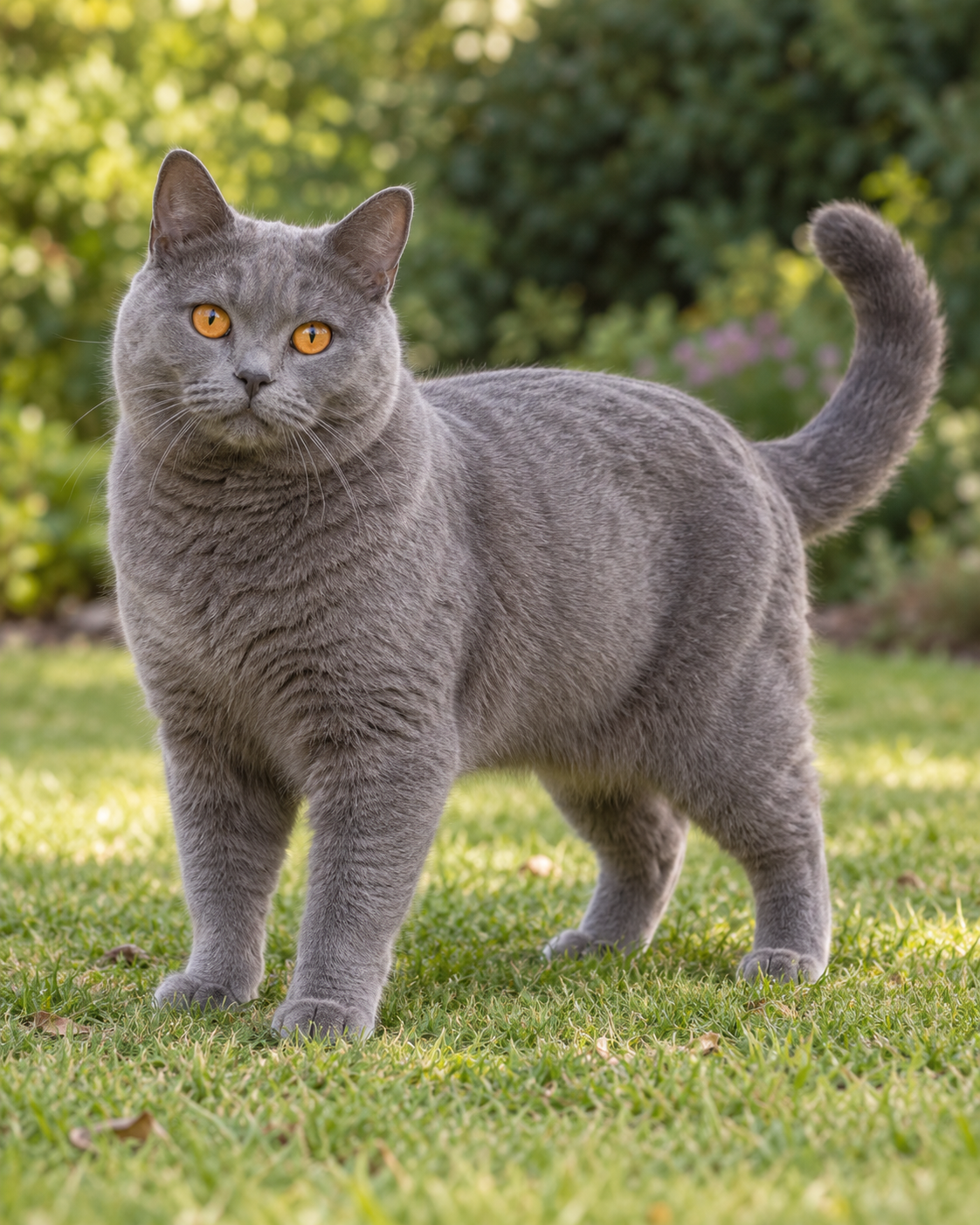
Selective breeding began with French blue-cat colonies in the 1920s; North American imports followed in 1970. Monastic-origin stories are uncertain.
More about this breed’s history
The Léger sisters and Mignonne de Guerveur
On Belle-Île-en-Mer, off the coast of Brittany, sisters Suzanne and Christine Léger noticed blue cats living freely and began selecting breeding animals in the 1920s. By 1928 they were exhibiting their cats. In 1933 their female Mignonne de Guerveur won at the Cat Club de Paris show. The breeders described their island work in print in 1935 and acknowledged how little they could establish about the cats’ earlier origins. (La Vie à la campagne, archived by the CFA Chartreux Breed Council: Le chat des Chartreux, race reconstituée (April 15, 1935); Cat Club de Paris: Le Chat des Chartreux et l’Histoire)
Full breed details
- Adult build
- Medium; males can be substantially larger
References & editorial notes
Adult-weight sources
Female: 6–9 lb; Male: 10–14 lb
direct: Canadian Cat Association breed standard specifies mature female 2.7-4.1 kg and male 4.5-6.4 kg; VCA gives matching 6-9/10-14 lb intervals; kg converted and rounded. French-language search completed; cited weight text is English.
- CFA 2026–2027 Breed Standards
- Recognised breeds
- Using Positive Reinforcement to Train and Support Your Cat
- Making the Commitment to Adopt a Cat
- How to Feed a Cat
- Introducing a New Cat Into Your Home
- Meeting the Physical and Emotional Needs of Indoor Cats
- TICA: Chartreux
- CFA: Chartreux
- TICA Standing Rules Version C, 3 June 2026
- Cornell: Feeding Your Cat
- Cornell: What To Expect
- FelineVMA 2025: Meeting the Physical and Emotional Needs of Indoor Cats
- Cornell: Hypertrophic Cardiomyopathy
- UC Davis VGL: Sphynx and Devon Rex Congenital Myasthenic Syndrome
- UC Davis VGL: Erythrocyte Pyruvate Kinase Deficiency
- CFA 2026–2027 Breed Standards Checked 2026-10-20.
- Recognised breeds Checked 2026-10-20.
- Using Positive Reinforcement to Train and Support Your Cat Checked 2026-10-20.
- Making the Commitment to Adopt a Cat Checked 2026-10-20.
- How to Feed a Cat Checked 2026-10-20.
- Introducing a New Cat Into Your Home Checked 2026-10-20.
- Meeting the Physical and Emotional Needs of Indoor Cats Checked 2026-10-20.
- TICA: Chartreux Checked 2026-10-20.
- CFA: Chartreux Checked 2026-10-20.
- TICA Standing Rules Version C, 3 June 2026 Checked 2026-10-20.
- Cornell: Feeding Your Cat Checked 2026-10-20.
- Cornell: What To Expect Checked 2026-10-20.
- FelineVMA 2025: Meeting the Physical and Emotional Needs of Indoor Cats Checked 2026-10-20.
- Cornell: Hypertrophic Cardiomyopathy Checked 2026-10-20.
- UC Davis VGL: Sphynx and Devon Rex Congenital Myasthenic Syndrome Checked 2026-10-20.
- UC Davis VGL: Erythrocyte Pyruvate Kinase Deficiency Checked 2026-10-20.
Rescues & sheltersPrint or citeBreed articles
Other profile sections and family fact sheet
Life with a Chartreux
A gentle, amiable companion.
Explore home life →Offer puzzle toys, interactive chasing and accessible climbing areas; do not equate a calm reputation with no play needs.
Explore daily care →Short, dense blue-gray coat needs regular combing.
Explore daily care →Print or cite this breed
Chartreux family fact sheet
Breed-level references are a starting point. Ask about the individual animal’s routine and care needs.
- Build
- Medium
- Female
- 6–9 lb
- Male
- 10–14 lb
- Reference lifespan
- 8–13+ years
- Adult size
- Adult weight often falls around 6 to 14 pounds.
Company
A gentle, amiable companion. Match the individual cat to household noise, handling and other animals rather than promising universal compatibility.
Play & enrichment
Offer puzzle toys, interactive chasing and accessible climbing areas; do not equate a calm reputation with no play needs.
Coat care
Short, dense blue-gray coat needs regular combing.
Everyday responsibilities
Plan food, supplies, routine care and veterinary visits. Agree who handles the everyday jobs and who covers absences.
Adult help
An adult should remain responsible for care, supervise children’s interactions and arrange help when needed.
My Breed Atlas. Chartreux breed profile. https://mybreedatlas.com/cats/breeds/chartreux
Read this profile’s sources →Adult ranges and source qualifications
- Build
- Medium
- Female
- 6–9 lb
- Male
- 10–14 lb
- Reference lifespan
- 8–13+ years
Reference ranges describe the breed, not a prediction for an individual.
Daily care
Play & enrichment
Offer puzzle toys, interactive chasing and accessible climbing areas; do not equate a calm reputation with no play needs.
More about everyday care
Provide places to retreat, separated resources, chances to play and predictable interaction. These are feline needs, not breed compatibility scores.
Coat, grooming & daily care
Short, dense blue-gray coat needs regular combing.
Training & communication
Reward a behavior the cat chooses with something it values. Build tasks in small steps, including approaching a carrier or a grooming tool. Stop when the cat is frightened, unwell or in pain; ask your veterinarian about cooperative care.
Food, routine & costs
The everyday ownership plan
Planning for this breed
Discuss cardiac family history; assess body condition independently of a stocky silhouette.
Meals and body condition
Discuss portions and body condition with your veterinarian instead of using the registry weight range as a feeding target. Smaller meals and appropriate food puzzles can support natural feeding behavior. Give each cat a separate feeding station.
Time and costs
Before committing, budget for food, litter, equipment and continuing veterinary care. Agree who handles play, cleaning, grooming and care during absences. Obtain local estimates for the individual’s care instead of relying on an invented breed cost.
Individual variation
Temperament statements are registry tendencies, not guarantees or quiz scores. Evaluate the individual cat’s history, behavior, health and introductions.
Environment
Provide a secure retreat, separate food/water/toileting/resting/scratching resources, opportunities to play and express hunting behavior, predictable positive interaction and respect for scent. In multi-cat homes, provide genuine choices and enough resources for each cat.
Nutrition
Choose a complete, balanced life-stage diet and fresh water. Adjust portions using veterinary assessment of body condition, not a breed weight chart. Do not infer a need for raw or grain-free feeding from appearance or ancestry.
Ownership budget
Plan for daily care, veterinary visits, emergency costs and lifelong housing arrangements. Ask about documented health history and socialization rather than treating registry membership as a health guarantee.
Home life
Temperament & companionship
A gentle, amiable companion. Match the individual cat to household noise, handling and other animals rather than promising universal compatibility.
Home life & introductions
Prepare a quiet transition room with food, water, litter, hiding places and scratching options. Introduce resident cats gradually and proceed when both are comfortable. Breed reputation cannot establish compatibility with children, dogs or another cat.
Offer a quiet retreat and let the cat control its distance. Supervise children and introduce resident animals gradually; individual history matters more than a breed reputation.
Personality & care details
Personality & care profile
Breed tendencies vary by individual. Higher means more of the named tendency, not better.
What everyday life tends to involve
These notes describe a tendency for the breed. Every animal is an individual.
- Play
- Playful energy can last into later life: climbing, tricks, and sometimes a harness walk.
- Coat care
- Once a week or less is usually enough brushing.
- Loose hair
- Regular shedding is part of living with this coat.
- Company
- Many like to stay close or share the room without constant contact.
- Adult size
- Adult weight often falls around 6 to 14 pounds.
YOUR EVERYDAY LIFE
How could this breed fit your life?
See household examples or compare this breed with answers you chose to save. The examples show combinations where this breed appeared among the first five results. Other combinations can work too.
Saved matching preferences stay in this browser, never on your account. They expire after 30 days and are removed the next time this feature reads them. Health answers, children’s ages and free-text notes are not saved. This section does not reproduce those personal care notes.
Chartreux health
Health observations and family records
Chartreux cats with HCM were included in a French referral-service study. HCM involves thickening of the heart muscle. Those selected clinical cases do not establish how common it is in Chartreux cats, an excess breed risk or a defined inherited cause.
Bring a diagnosis, not just a family label
If a close relative was said to have a heart problem, ask whether an ultrasound identified cardiomyopathy and request the dated report. Cats with heart changes may still appear well. A veterinarian can decide whether an examination or imaging is appropriate for this cat. Cats can seem well early on. If your cat is breathing comfortably now but you've noticed a repeated change in usual sleeping breathing or a drop in activity, call your vet promptly. Go to an emergency vet now if your cat breathes unusually fast at rest, struggles to breathe, breathes with their mouth open, collapses, or suddenly drags or can't use one or both back legs. Don't wait to count breaths. Bring dated ultrasound records for your cat and the actual written diagnosis for any affected relative. Ask what the ultrasound is looking for, whether other conditions could account for a thickened heart muscle, and when a repeat exam would be useful. Ask what the diagnosis and stage mean for your cat, how and when to check sleeping breathing if your vet recommends it, and whom to contact after hours. Keep those instructions with recheck dates and any prescribed plan. Do not adjust treatment after one home measurement without contacting the clinic.
Family history and screening
Ask which relatives were examined, their ages and the actual findings. A normal heart report concerns that examination; it is not a lifetime guarantee or evidence that an unspecified DNA panel checked Chartreux heart disease.
Questions for your veterinarian
- Does this particular family report change what you would investigate?
- Which findings came from ultrasound rather than a murmur or an unconfirmed history?
Choosing a kitten? Ask to see both parents’ results, with the animal’s name and the date on each report. If you’re adopting an adult, ask which records come with that individual.
More from My Breed Atlas
Health sources
- Primary retrospective clinical study
- Cornell clinical guidance
- Cornell feline cardiomyopathy
- Tufts emergency limb and respiratory signs
Screening evidence and limits
Cornell includes Chartreux among breeds with higher HCM prevalence. Discuss cardiac history and appropriate screening with a veterinarian. This packet establishes neither a numerical risk nor a universal Chartreux DNA clearance test.
Preventive care
Arrange an individual veterinary prevention plan, including vaccination and parasite assessment. Prefer indoor living with enrichment or secure, supervised outdoor access over roaming. Request existing veterinary and screening records before bringing a cat home.
Screening limits
No evidence found is not evidence of no risk. A DNA result addresses its tested variant and cannot certify general health. Ask a veterinarian which examinations or tests fit the individual’s ancestry, family history and findings.
Breeders & rescues
Questions to bring
- What veterinary records and family health history are available?
- How does this individual cat’s coat and activity fit the care described here?
- Which screening findings and individual needs should I discuss with my veterinarian?