Chartreux vs Korat: size, character and breed identity
Compare Chartreux vs Korat using current adult weights, distinctive Korat features, companionship and the different histories behind these breeds.
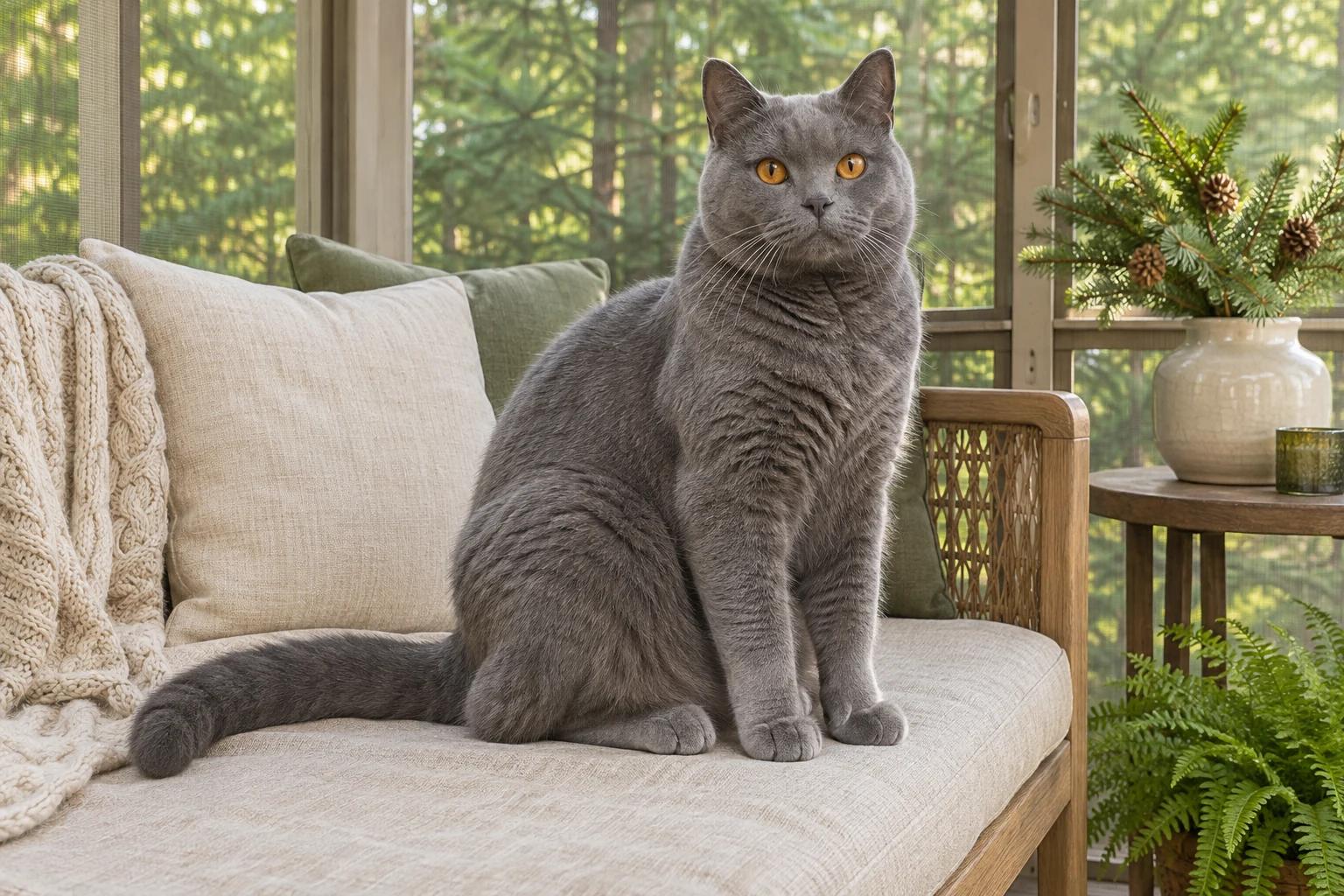
Chartreux vs Korat is not a choice that can be settled by a photograph alone. Start with the adult size you can reasonably expect, then consider the individual cat's manner of interacting. Breed history and appearance help explain identity, but they do not choose a companion on your behalf.
Chartreux vs Korat: compare the adult ranges first
The current Chartreux profile gives females at 6–9 pounds and males at 10–14 pounds. The Korat profile gives females at 6–8 pounds and males at 8–10 pounds. These are adult references with sex qualifiers, not promises about a kitten's eventual weight.
The female intervals overlap from six to eight pounds. The male intervals meet at ten pounds, while the Chartreux male reference extends farther upward. A comparison that says every Chartreux is heavier than every Korat therefore goes too far. A female Chartreux and male Korat can also occupy overlapping parts of their respective ranges.
This is the most useful numerical difference to keep in mind when comparing Korat vs Chartreux. Do not combine the heaviest male reference from one breed with the lightest female reference from the other and call that the normal difference between them. Sex and individual size matter. For an adult you can meet, its actual weight is more immediately useful than an estimate based only on its breed label.
The Korat has a distinctive face and surface
CFA's Korat description and standard identify a heart-shaped head, with the eyebrow contours forming the upper curves and the face narrowing toward the chin. Large, rounded-tip ears and prominent eyes contribute to that expression. The mature eye color is green, although younger cats can look different while developing.
The Korat's silver-tipped blue coat is short, fine and close to the body. Its outline should not make you mistake it for a fragile animal: the breed is muscular and can feel surprisingly substantial. Looking at face shape, coat finish and body together is more informative than identifying a breed from one eye-color photograph.
For someone attracted to this appearance, examine the complete cat rather than hunting for a single identifying mark. A heart-shaped impression depends on several contours, not a literal heart drawn on the face. Likewise, a change in lighting can alter how strongly a silver sheen appears in a picture. These features describe the breed; they are not a substitute for reliable information about an individual cat's identity.
Understand the Chartreux's way of joining in
VCA's Chartreux account describes a cat that watches its surroundings, may follow a favored person and can still show affection to other people. It also notes that some learn to operate doors or household controls. These are useful examples of involvement that need not be expressed through loud demands.
If a Chartreux follows you between rooms, the interaction may be about accompanying you rather than asking for a particular performance. It is worth making ordinary access decisions deliberately: a door that an individual has learned to open is no longer a dependable boundary simply because you closed it.
That does not mean every Chartreux will manipulate a latch, or that such behavior measures its worth as a companion. It means that its actual skills can matter more than a general reputation. When choosing an adult, ask about specific things it already does in its current home. “Opens this lever handle” gives you something concrete to accommodate; a flattering intelligence label does not explain the mechanism.
The Chartreux's French identity is not just a nickname
The GCCF's history of the Chartreux traces the breed to French cats and later preservation efforts. It also distinguishes that older background from the much more recent recognition process in Britain. Those are different timelines: a registry's recognition date is not the date a breed first existed.
The breed also appears in French cultural history. GCCF discusses Colette's novel La Chatte, whose feline character Saha was based on one of the author's cats. This connection helps explain why the Chartreux carries a particular French association rather than being simply a descriptive name for any similarly colored cat.
For an owner comparing the two breeds, history is useful as identity and context, not a forecast of household behavior. A literary cat is a character in a story. Your own cat does not inherit the plot, and an old origin does not remove the need to assess the living individual. Enjoy the background without making it a substitute for a real encounter.
The Korat's interest in people comes with things to do
GCCF describes the Korat as strongly attached to its human family, with an interest in play, climbing and learning tricks. Its account also notes that individuals can have definite preferences about toys. That is a useful reason to offer different forms of participation rather than assuming one purchased object will satisfy every cat.
A climbing opportunity and an interactive game are different invitations. One lets the cat move through the room's structure; the other involves following an activity you provide. Neither requires deciding that the Korat must win an activity contest against a Chartreux. The question is whether those forms of involvement fit the cat you are meeting and the life you can offer.
In practical terms, a prospective owner interested in a Korat should be comfortable participating, not just admiring. Watch how the individual joins an interaction, which objects it selects and when it moves on. Do not turn a breed tendency into a requirement that it entertain visitors or demonstrate a trick on demand.
For a separate discussion of observations, read Chartreux everyday behaviour changes. The cat match quiz helps you consider ownership preferences alongside appearance.
Frequently asked questions
Is a Chartreux or Korat always the smaller cat?
Neither the Chartreux nor the Korat is always smaller. Their current female weight ranges overlap, and the male ranges meet at ten pounds. Compare sex-qualified references and the individual animal.
What is the difference between Chartreux and Korat weights?
Chartreux females are listed at 6–9 pounds and males at 10–14; Korat females at 6–8 and males at 8–10. These are reference intervals, not fixed differences between pairs of cats.
Which range should I use when considering a kitten?
For a Chartreux or Korat kitten, use the appropriate adult breed weight reference as background, not a guaranteed forecast. A kitten’s current weight is not its final adult measurement.
Sources behind this article
- CFA Korat appearance and standard ↗
- VCA Chartreux behavior ↗
- GCCF Chartreux history ↗
- GCCF Korat character ↗
- TICA Traits adult reference — adult-weight reference ↗
Article source checked: November 16, 2026. Source checked 2026-11-16Article source checked: November 18, 2026. Source checked 2026-11-18
Keep reading

Abyssinian vs Somali: Coat, Size and Everyday Company
Read article →