Cat breed · Modern breed development in the United States from Wong Mau and subsequent breeding
Burmese: Home life
Home life
Temperament & companionship
Human company. Ask about the individual’s preferred contact and how it copes with daily absences rather than assuming another pet will meet its social needs.
Home life & introductions
Prepare a quiet transition room with food, water, litter, hiding places and scratching options. Introduce resident cats gradually and proceed when both are comfortable. Breed reputation cannot establish compatibility with children, dogs or another cat.
Offer a quiet retreat and let the cat control its distance. Supervise children and introduce resident animals gradually; individual history matters more than a breed reputation.
Personality & care details
Personality & care profile
Breed tendencies vary by individual. Higher means more of the named tendency, not better.
What everyday life tends to involve
These notes describe a tendency for the breed. Every animal is an individual.
- Play
- Playful energy can last into later life: climbing, tricks, and sometimes a harness walk.
- Coat care
- Once a week or less is usually enough brushing.
- Loose hair
- Loose hair tends to stay light.
- Company
- Many like to stay close.
- Adult size
- Adult weight often falls around 6 to 12 pounds.
- Time alone
- Long stretches alone are a poor fit. They want company nearby.
YOUR EVERYDAY LIFE
How could this breed fit your life?
See household examples or compare this breed with answers you chose to save. The examples show combinations where this breed appeared among the first five results. Other combinations can work too.
Saved matching preferences stay in this browser, never on your account. They expire after 30 days and are removed the next time this feature reads them. Health answers, children’s ages and free-text notes are not saved. This section does not reproduce those personal care notes.
More practical reading
Rescues & sheltersPrint or citeBreed articles
Other profile sections and family fact sheet
Life with a Burmese
Human company.
Explore home life →Use the caregiver’s examples of favorite games to plan interaction.
Explore daily care →Weekly use of a rubber brush and does not describe routine bathing as necessary.
Explore daily care →Print or cite this breed
Burmese family fact sheet
Breed-level references are a starting point. Ask about the individual animal’s routine and care needs.
- Build
- Medium
- Female
- 6–9 lb
- Male
- 11–14 lb
- Adult size
- Adult weight often falls around 6 to 12 pounds.
Company
Human company. Ask about the individual’s preferred contact and how it copes with daily absences rather than assuming another pet will meet its social needs.
Play & enrichment
Use the caregiver’s examples of favorite games to plan interaction. The general reward-based training guidance applies to this individual without assigning a breed intelligence or trainability score.
Coat care
Weekly use of a rubber brush and does not describe routine bathing as necessary.
Everyday responsibilities
Plan food, supplies, routine care and veterinary visits. Agree who handles the everyday jobs and who covers absences.
Adult help
An adult should remain responsible for care, supervise children’s interactions and arrange help when needed.
My Breed Atlas. Burmese breed profile. https://mybreedatlas.com/cats/breeds/burmese
Read this profile’s sources →Adult ranges and source qualifications
- Build
- Medium
- Female
- 6–9 lb
- Male
- 11–14 lb
Reference ranges describe the breed, not a prediction for an individual.
Daily care
Play & enrichment
Use the caregiver’s examples of favorite games to plan interaction. The general reward-based training guidance applies to this individual without assigning a breed intelligence or trainability score.
More about everyday care
Provide places to retreat, separated resources, chances to play and predictable interaction. These are feline needs, not breed compatibility scores.
Coat, grooming & daily care
Weekly use of a rubber brush and does not describe routine bathing as necessary.
Training & communication
Reward a behavior the cat chooses with something it values. Build tasks in small steps, including approaching a carrier or a grooming tool. Stop when the cat is frightened, unwell or in pain; ask your veterinarian about cooperative care.
Food, routine & costs
The everyday ownership plan
Planning for this breed
Plan weekly coat care and consistent company. Retain the Burmese and European Burmese as separate identities; registry acceptance and lineage standards need to be read on their own terms.
Meals and body condition
Discuss portions and body condition with your veterinarian instead of using the registry weight range as a feeding target. Smaller meals and appropriate food puzzles can support natural feeding behavior. Give each cat a separate feeding station.
Time and costs
Before committing, budget for food, litter, equipment and continuing veterinary care. Agree who handles play, cleaning, grooming and care during absences. Obtain local estimates for the individual’s care instead of relying on an invented breed cost.
Burmese health
Health observations and family records
Inherited episodes of muscle weakness have been linked to a WNK4 change in clinically affected Burmese cats. A weak individual cat can still have a different problem; the family result does not identify the cause by itself.
Describe the whole episode, even if it eases
Tell your veterinarian about unusual walking difficulty or trouble holding the head normally, and whether the change comes and goes. The clinical literature describes variable episodes, so explain what happened rather than trying to reproduce it through play or exertion.
Episodes of mouth and facial pain
Feline orofacial pain syndrome (FOPS) causes bouts of pain or discomfort around a cat’s mouth or face, thought to involve the nerves that carry sensation there. Burmese cats made up most of the cases in a veterinary study of cats already affected. That does not say how often it happens among Burmese cats generally. Dental problems can themselves cause pain and sometimes accompany these episodes, so a vet still needs to look for other causes. Your cat may suddenly lick, make chewing movements, or paw at one side of the mouth, sometimes just as it starts eating or grooming. A cat can seem comfortable between episodes. Contact your vet promptly if this repeats, especially if eating changes. If your cat stops eating or is actively injuring its tongue or face, call the clinic right away for urgent assessment. Trouble breathing or heavy, ongoing bleeding needs emergency care. Do not pry the mouth open or offer food just to trigger another episode. Tell the clinic whether movements began on one side, when they happened, whether normal eating was interrupted, and about previous dental work. A short video of an episode that happened on its own may help if you already have one. Ask: “Could a tooth or gum problem, an injury, or something else cause this? Would dental imaging help? How will we tell if my cat is eating comfortably again?” Episodes may recur. Your vet can address dental problems and work with you on pain control and rechecks. Between visits, notice whether the cat finishes normal meals and resumes grooming comfortably. Keep a brief record of episodes, changes in appetite and anything the clinic asked you to track. If another pet crowds the food bowl, offer a quiet feeding area so you can tell how much your cat eats. Ask for a written plan for what to do if signs return. Do not give human or leftover pet pain medicine on your own.
Family history and screening
Ask for WNK4 reports and veterinary records from relatives with weakness. A genetic category and a potassium measurement answer different questions; keep both with the individual cat’s identity and examination history.
Questions for your veterinarian
- Was a relative’s episode clinically investigated?
- What does the genetic report establish separately from the current examination?
Choosing a kitten? Ask to see both parents’ results, with the animal’s name and the date on each report. If you’re adopting an adult, ask which records come with that individual.
Health sources
- primary case-control, pedigree and laboratory survey
- review with original submitted laboratory sample dataset, Table 1
- UC Davis veterinary genetics lab test documentation
- Original case follow-up and clinician discussion
- FelineVMA oral-care guidelines
- Rusbridge et al., clinical description
- Cornell on loss of appetite
- Merck emergency triage
- 2024 AAFP chronic pain toolkit
Screening evidence and limits
UC Davis describes inherited Burmese hypokalemia, which can cause episodic weakness, and the ALX1 head-defect variant. Two copies of the latter cause severe abnormalities; one copy can affect facial shape without that severe defect. Midline defect is a separate issue. Discuss the actual test reports and family history with a veterinarian.
History & sources
Heritage & appearance
Meet the Burmese
Adult ranges are reference examples, not targets or predictions for an individual cat.
Heritage & appearance
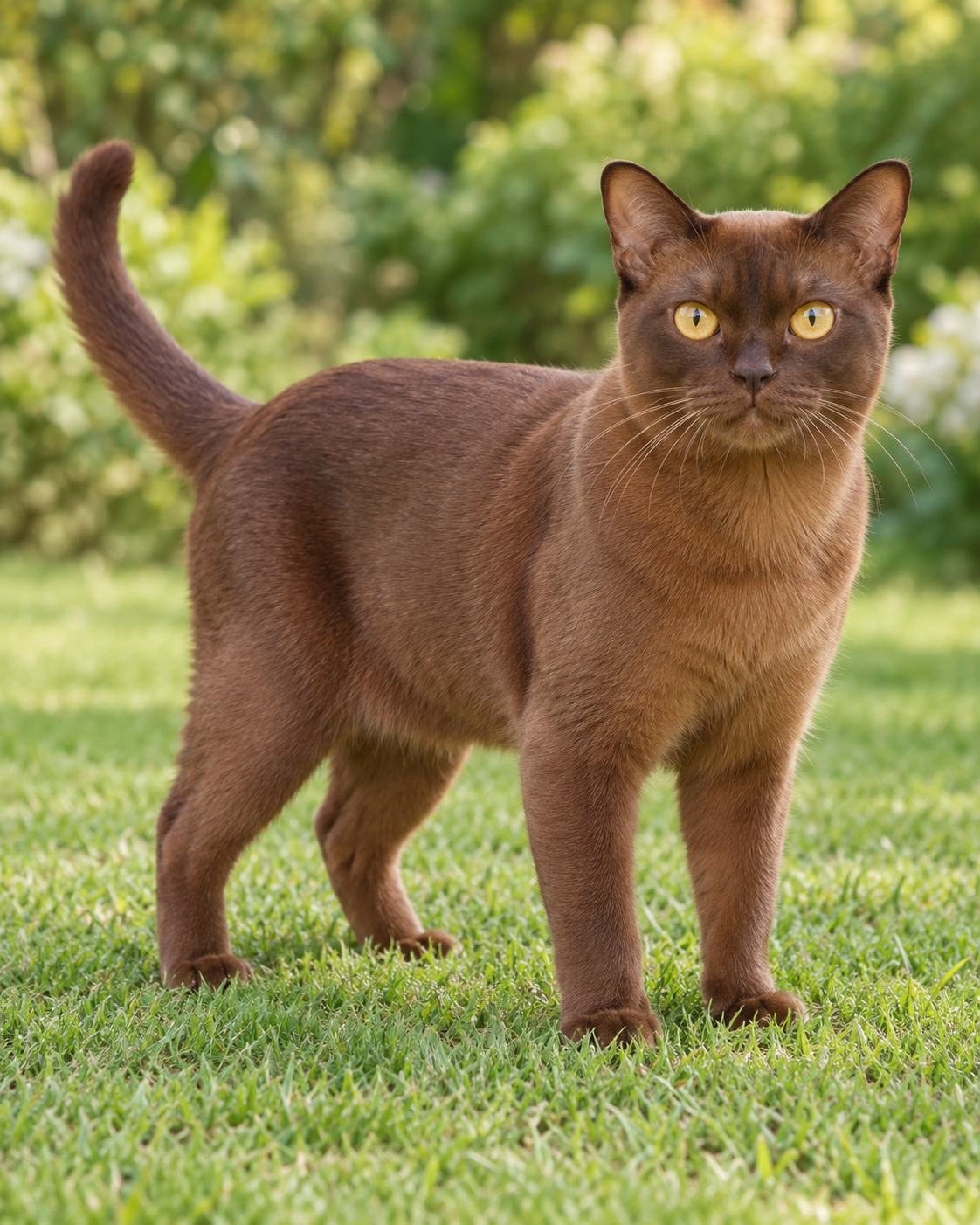
Wong Mau arrived in America in 1930 and contributed to breed development with Siamese cats. CFA registration began in 1936 and championship recognition followed in 1959.
More about this breed’s history
The first British breeding records
Burmese bred in the United States reached Britain in 1949. Among the early imports were Casa Gatos Da Foong, a male, and Chindwin’s Minou Twm, a female already carrying kittens sired by a different male in America. Minou lost that litter in quarantine. She later produced three litters with Da Foong. Britain’s Governing Council of the Cat Fancy recognized the Burmese in 1952, and the British Burmese Cat Club formed in 1954. CFA later registered the European Burmese separately, a distinction that matters when tracing descendants of those imports. (Burmese Cat Club: History of Burmese; Governing Council of the Cat Fancy: Burmese history; Cat Fanciers’ Association: European Burmese)
Full breed details
A stocky, muscular, shorthaired cat that is affectionate and strongly interested in human company.
- Adult build
- Medium; stocky and muscular
References & editorial notes
Adult-weight sources
Female: 6–9 lb; Male: 11–14 lb
direct: GCCF explicitly gives female 6-9 lb and male 11-14 lb; European Burmese is retained as its own separate site entry. Burmese-language search completed; cited weight text is English.
- Using Positive Reinforcement to Train and Support Your Cat
- Making the Commitment to Adopt a Cat
- How to Feed a Cat
- Introducing a New Cat Into Your Home
- Meeting the Physical and Emotional Needs of Indoor Cats
- Burmese Head Defect
- Burmese Hypokalemia
- Burmese
- CFA 2026–2027 Breed Standards
- Recognised breeds
- Standing Rules Version C, 3 June 2026, section 701.4.1
- Burmese
- Using Positive Reinforcement to Train and Support Your Cat Checked 2026-10-20.
- Making the Commitment to Adopt a Cat Checked 2026-10-20.
- How to Feed a Cat Checked 2026-10-20.
- Introducing a New Cat Into Your Home Checked 2026-10-20.
- Meeting the Physical and Emotional Needs of Indoor Cats Checked 2026-10-20.
- Burmese Head Defect Checked 2026-10-20.
- Burmese Hypokalemia Checked 2026-10-20.
- Burmese Checked 2026-10-20.
- CFA 2026–2027 Breed Standards Checked 2026-10-20.
- Recognised breeds Checked 2026-10-20.
- Standing Rules Version C, 3 June 2026, section 701.4.1 Checked 2026-10-20.
- Burmese Checked 2026-10-20.
Breeders & rescues
Questions to bring
- Are the reports specific to inherited hypokalemia and ALX1 head defect, and which lineage do they concern?
- Can the current caregiver demonstrate this individual’s usual grooming and play routine?
- How does this cat signal that it wants to end contact or rest alone?