Burmese cat toys
Choose Burmese cat toys around carrying, chasing and shared play, with practical fetch steps and realistic expectations for the individual cat.
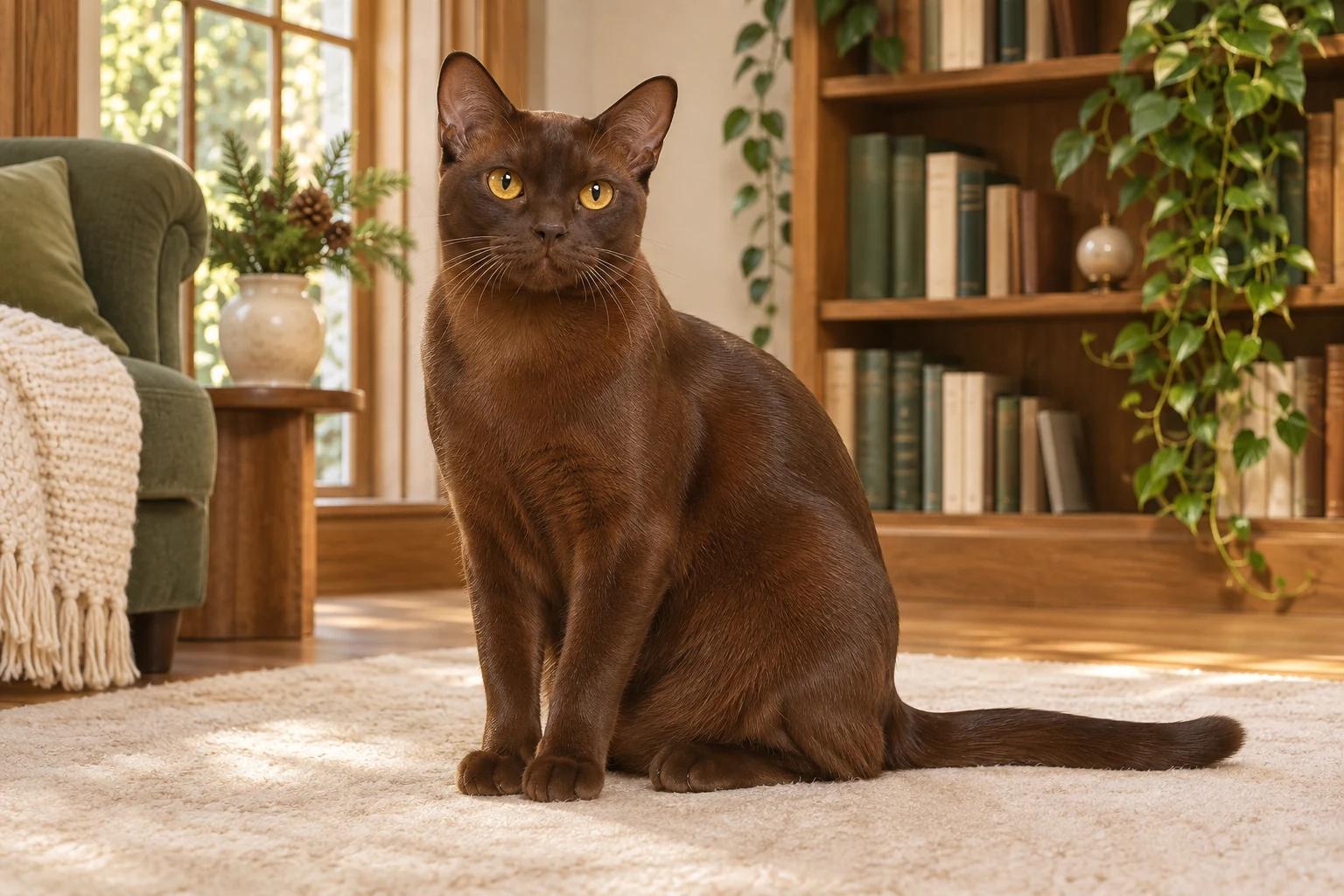
Burmese cat toys are easier to choose when the question is what this cat does with an object, rather than how many products belong in the basket. The Burmese profile introduces everyday ownership. Here, the focus is the physical game: an object can be carried, chased or returned, and those actions need not all happen together.
Burmese cat toys can become familiar play partners
The Burmese Cat Association describes cats becoming attached to favorite toys and carrying them to people to invite participation. It also notes retrieving among the breed's playful behaviors. That is a useful reason to notice an existing favorite before replacing it with something that looks more impressive to a human.
A familiar carried toy tells you something specific: this object already fits into the cat's own play. If the Burmese approaches with it, your participation may matter more than adding another item to the floor. Give that invitation attention instead of assuming the animal is merely moving its possessions around.
This does not make every Burmese a reliable retriever. It gives you a starting point for shared play with a cat that already carries things. The useful question is whether the individual wants you involved with that particular object. A toy chosen voluntarily by the cat can reveal more than a package describing what a breed is supposed to enjoy.
Fetching is a sequence, not simply a chase
A study from Purdue and Penn researchers found Burmese among the breeds more likely than expected to fetch in owner-reported survey data. The researchers distinguish carrying an object, bringing it to a person and retrieving something that was thrown. Those behaviors overlap, but they are not identical.
For Burmese cat indoor play, that distinction prevents an unnecessary sense of failure. Your cat may chase a toy and keep it, or bring you an object without first having chased it. Describing the actual action is more useful than declaring the game unsuccessful because it lacks a complete return.
The research is not a promise about an individual Burmese cat activity level. It describes patterns in survey responses, not a test that every animal must pass. Treat fetching as one possible game rather than proof of intelligence or the only worthwhile exercise. The presence of a breed association is a reason to explore an opportunity, not to keep demanding a response from an uninterested cat.
Build the return in small, rewarded steps
VCA's fetch lesson begins by rewarding a cat for picking up a toy rolled a short distance away. Once that happens reliably, the next step is calling the cat back and rewarding the return. Greater throwing distance comes later; dropping the toy into a waiting hand is another separate step.
This gives an owner wondering how to exercise a Burmese cat a concrete alternative to throwing farther and hoping for more. Work with the piece of the sequence the cat can already perform. If it picks up the toy but does not return, the lesson has not yet reached the same point as a completed retrieve.
VCA recommends positive reinforcement and specifically rejects punishment when a cat wanders away with the toy. Smaller steps may be necessary, such as rewarding a look toward you after the pickup. Keep the distinction between invitation and demand: a play session is not improved by making the cat afraid to keep an object or leave the interaction.
Secure the play area rather than relying on curiosity
The Burmese Cat Club's kitten guide identifies open windows, appliance doors, unprotected heat sources and exposed electrical flexes among household hazards. It also describes enclosed outdoor runs or balconies as an alternative to unrestricted access. These are practical boundaries around play, not a claim that an adventurous cat will understand a human danger label.
Before a floor game, look beyond the toy itself. A rolling object can lead the cat toward an opening or an appliance that was harmless while closed. The route matters as much as the patch of floor where the game begins. Close access to unsafe spaces rather than expecting a Burmese to stop investigating at the point you consider inconvenient.
Where outdoor space is available, distinguish an actual secure enclosure from a balcony with an ordinary open edge. A view of the outdoors does not make the space contained. The club's guidance is particularly useful for owners tempted to interpret an inquisitive kitten's confidence as evidence that unrestricted exploration will be safe.
Adult scale is not a toy-size formula
The current Burmese adult references are 6–9 pounds for females and 11–14 pounds for males. A kitten may be substantially smaller than either adult reference. Those figures help picture the animal that will eventually use the room, but they do not provide a mouth measurement, a paw width or a universal toy diameter.
An item described as suitable for a medium cat still needs to be suitable for your actual animal and used as its manufacturer intends. The word medium is not a standardized measurement of every opening, attachment or moving component. Likewise, a photograph showing another Burmese beside an item supplies no reliable scale unless dimensions are stated.
Do not buy according to the largest adult figure and assume that settles suitability for a youngster. Age, present dimensions and the specific object are separate pieces of information. If a product's instructions do not make its intended use clear, a breed label does not fill the gap.
The Burmese workday-routine article covers changes to time away; it is a different question from selecting a game. Use the cat quiz for broader ownership preferences.
FAQ
Does a fourteen-pound adult reference specify toy dimensions?
A fourteen-pound Burmese adult reference does not supply the measurements of an individual cat's mouth or paws, or establish the suitability of a particular product.
Should a kitten be treated as an adult for equipment choices?
Choose Burmese kitten equipment by present age, dimensions and the item’s intended use, rather than substituting an adult breed endpoint.
Is a photograph enough to establish an object's size?
A Burmese toy photograph cannot establish the object’s size: camera distance and framing change apparent scale. Actual dimensions are more informative than the breed of the cat pictured beside it.
Sources behind this article
- Burmese Cat Association ↗
- Purdue and Penn fetching research ↗
- VCA teaching fetch ↗
- Burmese Cat Club kitten guide ↗
Article source checked: November 16, 2026. Source checked 2026-11-16
Keep reading

American Curl exercise
Read article →