Burmese cat temperament
Understand Burmese cat temperament through companionship, familiar sounds, kneading and subtle eye movements.
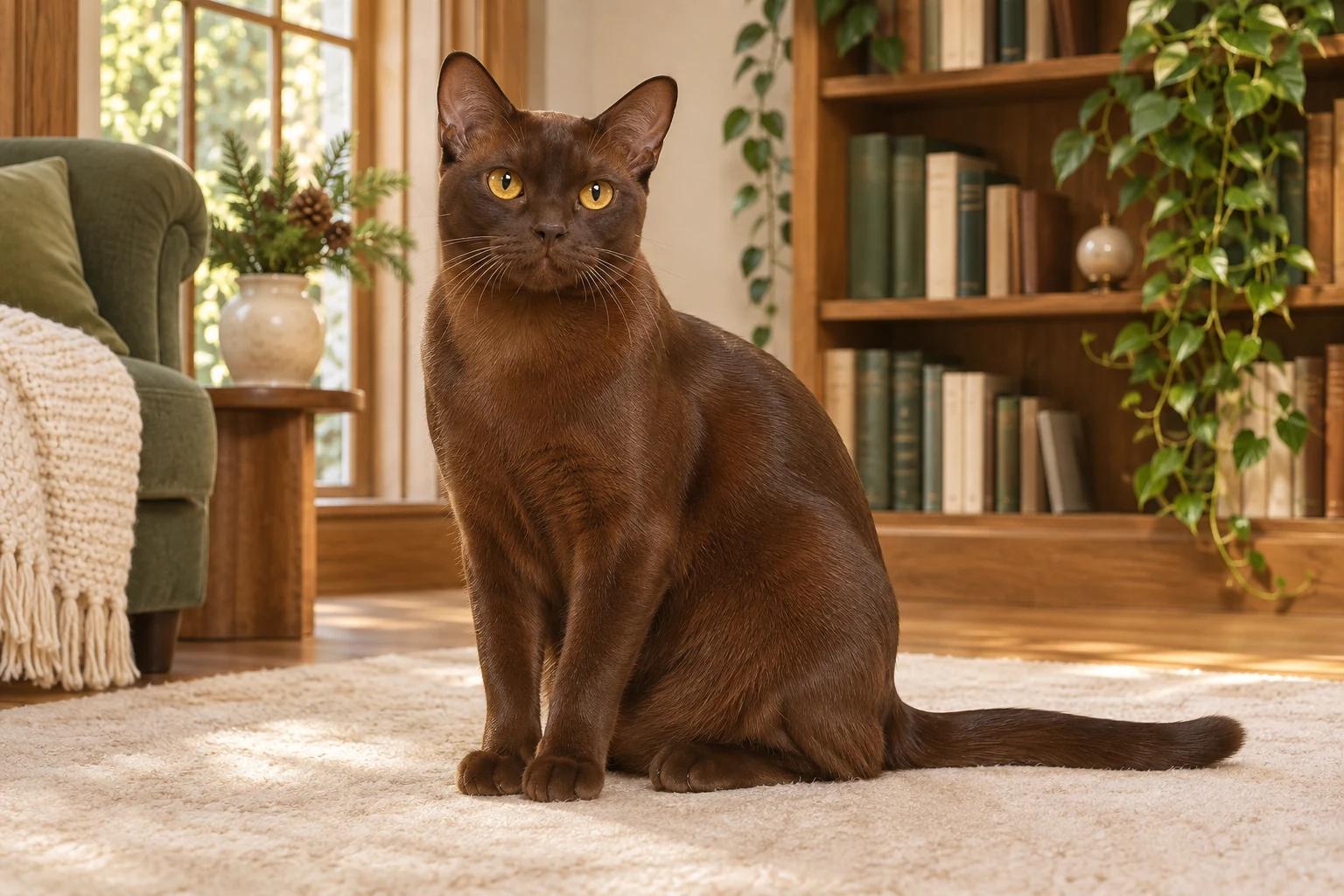
Burmese cat temperament is best understood through the individual you live with, not a numerical personality score. The Burmese profile supplies the breed overview. Everyday encounters add detail that a label cannot: what happened, where it happened and who was present.
Burmese cat temperament often brings people into the picture
The National Alliance of Burmese Breeders describes a companion that seeks close physical contact and may follow a person from room to room. Its account also describes playful antics performed with an apparent interest in whether the human is watching. That suggests involvement, not simply the presence of a warm place to sleep.
If this is what attracts you to Burmese cat personality, picture company as an interaction rather than an ornament on the sofa. A cat that accompanies you between rooms may want to be part of the activity, while another encounter may involve settling nearby. The breed description offers possibilities, not an appointment schedule for cuddling.
The practical appeal is a shared household life. It should not become a demand that your cat demonstrate affection whenever you have a free moment. An individual relationship develops through the encounters you actually have, rather than by measuring how closely every scene resembles an enthusiastic breed description. Neither a photograph nor a testimonial can provide that relationship in advance.
Kneading has a kittenhood connection, but no simple adult translation
Cats Protection explains kneading as repetitive pressing of the forepaws into a soft surface. Nursing kittens use the action to stimulate milk flow. Some cats continue it into adulthood, although the reason for that continuation is not established with certainty.
For an owner interpreting Burmese cat behavior, this is a useful distinction between seeing an action and knowing its entire meaning. An adult pressing its paws into a blanket is not necessarily asking you to supply milk. Nor is the action proof of one particular story about its early life.
The charity discusses several possible explanations, including pleasurable associations or an automatic response to a texture, without presenting them as settled facts. Keep that same restraint when describing your own cat. You can recognize the alternating paw movement and the surface involved without turning it into a diagnosis or a universal declaration of emotion. A familiar behavior can be worth understanding even when science has not assigned it one definitive adult purpose.
A familiar sound is not the same as every sound
The Merck Veterinary Manual's explanation of learning describes habituation: a response can decrease as a cat becomes accustomed to a repeated stimulus. It also makes an important qualification: becoming accustomed to one sound does not automatically make a cat accustomed to other sounds.
That helps explain why a Burmese may ignore the ordinary traffic outside its window yet respond to a different noise. The second event does not necessarily contradict everything you thought you knew about the animal. Familiarity is specific, not a single personality setting that applies to the entire world.
The manual also notes that a response may return after a long interval without the familiar event. This is an explanation of learning, not a recommendation to overwhelm a cat with noise until it stops reacting. Do not turn confidence into a challenge the animal must endure. For a behavior concern, ask your veterinarian for individual guidance instead of attempting a treatment program from a breed description or insisting that repeated exposure must always solve it.
A small eye movement can be part of an exchange
Research from Sussex and Portsmouth examined slow-blink interactions between cats and people. Cats produced more eye narrowing in response to a person's slow blinking, and in a second experiment were more inclined to approach an unfamiliar experimenter's offered hand after that interaction than after a neutral expression.
These results suggest a possible positive communication role; they do not translate every blink into a fixed sentence. The work examined cats generally, not a special Burmese-only signal. For a Burmese owner, its value is noticing that interaction can include a subtle facial movement rather than only an obvious approach or a loud sound.
A slow-blink sequence is also not simply the routine blink that moistens an eye. The researchers distinguished partial eyelid movements and sustained narrowing from ordinary reflexive blinking. Observe without turning the exchange into a staring contest or a demand for a particular response. The study's home-based sessions allowed for cats walking away, an important reminder that participating in an encounter and being compelled to remain are different things.
Read the description at the right level
Burmese cat characteristics include physical references as well as behavioral descriptions. Current adult weight ranges are 6–9 pounds for females and 11–14 pounds for males. Those sex-qualified figures describe scale; they do not tell you which person an adult recognizes or which household it has lived in.
Keep a specific account specific. “This cat has lived here for four years” says something about its history. “This cat weighed eight pounds at its last measurement” says something different. Combining the statements does not create an eight-pound personality type. The same caution applies when comparing an adult you know well with a newly encountered kitten: age and acquaintance are part of the comparison, not details to erase.
The Burmese workday-routine guide addresses changing time away. For broader preferences, the cat quiz helps organize what you want from ownership without substituting for meeting an individual.
FAQ
Does a female's adult weight range describe her personality?
A Burmese female’s adult range of six to nine pounds is a physical reference, not a temperament category or a prediction about a particular relationship.
Can an account of a kitten stand in for an adult's history?
A Burmese kitten account cannot replace an adult’s history. State its age and setting rather than treating observations from different life stages as interchangeable.
Is a numerical breed score an individual assessment?
A numerical Burmese breed score cannot describe the specific animal's experiences, present setting or relationship with you.
Sources behind this article
- National Alliance of Burmese Breeders ↗
- Cats Protection kneading ↗
- Merck Veterinary Manual learning ↗
- Sussex and Portsmouth communication research ↗
Article source checked: November 16, 2026. Source checked 2026-11-16
Keep reading

American Bobtail cat temperament
Read article →