Burmese vs Tonkinese
Compare Burmese vs Tonkinese through current adult weights, Tonkinese patterns, shared history and practical differences in everyday interaction.
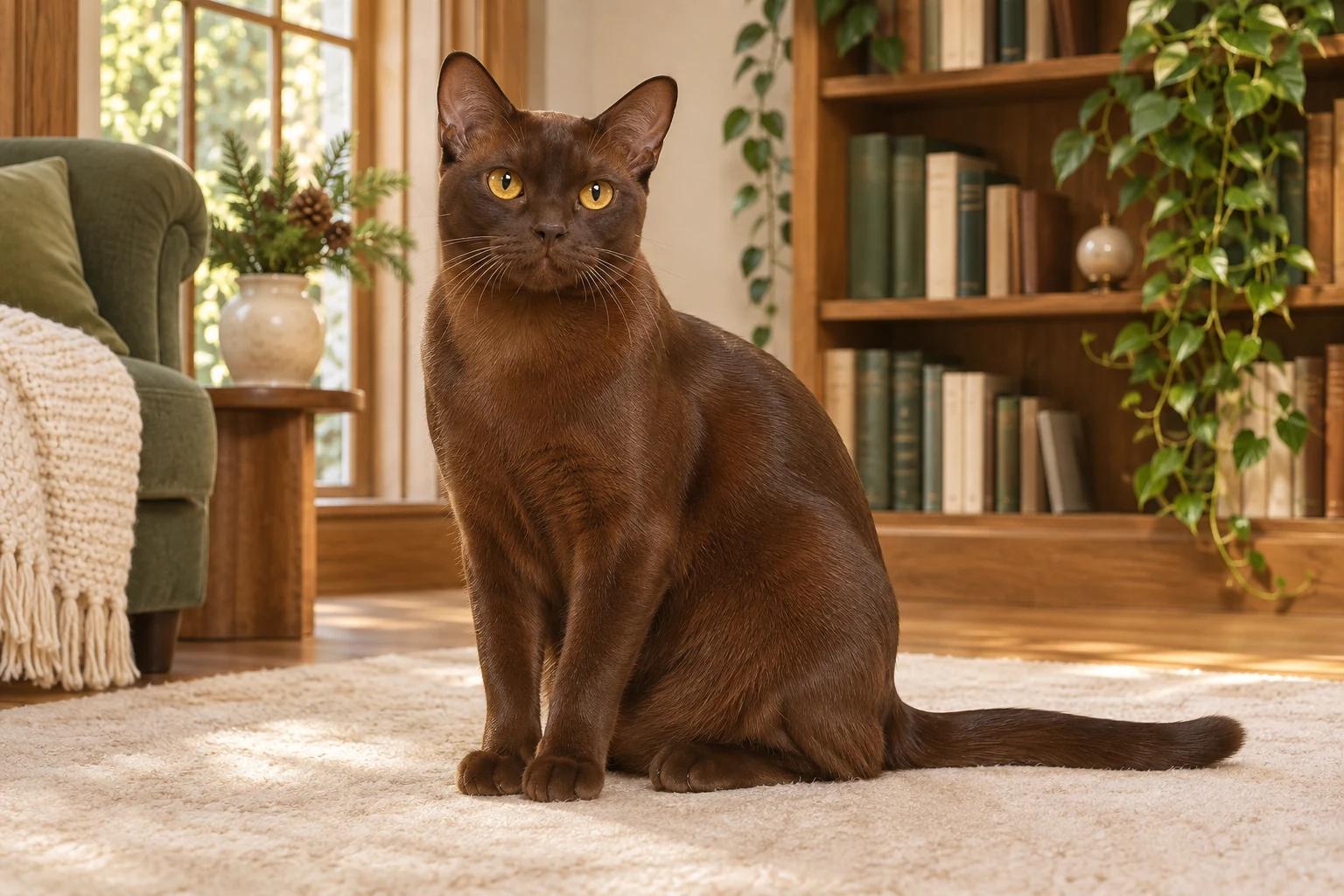
Burmese vs Tonkinese is not a choice between two names for the same cat. Start with the current Burmese profile and Tonkinese profile, then separate adult measurements from breed identity. The ranges overlap, so neither a scale reading nor an attractive photograph can settle the comparison alone. Sex-qualified figures make a more useful starting point than a single supposed average.
Burmese vs Tonkinese adult weights
Current adult references are 6–9 pounds for female Burmese and 11–14 pounds for males, compared with 6–8 pounds for female Tonkinese and 8–12 pounds for males. These figures describe reference ranges, not a requirement that every individual reach an endpoint.
The female ranges overlap from six to eight pounds. The male ranges overlap from eleven to twelve. A twelve-pound adult male therefore fits both published male ranges; knowing that number alone does not identify his breed. Conversely, comparing a fourteen-pound male Burmese with a six-pound female Tonkinese exaggerates the difference by choosing opposite sexes and opposite ends of the references.
For someone deciding between Burmese or Tonkinese, this matters when picturing the actual adult rather than a kitten. Ask for the individual's current measurement and age, and distinguish those from the breed reference. Do not turn the upper endpoint into a feeding goal. Questions about an individual cat's appropriate weight belong with its veterinarian.
The Tonkinese outline is a deliberate middle ground
The CFA Tonkinese description places its body between a compact, cobby outline and a long, slender one. It describes a muscular medium-sized cat with a modified wedge head, a rounded muzzle and open almond-shaped eyes. Ears have broad bases and oval tips, sitting partly toward the sides of the head rather than entirely on top.
Those details help explain why a Tonkinese should not be judged simply as a Burmese with different coloring. Look at the relationship between head, muzzle and ears as well as the overall silhouette. A close-up of the eyes can be beautiful while hiding most of the structure that distinguishes the animal.
The standard also emphasizes balance and proportion over size alone. That is a useful distinction when two adults have similar weights: equal pounds do not require equal outlines. A standing view and a clear face view answer different visual questions. Neither needs to become a search for the largest possible representative of the breed.
Related history does not erase separate identities
GCCF's Burmese history describes Wong Mau's arrival in the United States in 1930 and the breeding work that followed. Matings with a Siamese, and subsequently within the resulting family, produced kittens with different appearances; dark-coated descendants helped establish the Burmese breed. The account identifies Wong Mau with what would now be called a Tonkinese.
For a prospective owner, the important point is shared ancestry rather than a claim that the names remain interchangeable. Historical foundation animals and today's established breeds answer different questions. A description of an early breeding program is not a way to identify an undocumented cat by color.
Keep this distinction when reading advertisements or family histories. A stated ancestor explains a relationship; it does not by itself supply a modern registration identity. Likewise, resemblance to a historical photograph does not establish a pedigree. The difference between Burmese and Tonkinese includes how breeders developed and maintained their respective identities, not merely which name sounds more familiar to a buyer.
Tonkinese pattern names describe contrast, not another breed
GCCF explains three Tonkinese color-restriction patterns. Burmese Colour Restriction has a comparatively even distribution, Tonkinese Colour Restriction blends darker extremities more gradually into the body, and the colourpointed pattern has a more clearly contrasting body and points. These are recognized pattern descriptions within Tonkinese, not instructions to rename each cat after a different breed.
This is especially useful when a Tonkinese looks darker overall than the example that first attracted you. One familiar photograph does not represent every pattern. Read the full description attached to the animal rather than assuming that a darker body excludes Tonkinese identity.
The registry also distinguishes pattern from the underlying color and other markings. In practice, asking only whether a cat is brown or blue leaves out part of the description. A color word and a contrast-pattern word perform different jobs. Understanding that vocabulary makes photographs easier to interpret without relying on a simplistic rule that every Tonkinese must have the same appearance.
Interaction is more informative than an activity ranking
TICA describes Tonkinese as interested in people, conversation and games, including climbing, puzzles and interactive play. Its account allows for both active periods and sitting with a person. These are not mutually exclusive ways to spend a day.
When considering a Tonkinese, picture an actual interaction rather than a generic promise of an entertaining pet. A puzzle asks the animal to work out a task; a shared game involves your participation; reaching a high place is another kind of activity. Buying one object does not automatically provide all three experiences.
Nor does an account of lap companionship mean that play can be omitted. The attraction may be the combination: a cat that takes part in household activity and also seeks contact. Ask which of those activities the particular animal already enjoys. That gives the description practical meaning without declaring Tonkinese universally busier, cleverer or more affectionate than Burmese.
For broader ownership priorities, use the cat quiz. The separate Burmese workday-routine guide addresses changing absences rather than trying to rank the two breeds.
FAQ
Can a twelve-pound male belong to either reference range?
A twelve-pound adult male fits both Burmese and Tonkinese weight references; that measurement alone cannot distinguish the breeds.
Does tonkinese vs burmese mean comparing females with males?
Compare Burmese and Tonkinese females with females and males with males; choosing opposite extremes creates a misleading picture of the difference.
Is a kitten's present weight an adult prediction?
A Burmese or Tonkinese kitten’s present weight is not an adult prediction. Keep its age and current weight separate from adult references rather than treating a kitten measurement as a finished adult size.
Sources behind this article
Article source checked: November 16, 2026. Source checked 2026-11-16
Keep reading

Abyssinian vs Somali: Coat, Size and Everyday Company
Read article →