Cat breed · Kentucky, United States
Bombay: Daily care
Daily care
Play & enrichment
Interest in games, puzzles and learning. Try an accessible puzzle and observe the response before making the challenge harder.
More about everyday care
Provide places to retreat, separated resources, chances to play and predictable interaction. These are feline needs, not breed compatibility scores.
Coat, grooming & daily care
Using a rubber brush two or three times a month.
Training & communication
Reward a behavior the cat chooses with something it values. Build tasks in small steps, including approaching a carrier or a grooming tool. Stop when the cat is frightened, unwell or in pain; ask your veterinarian about cooperative care.
Food, routine & costs
The everyday ownership plan
Planning for this breed
Schedule the coat care described by CFA and ask for the cat’s normal daily routine. Confirm registry identity rather than assuming every black cat or every population called Bombay shares the same history.
Meals and body condition
Discuss portions and body condition with your veterinarian instead of using the registry weight range as a feeding target. Smaller meals and appropriate food puzzles can support natural feeding behavior. Give each cat a separate feeding station.
Time and costs
Before committing, budget for food, litter, equipment and continuing veterinary care. Agree who handles play, cleaning, grooming and care during absences. Obtain local estimates for the individual’s care instead of relying on an invented breed cost.
More practical reading
Rescues & sheltersPrint or citeBreed articles
Other profile sections and family fact sheet
Life with a Bombay
The affectionate, playful description supports planning time together.
Explore home life →Interest in games, puzzles and learning.
Explore daily care →Using a rubber brush two or three times a month.
Explore daily care →Print or cite this breed
Bombay family fact sheet
Breed-level references are a starting point. Ask about the individual animal’s routine and care needs.
- Build
- Medium
- Female
- 6–9 lb
- Male
- 8–11 lb
- Reference lifespan
- 12+ years
- Adult size
- Adult weight often falls around 6 to 11 pounds.
Company
The affectionate, playful description supports planning time together. Ask how the individual handles visitors and quiet periods; no breed description guarantees compatibility.
Play & enrichment
Interest in games, puzzles and learning. Try an accessible puzzle and observe the response before making the challenge harder.
Coat care
Using a rubber brush two or three times a month.
Everyday responsibilities
Plan food, supplies, routine care and veterinary visits. Agree who handles the everyday jobs and who covers absences.
Adult help
An adult should remain responsible for care, supervise children’s interactions and arrange help when needed.
My Breed Atlas. Bombay breed profile. https://mybreedatlas.com/cats/breeds/bombay
Read this profile’s sources →Adult ranges and source qualifications
- Build
- Medium
- Female
- 6–9 lb
- Male
- 8–11 lb
- Reference lifespan
- 12+ years
Reference ranges describe the breed, not a prediction for an individual.
Home life
Temperament & companionship
The affectionate, playful description supports planning time together. Ask how the individual handles visitors and quiet periods; no breed description guarantees compatibility.
Home life & introductions
Prepare a quiet transition room with food, water, litter, hiding places and scratching options. Introduce resident cats gradually and proceed when both are comfortable. Breed reputation cannot establish compatibility with children, dogs or another cat.
Offer a quiet retreat and let the cat control its distance. Supervise children and introduce resident animals gradually; individual history matters more than a breed reputation.
Personality & care details
Personality & care profile
Breed tendencies vary by individual. Higher means more of the named tendency, not better.
What everyday life tends to involve
These notes describe a tendency for the breed. Every animal is an individual.
- Play
- Several play sessions through the day fit this cat.
- Coat care
- Once a week or less is usually enough brushing.
- Bathing and skin care
- Some cats of this breed need a bath or skin care now and then. It is not a set schedule for every cat.
- Loose hair
- A little loose hair shows up here and there.
- Company
- Long stretches alone are a poor fit. They want company nearby.
- Adult size
- Adult weight often falls around 6 to 11 pounds.
- Time alone
- Long stretches alone are a poor fit. They want company nearby.
- Health note
- Hand grooming or a rubber brush is the coat plan. Baths are not the ordinary routine.
YOUR EVERYDAY LIFE
How could this breed fit your life?
See household examples or compare this breed with answers you chose to save. The examples show combinations where this breed appeared among the first five results. Other combinations can work too.
Saved matching preferences stay in this browser, never on your account. They expire after 30 days and are removed the next time this feature reads them. Health answers, children’s ages and free-text notes are not saved. This section does not reproduce those personal care notes.
Bombay health
Health observations and family records
Clinical low-potassium episodes and WNK4 findings have been reported in Bombays. The submitted laboratory data include a cluster from one cattery, so they cannot estimate the chance of illness in an unrelated Bombay family.
Tell the clinic about an episode of weakness
Describe any unusual trouble walking normally or holding the head up, including whether it eased. Such changes need veterinary assessment; neither the breed name nor a WNK4 report establishes the cause of an episode or the cat’s current potassium level. Episodes of muscle weakness with low potassium have been reported in Bombay cats. They are not a diagnosis for every spell. After a confirmed diagnosis, ask the vet which blood tests need repeating and which changes in appetite or strength to report. Keep food, water and a low-entry litter tray close by while your cat is weak. Never give potassium on your own. Go to an emergency vet now if your cat suddenly cannot stand or walk, collapses or is struggling to breathe.
Family history and screening
Ask whether a relative’s weakness had a clinical explanation and request the actual WNK4 report if one exists. Keep submitted genetic status separate from examination or laboratory findings made during illness.
Questions for your veterinarian
- Was low potassium documented during the relative’s illness?
- Which individual and genetic category does this report identify?
Choosing a kitten? Ask to see both parents’ results, with the animal’s name and the date on each report. If you’re adopting an adult, ask which records come with that individual.
Health sources
- review with original submitted laboratory sample dataset, Table 1
- UC Davis veterinary genetics lab test documentation
- Evidence exact_report_and_test_set
- Evidence variant_mechanism_not_bombay_clinical
- Evidence emergency_only
- Evidence emergency_only
Screening evidence and limits
UC Davis includes Bombay in the appropriate-breed lists for Burmese hypokalemia and head-defect testing. These are specific inherited conditions; head-defect testing is not a test for midline defect. Ask a veterinarian to interpret dated reports in the context of family history.
History & sources
Heritage & appearance
Meet the Bombay
Adult ranges are reference examples, not targets or predictions for an individual cat.
Heritage & appearance
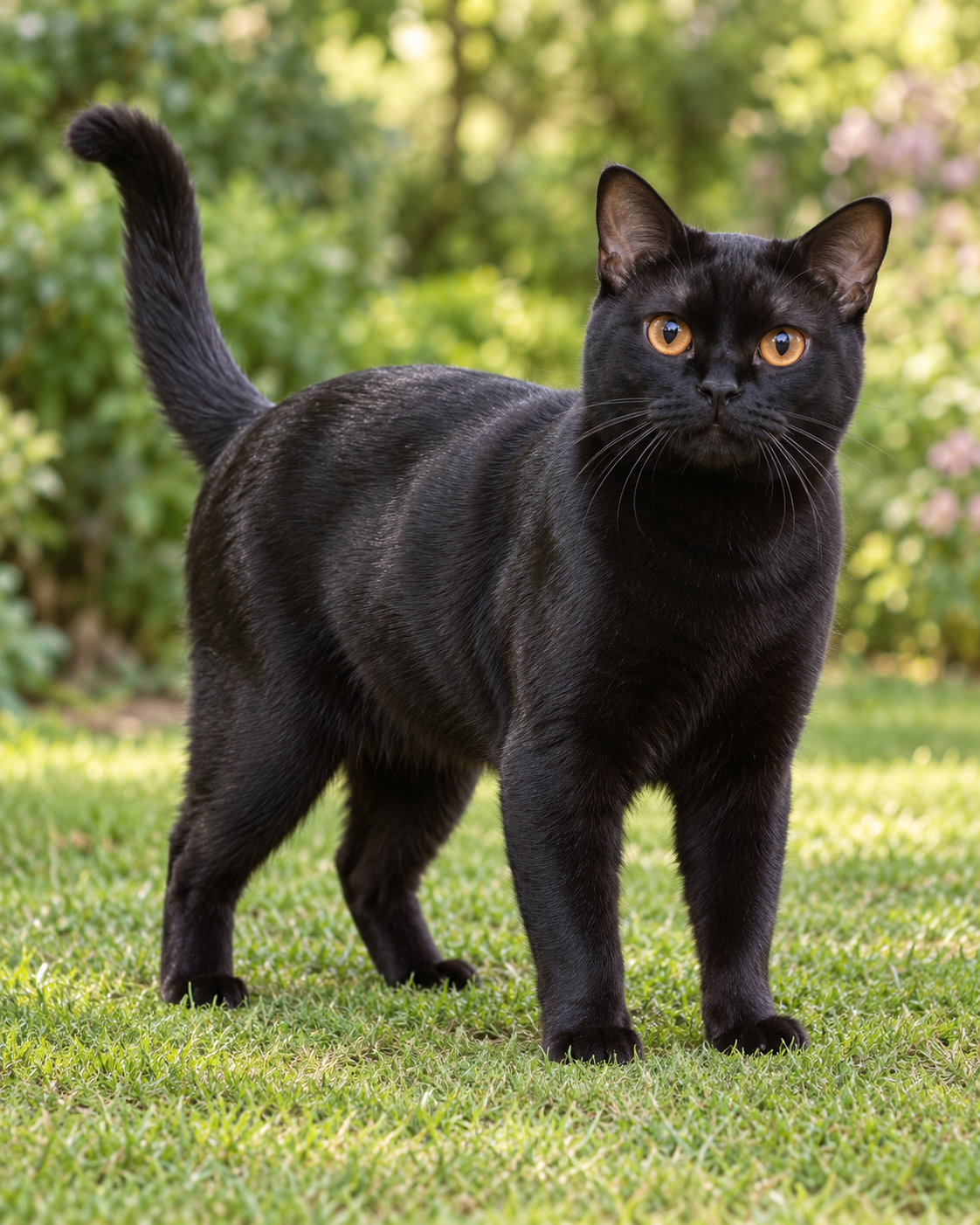
Nikki Horner developed the breed in Kentucky using American Shorthair and Burmese cats. CFA registration began in 1970 and championship recognition in 1976. It is a domestic breed, not a wild-cat hybrid.
More about this breed’s history
The American breed and the British use of Bombay
In the US breed, the combination Horner sought was more specific than a black coat. CFA’s judges’ presentation describes a 1996 revision emphasizing a head profile distinct from both the Burmese and the American Shorthair. In Britain, the Governing Council of the Cat Fancy uses Bombay for the solid-black variety in its Asian group. It traces the group to a separate mating between Sanquist, a Chinchilla Persian, and Faberge, a lilac Burmese. That is the history behind the British classification, separate from Horner’s Kentucky program. (Cat Fanciers’ Association: Bombay judges’ presentation; Governing Council of the Cat Fancy: Asian group)
Full breed details
A muscular, shorthaired black cat with gold-to-copper eyes. A playful, affectionate companion.
- Adult build
- Medium; solid, muscular body and short black coat.
References & editorial notes
Adult-weight sources
Female: 6–9 lb; Male: 8–11 lb
direct: veterinary nutrition breed profile explicitly lists female 6-9 lb and male 8-11 lb; registry standards checked for numerical intervals.
- Using Positive Reinforcement to Train and Support Your Cat
- Making the Commitment to Adopt a Cat
- How to Feed a Cat
- Introducing a New Cat Into Your Home
- Meeting the Physical and Emotional Needs of Indoor Cats
- Burmese Head Defect
- Burmese Hypokalemia
- Bombay
- CFA 2026–2027 Breed Standards
- Recognised breeds
- Standing Rules Version C, 3 June 2026, section 701.4.1
- Bombay
- Using Positive Reinforcement to Train and Support Your Cat Checked 2026-10-20.
- Making the Commitment to Adopt a Cat Checked 2026-10-20.
- How to Feed a Cat Checked 2026-10-20.
- Introducing a New Cat Into Your Home Checked 2026-10-20.
- Meeting the Physical and Emotional Needs of Indoor Cats Checked 2026-10-20.
- Burmese Head Defect Checked 2026-10-20.
- Burmese Hypokalemia Checked 2026-10-20.
- Bombay Checked 2026-10-20.
- CFA 2026–2027 Breed Standards Checked 2026-10-20.
- Recognised breeds Checked 2026-10-20.
- Standing Rules Version C, 3 June 2026, section 701.4.1 Checked 2026-10-20.
- Bombay Checked 2026-10-20.
Breeders & rescues
Questions to bring
- Do health reports distinguish Burmese head defect from other craniofacial conditions?
- Can the current caregiver demonstrate this individual’s usual grooming and play routine?
- How does this cat signal that it wants to end contact or rest alone?