Burmilla cat size: adult weight, proportions and growth
Burmilla cat size explained: the current adult weight range, body proportions, coat effects and the difference between growth and a scale reading.
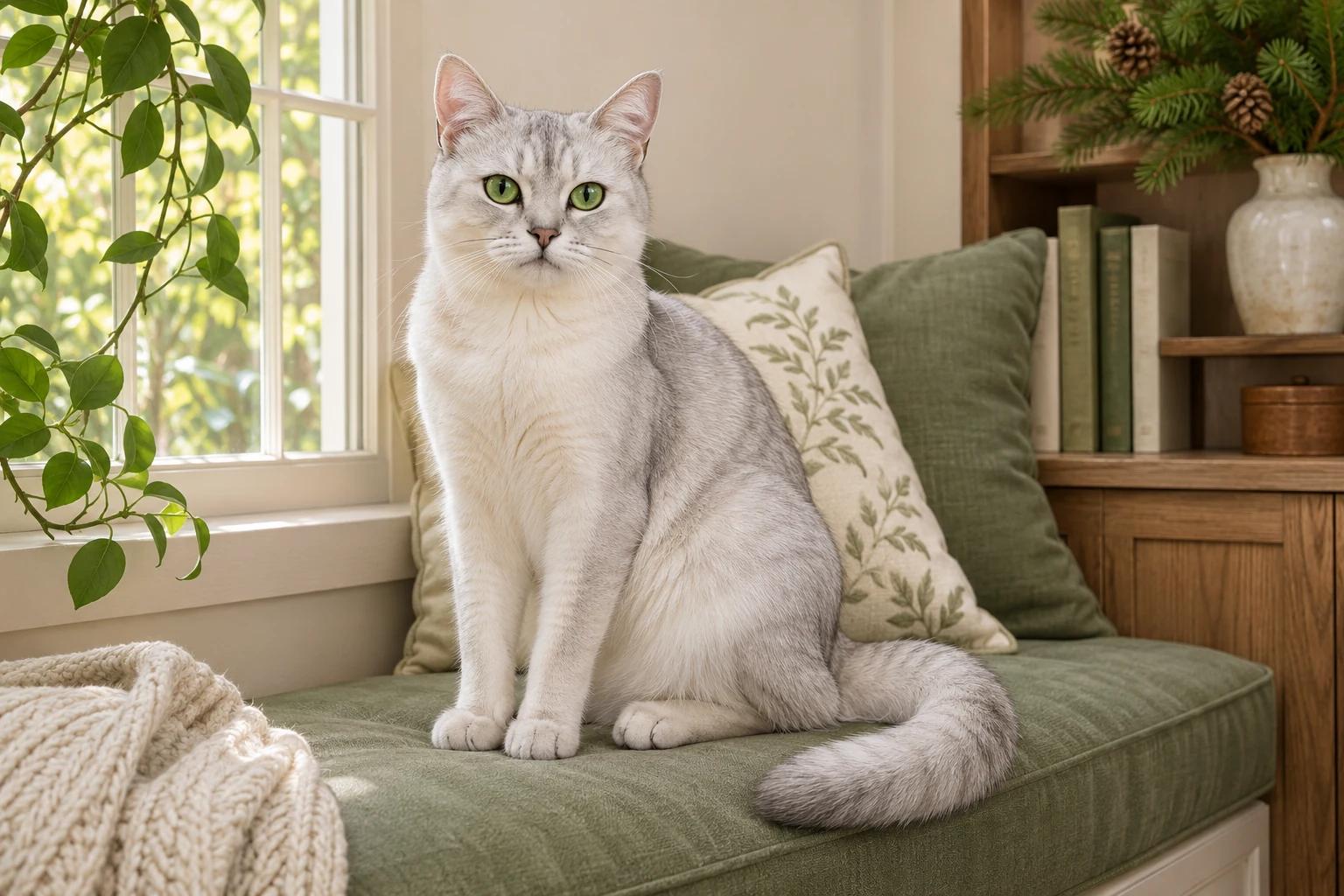
Burmilla cat size is described as medium, with a current adult reference weight of 9–11 pounds on the Burmilla breed profile. That is approximately 4.1–5.0 kilograms. The range is not separated into male and female figures, and it should not be divided into an invented sex-specific chart.
Burmilla cat size: what the adult range tells you
The useful starting point is an adult cat around ten pounds, not a miniature cat and not an assumed giant. Ten pounds is simply the midpoint of the displayed interval, not a measured breed average. The two-pound span is a reminder that the breed reference already allows variation; it does not mean that every kitten should finish at the same number.
Burmilla cat weight also needs its units attached. A record of “4.5” means something very different in kilograms than in pounds. At approximately 9.9 pounds, 4.5 kilograms falls within the current adult reference. This straightforward conversion is particularly useful when comparing a veterinary record with a profile written for readers using another unit system.
Keep the range separate from the actual animal. An adult's measured weight is information about that cat on that occasion. The breed range is background. For questions about an individual cat's appropriate weight, ask its veterinarian rather than treating either end of the interval as a target to reach.
Look at chest, limbs and tail together
TICA's Burmilla standard describes a medium-length torso with a rounded chest of moderate width, a straight back and firm musculature. The legs are proportionate, with the hind legs slightly longer than the forelegs; the feet are medium and oval. The tail extends from a medium-thickness base and narrows toward a rounded end.
This is a description of balance, not a request to maximize bulk. Looking only at the chest misses the relationship between torso and limbs. Looking only at the tail can also exaggerate the impression of overall length, because tail length and trunk length are different dimensions.
The longhaired form adds another visual complication: hair around the lower body and a plumed tail alters the outline, while toe tufts can make the paws appear larger. Those furnishings are not additional bone. When two Burmillas look different in photographs, separate the visible coat outline from the underlying proportions before deciding that one has a much larger frame. Both coat forms belong within this breed's size discussion.
Growth happens in different structures at different times
A longitudinal veterinary study of feline skeletal development followed domestic shorthair cats using radiographs. It found that growth plates in different locations closed at different times. The fastest increases in the measured femur and pelvic dimensions occurred early, with the rate slowing later. These were not Burmillas, so the results do not establish a breed-specific finishing date.
The practical distinction is between gaining weight and completing skeletal development. A kitten looking almost adult does not prove that every bone has finished developing. Conversely, a slower visible change does not mean that development has stopped everywhere at once.
For a growing Burmilla, avoid the tempting shortcut of multiplying one kitten weight to announce its final adult size. That calculation leaves out the developmental stage and the individual trajectory. A veterinarian can interpret growth in context; an owner does not need to obtain radiographs simply to satisfy curiosity about future size. The research explains why “fully grown” is a biological question, not just a visual impression from a recent photograph.
Height needs a defined measuring point
Burmilla cat height is not supplied as a verified numeric range here. A study of shoulder-height estimation in domestic cats illustrates why dimensions need careful definitions: the investigators compared standing shoulder height with measurements of limb bones. They did not simply infer height from body weight.
The shoulder, sometimes called the withers, is a different endpoint from the tips of the ears. A number measured to the head cannot be compared directly with a shoulder-height number. Likewise, the length of a standing torso is not the same as the entire distance from nose to tail tip.
These distinctions matter when someone asks, “How big do Burmilla cats get?” Weight answers only one part of that question. If a particular dimension matters, describe the actual dimension rather than attaching an unspecified height to the breed. The study's European shorthaired cats are not a replacement Burmilla size chart, and its research equations are not a reason to attempt bone measurements at home.
Moving through a space is different from weighing it
In a study of cats passing through openings, cats approached tall, narrow openings differently from low ones. They showed more hesitation around the shortest openings, and taller cats were more likely to seek another route. The experiment concerned domestic cats generally, not a special Burmilla skill.
This provides a useful distinction between the width and height of an available passage. Two openings can have similar areas yet ask for different body movements. A tall slot and a low rectangle are not interchangeable merely because their measurements multiply to the same total.
For a Burmilla, an apparent willingness to investigate a gap is not proof that the gap is suitable. Do not recreate progressively smaller openings as a home challenge or push the cat through a confined space. Think instead about comfortable passage and an alternative route. The point of knowing body dimensions is to accommodate the animal, not to discover the tightest opening it can negotiate.
Coat handling is covered separately in Burmilla brushing and rewards. For broader ownership preferences, use the cat match quiz.
Frequently asked questions
How big do Burmilla cats get?
The current adult Burmilla reference is medium size and 9–11 pounds, approximately 4.1–5.0 kilograms. It is not a guarantee for every individual.
Is ten pounds the average Burmilla weight?
Ten pounds is the midpoint of the displayed Burmilla weight range, not a measured population average.
Does the current range give separate male and female weights?
The displayed Burmilla weight interval is unsexed. It should not be presented as two different male and female ranges.
Sources behind this article
- TICA Burmilla breed and linked standard ↗
- Miranda and colleagues: feline skeletal development ↗
- Poradowski and colleagues: feline shoulder height ↗
- Pongracz: cats and body-size awareness ↗
Article source checked: November 16, 2026. Source checked 2026-11-16
Keep reading
Burmilla cat temperament: company, curiosity and communication
Read article →