Cat breed
Exotic Shorthair: Home life
Home life
Temperament & companionship
Affectionate, adaptable cats; introductions and individual preferences determine household fit.
Home life & introductions
Prepare a quiet transition room with food, water, litter, hiding places and scratching options. Introduce resident cats gradually and proceed when both are comfortable. Breed reputation cannot establish compatibility with children, dogs or another cat.
Offer a quiet retreat and let the cat control its distance. Supervise children and introduce resident animals gradually; individual history matters more than a breed reputation.
Personality & care details
Personality & care profile
Breed tendencies vary by individual. Higher means more of the named tendency, not better.
What everyday life tends to involve
These notes describe a tendency for the breed. Every animal is an individual.
- Play
- Short play sessions can be enough on a busy day.
- Coat care
- Wiping around the eyes, and sometimes the ears, sits beside the coat work.
- Bathing and skin care
- Some cats of this breed need a bath or skin care now and then. It is not a set schedule for every cat.
- Loose hair
- Regular shedding is part of living with this coat.
- Company
- Many like to share the room without constant contact.
- Adult size
- Female: 6–10 lb (Purina US adult reference); Male: 7–14 lb (Purina US adult reference)
Typical adult references vary between sources and individuals. See the full source accounts.
- Time alone
- Long stretches alone are a poor fit. They want company nearby.
YOUR EVERYDAY LIFE
How could this breed fit your life?
See household examples or compare this breed with answers you chose to save. The examples show combinations where this breed appeared among the first five results. Other combinations can work too.
Saved matching preferences stay in this browser, never on your account. They expire after 30 days and are removed the next time this feature reads them. Health answers, children’s ages and free-text notes are not saved. This section does not reproduce those personal care notes.
More practical reading
Rescues & sheltersPrint or citeBreed articles
Other profile sections and family fact sheet
Life with a Exotic Shorthair
Affectionate, adaptable cats; introductions and individual preferences determine household fit.
Explore home life →A playful but generally quiet companion.
Explore daily care →Dense plush coat; weekly combing most of the year, with extra attention during seasonal shedding.
Explore daily care →Print or cite this breed
Exotic Shorthair family fact sheet
Breed-level references are a starting point. Ask about the individual animal’s routine and care needs.
- Build
- Medium
- Female
- 6–10 lb (Purina US adult reference)
- Male
- 7–14 lb (Purina US adult reference)
- Reference lifespan
- 8–11 years
- Adult size
- Female: 6–10 lb (Purina US adult reference); Male: 7–14 lb (Purina US adult reference) Typical adult references vary between sources and individuals. See the full source accounts.
Company
Affectionate, adaptable cats; introductions and individual preferences determine household fit.
Play & enrichment
A playful but generally quiet companion. Provide gentle daily play rather than assuming inactivity.
Coat care
Dense plush coat; weekly combing most of the year, with extra attention during seasonal shedding.
Everyday responsibilities
Plan food, supplies, routine care and veterinary visits. Agree who handles the everyday jobs and who covers absences.
Adult help
An adult should remain responsible for care, supervise children’s interactions and arrange help when needed.
My Breed Atlas. Exotic Shorthair breed profile. https://mybreedatlas.com/cats/breeds/exotic-shorthair
Read this profile’s sources →Adult ranges and source qualifications
- Build
- Medium
- Female
- 6–10 lb (Purina US adult reference)
- Male
- 7–14 lb (Purina US adult reference)
- Reference lifespan
- 8–11 years
Reference ranges describe the breed, not a prediction for an individual.
Daily care
Play & enrichment
A playful but generally quiet companion. Provide gentle daily play rather than assuming inactivity.
More about everyday care
Provide places to retreat, separated resources, chances to play and predictable interaction. These are feline needs, not breed compatibility scores.
Coat, grooming & daily care
Dense plush coat; weekly combing most of the year, with extra attention during seasonal shedding.
Training & communication
Reward a behavior the cat chooses with something it values. Build tasks in small steps, including approaching a carrier or a grooming tool. Stop when the cat is frightened, unwell or in pain; ask your veterinarian about cooperative care.
Food, routine & costs
The everyday ownership plan
Planning for this breed
Budget for coat care and veterinary assessment of facial function, not appearance alone.
Meals and body condition
Discuss portions and body condition with your veterinarian instead of using the registry weight range as a feeding target. Smaller meals and appropriate food puzzles can support natural feeding behavior. Give each cat a separate feeding station.
Time and costs
Before committing, budget for food, litter, equipment and continuing veterinary care. Agree who handles play, cleaning, grooming and care during absences. Obtain local estimates for the individual’s care instead of relying on an invented breed cost.
Individual variation
Temperament statements are registry tendencies, not guarantees or quiz scores. Evaluate the individual cat’s history, behavior, health and introductions.
Environment
Provide a secure retreat, separate food/water/toileting/resting/scratching resources, opportunities to play and express hunting behavior, predictable positive interaction and respect for scent. In multi-cat homes, provide genuine choices and enough resources for each cat.
Nutrition
Choose a complete, balanced life-stage diet and fresh water. Adjust portions using veterinary assessment of body condition, not a breed weight chart. Do not infer a need for raw or grain-free feeding from appearance or ancestry.
Ownership budget
Plan for daily care, veterinary visits, emergency costs and lifelong housing arrangements. Ask about documented health history and socialization rather than treating registry membership as a health guarantee.
Exotic Shorthair health
Health observations and family records
PKD1 findings have been documented in Exotic Shorthairs. The kidney result is separate from breathing and eye comfort: a study including Persian and Exotic cats connected facial conformation with owner-reported breathing observations, not a diagnosis for every flat-faced cat.
Notice changes around water, food and litter
Tell your veterinarian about increased drinking, more urine, reduced appetite or weight loss. These general feline observations need their own assessment, whether or not a past PKD1 report is available.
Describe new noise or eye discomfort
Mention a change in breathing noise at rest or new squinting rather than assuming it is usual because of face shape. Describe when it happens. The face study used owners’ reports, and an eye or breathing concern still needs individual veterinary assessment. Difficulty or open-mouth breathing needs emergency veterinary care, not a routine appointment.
When an eyelid rolls inward
Entropion means part of the eyelid turns inward. The nearby hair can rub the clear surface of the eye, causing pain or a sore on that surface. It has been documented in Exotic Shorthairs. Face shape can play a part, but pain from another eye problem can also make an eyelid turn inward. One eye may water more than usual, stay partly shut, or draw repeated rubbing. Ask a vet about persistent watering or rubbing rather than guessing from tear marks. For a suddenly painful or closed eye, eye injury or sudden sight loss, call a vet now for an immediate exam. If your clinic cannot see your cat right away, go to an emergency vet. Do not pull on the eyelid to check it or assume all watering is due to face shape. Tell the clinic which eye changed, when it started, and whether this is different from your cat’s usual tearing. Mention any previous eye problems or medications. Ask: “Is the eyelid rubbing the eye? Is the surface scratched or ulcerated? Could another painful eye problem be causing the lid to roll inward? When would you refer us to a veterinary ophthalmologist?” Some cats need the eyelid corrected surgically. Ask what recovery should look like and how soon to call if your cat starts rubbing or closing the eye again. If your vet prescribes a protective collar, ask how long it should stay on and what to do if it makes eating difficult. Share the written recovery and visit instructions with everyone who cares for your cat. Keep the recheck even if tearing looks better.
Family history and screening
Ask for parental PKD1 reports and any clinically diagnosed kidney findings in close relatives. Ask separately about breathing and eye problems that were examined; a kidney DNA result does not answer those questions.
Questions for your veterinarian
- What should I describe about new resting noise or an eye change?
- Which kidney findings were clinically confirmed in this family?
Choosing a kitten? Ask to see both parents’ results, with the animal’s name and the date on each report. If you’re adopting an adult, ask which records come with that individual.
More from My Breed Atlas
Health sources
- primary Japanese insured and genotyped cohorts
- primary cross-breed clinical owner questionnaire
- UC Davis veterinary genetics lab test documentation
- Cornell clinical guidance
- Cornell clinical guidance
- Cornell Feline Health Center · Difficulty breathing
- Treating clinician exact Exotic case
- Merck feline eyelids
- AAHA eye emergencies
Screening evidence and limits
UC Davis lists Exotic Shorthair for PKD1 testing. A primary Persian/Exotic show-cat study documented narrow nostrils, tear overflow and inward-rolling eyelids; its sample is not a breed-wide prevalence estimate. Ask the veterinarian about breathing, eyes, dental function and kidney screening.
Preventive care
Arrange an individual veterinary prevention plan, including vaccination and parasite assessment. Prefer indoor living with enrichment or secure, supervised outdoor access over roaming. Request existing veterinary and screening records before bringing a cat home.
Screening limits
No evidence found is not evidence of no risk. A DNA result addresses its tested variant and cannot certify general health. Ask a veterinarian which examinations or tests fit the individual’s ancestry, family history and findings.
History & sources
Heritage & appearance
Meet the Exotic Shorthair
Adult ranges are reference examples, not targets or predictions for an individual cat.
Heritage & appearance
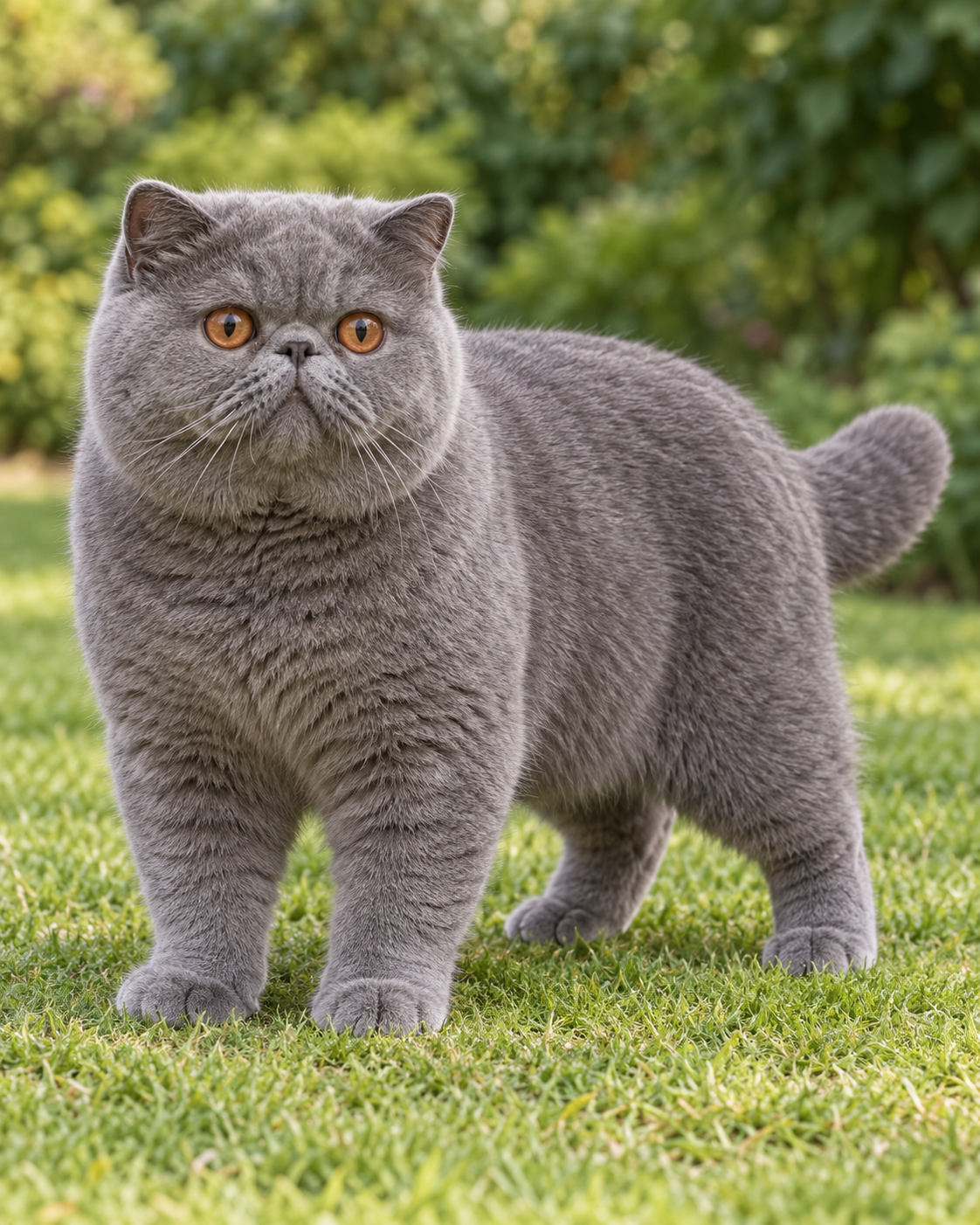
CFA traces development to 1950s Persian–American Shorthair crosses and its 1966 breed decision.
More about this breed’s history
From the proposed Sterling to CFA’s Exotic standard
When Jane Martinke proposed a new class to CFA in 1966, her suggested name was Sterling, a reference to the silver cats that had caught her attention. Breeders went on to develop Exotics in other colors. CFA’s rules also changed as the breed took shape. In 1975 breeders could still outcross to Persians or American Shorthairs. The American Shorthair option ended in the 1987–88 show season. By the 1990 season, CFA judged Exotics against the Persian standard except for the coat. (Cat Fanciers’ Association: Exotic article, origins and Development of the Standard; Governing Council of the Cat Fancy: Exotic Shorthair, history of CFA outcross limits)
Full breed details
A short-coated member of the Persian group with a compact build and flattened face.
- Adult weight
- Purina US adult reference: Female: 6–10 lb; Male: 7–14 lb
View all Exotic Shorthair articles →
View sources and checked dates →References & editorial notes
Adult-weight sources
Purina US adult reference: Female: 6–10 lb; Male: 7–14 lb
direct: Purina US adult reference; published-sex-reference.
- CFA 2026–2027 Breed Standards
- Recognised breeds
- Using Positive Reinforcement to Train and Support Your Cat
- Making the Commitment to Adopt a Cat
- How to Feed a Cat
- Introducing a New Cat Into Your Home
- Meeting the Physical and Emotional Needs of Indoor Cats
- TICA: Exotic Shorthair
- CFA: Exotic
- TICA Standing Rules, Version C, 3 June 2026
- UC Davis VGL: Polycystic Kidney Disease (PKD1)
- Facial conformation characteristics in Persian and Exotic Shorthair cats
- Cornell: Feeding Your Cat
- Cornell: What To Expect
- FelineVMA 2025: Meeting the Physical and Emotional Needs of Indoor Cats
- Cornell: Hypertrophic Cardiomyopathy
- UC Davis VGL: Sphynx and Devon Rex Congenital Myasthenic Syndrome
- UC Davis VGL: Erythrocyte Pyruvate Kinase Deficiency
- Purina US adult reference — adult-weight reference
- CFA 2026–2027 Breed Standards Checked 2026-10-20.
- Recognised breeds Checked 2026-10-20.
- Using Positive Reinforcement to Train and Support Your Cat Checked 2026-10-20.
- Making the Commitment to Adopt a Cat Checked 2026-10-20.
- How to Feed a Cat Checked 2026-10-20.
- Introducing a New Cat Into Your Home Checked 2026-10-20.
- Meeting the Physical and Emotional Needs of Indoor Cats Checked 2026-10-20.
- TICA: Exotic Shorthair Checked 2026-10-20.
- CFA: Exotic Checked 2026-10-20.
- TICA Standing Rules, Version C, 3 June 2026 Checked 2026-10-20.
- UC Davis VGL: Polycystic Kidney Disease (PKD1) Checked 2026-10-20.
- Facial conformation characteristics in Persian and Exotic Shorthair cats Checked 2026-10-20.
- Cornell: Feeding Your Cat Checked 2026-10-20.
- Cornell: What To Expect Checked 2026-10-20.
- FelineVMA 2025: Meeting the Physical and Emotional Needs of Indoor Cats Checked 2026-10-20.
- Cornell: Hypertrophic Cardiomyopathy Checked 2026-10-20.
- UC Davis VGL: Sphynx and Devon Rex Congenital Myasthenic Syndrome Checked 2026-10-20.
- UC Davis VGL: Erythrocyte Pyruvate Kinase Deficiency Checked 2026-10-20.
- Purina US adult reference — adult-weight reference Checked 2026-11-18.
References
Breeders & rescues
Explore Exotic Shorthair breeders →
Questions to bring
- What veterinary records and family health history are available?
- How does this individual cat’s coat and activity fit the care described here?
- Which screening findings and individual needs should I discuss with my veterinarian?