Cat breed · North America; developed from working domestic cats
American Shorthair: Health
American Shorthair health
Health observations and family records
Heart disease reported in an American Shorthair’s family is a reason to bring the actual records to the veterinarian. The evidence reviewed here does not establish an excess HCM risk for every American Shorthair. A separate Japanese testing study detected a known PKD1 kidney variant in submitted cats of this breed.
An available test is different from a recommendation to use it. Ask which records are relevant to this individual; neither a test listing nor a screening recommendation tells you how often illness occurs.
Find out what “heart trouble” meant
A relative’s murmur and an ultrasound diagnosis are different records. If a family member was diagnosed with heart muscle thickening, ask for the dated findings and how closely the cats are related. A cat can appear well despite heart changes; the veterinarian can decide whether imaging is useful.
A changing water-bowl routine is separate information
Tell the clinic about persistent increases in drinking or urine volume, or unexplained weight loss. Kidney conditions have several causes. A PKD1 report concerns one variant; it neither evaluates the heart nor explains those changes by itself. A cat may seem well at first. Call your clinic about persistent changes such as drinking more, larger urine clumps, weight loss, poorer appetite or vomiting. Ask for same-day advice if your cat repeatedly vomits or stops eating. If your cat repeatedly strains and passes only drops or no urine, go to an emergency vet immediately. Don’t assume cysts explain it. Collapse or severe distress needs emergency care too. Bring dated imaging, test results and notes on appetite, weight and litter habits. Ask whether the cysts and the gene result point to the same cause, whether kidney function is changing, and when a blood pressure, urine or blood check would be useful. Keep fresh water within easy reach and track the changes your clinic asks for. Have a plan for rechecks and for what should bring your visit forward. Ask before changing food, adding supplements or giving fluids. A repeat gene test cannot tell you how the kidneys are working now.
Family history and screening
Keep confirmed family heart diagnoses, dated ultrasound reports and any PKD1 result in separate parts of the record. Ask which cat and variant each DNA report identifies, rather than treating a broad panel label as a complete health examination.
Questions for your veterinarian
- Does the confirmed family diagnosis change which examinations you would discuss for this cat?
- What does this particular kidney report cover, and what would a current examination assess separately?
Choosing a kitten? Ask to see both parents’ results, with the animal’s name and the date on each report. If you’re adopting an adult, ask which records come with that individual.
Health sources
- Primary Japanese insurance and testing cohort
- Cornell clinical guidance
- Cornell clinical guidance
- Exact ASH imaging and genotype
- iCatCare kidney care
- Cornell urinary emergencies
Screening evidence and limits
UC Davis reports finding the rdAc retinal-disease variant in American Shorthairs. Detection in a breed is not a prevalence estimate or a recommendation that every cat needs the same panel. Discuss family history and the exact report with a veterinarian.
Rescues & sheltersPrint or citeBreed articles
Other profile sections and family fact sheet
Life with a American Shorthair
Ask how this cat balances company and independent rest.
Explore home life →Enthusiasm for interactive toys.
Explore daily care →TICA says combing once a week is sufficient for ordinary care.
Explore daily care →Print or cite this breed
American Shorthair family fact sheet
Breed-level references are a starting point. Ask about the individual animal’s routine and care needs.
- Build
- Medium to large
- Female
- 8–12 lb
- Male
- 11–15 lb
- Adult size
- Adult weight often falls around 8 to 15 pounds.
Company
Ask how this cat balances company and independent rest. Provide an accessible quiet place as well as time for interaction; “easygoing” does not establish how an individual will react to children or other animals.
Play & enrichment
Enthusiasm for interactive toys. Try a game the caregiver already uses and watch when the cat chooses to stop.
Coat care
TICA says combing once a week is sufficient for ordinary care. CFA recommends brushing daily to control shedding; its breed guide describes spring undercoat shedding followed by a lighter fall shed. Its description of play includes interactive toys.
Everyday responsibilities
Plan food, supplies, routine care and veterinary visits. Agree who handles the everyday jobs and who covers absences.
Adult help
An adult should remain responsible for care, supervise children’s interactions and arrange help when needed.
My Breed Atlas. American Shorthair breed profile. https://mybreedatlas.com/cats/breeds/american-shorthair
Read this profile’s sources →Adult ranges and source qualifications
- Build
- Medium to large
- Female
- 8–12 lb
- Male
- 11–15 lb
Reference ranges describe the breed, not a prediction for an individual.
Daily care
Play & enrichment
Enthusiasm for interactive toys. Try a game the caregiver already uses and watch when the cat chooses to stop.
More about everyday care
Provide places to retreat, separated resources, chances to play and predictable interaction. These are feline needs, not breed compatibility scores.
Coat, grooming & daily care
TICA says combing once a week is sufficient for ordinary care. CFA recommends brushing daily to control shedding; its breed guide describes spring undercoat shedding followed by a lighter fall shed. Its description of play includes interactive toys.
Training & communication
Reward a behavior the cat chooses with something it values. Build tasks in small steps, including approaching a carrier or a grooming tool. Stop when the cat is frightened, unwell or in pain; ask your veterinarian about cooperative care.
Food, routine & costs
The everyday ownership plan
Planning for this breed
Include daily brushing in the care plan described by CFA. Ask how seasonal shedding changes the routine and assess body condition individually rather than assuming a stocky cat should gain weight.
Meals and body condition
Discuss portions and body condition with your veterinarian instead of using the registry weight range as a feeding target. Smaller meals and appropriate food puzzles can support natural feeding behavior. Give each cat a separate feeding station.
Time and costs
Before committing, budget for food, litter, equipment and continuing veterinary care. Agree who handles play, cleaning, grooming and care during absences. Obtain local estimates for the individual’s care instead of relying on an invented breed cost.
Home life
Temperament & companionship
Ask how this cat balances company and independent rest. Provide an accessible quiet place as well as time for interaction; “easygoing” does not establish how an individual will react to children or other animals.
Home life & introductions
Prepare a quiet transition room with food, water, litter, hiding places and scratching options. Introduce resident cats gradually and proceed when both are comfortable. Breed reputation cannot establish compatibility with children, dogs or another cat.
Offer a quiet retreat and let the cat control its distance. Supervise children and introduce resident animals gradually; individual history matters more than a breed reputation.
Personality & care details
Personality & care profile
Breed tendencies vary by individual. Higher means more of the named tendency, not better.
What everyday life tends to involve
These notes describe a tendency for the breed. Every animal is an individual.
- Play
- Several play sessions through the day fit this cat.
- Coat care
- TICA says combing once a week is sufficient for ordinary care. CFA recommends brushing daily to control shedding; its breed guide describes spring undercoat shedding followed by a lighter fall shed.
Its description of play includes interactive toys.
- Loose hair
- Loose hair tends to stay light.
- Company
- Many like to share the room without constant contact.
- Adult size
- Adult weight often falls around 8 to 15 pounds.
YOUR EVERYDAY LIFE
How could this breed fit your life?
See household examples or compare this breed with answers you chose to save. The examples show combinations where this breed appeared among the first five results. Other combinations can work too.
Saved matching preferences stay in this browser, never on your account. They expire after 30 days and are removed the next time this feature reads them. Health answers, children’s ages and free-text notes are not saved. This section does not reproduce those personal care notes.
History & sources
Heritage & appearance
Meet the American Shorthair
Adult ranges are reference examples, not targets or predictions for an individual cat.
Heritage & appearance
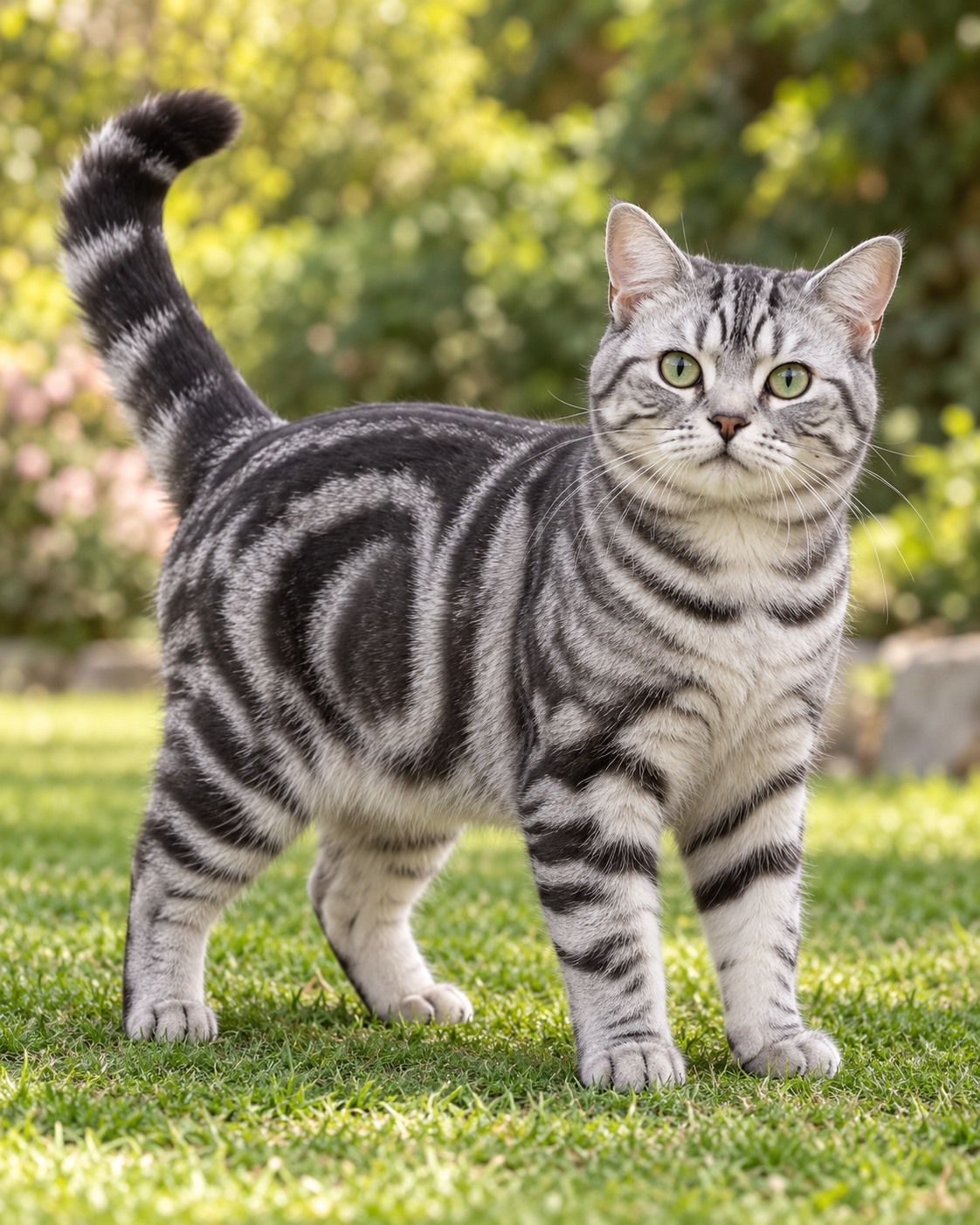
Its North American history includes ship cats accompanying early settlers. CFA changed its breed name from Domestic Shorthair to American Shorthair in 1965.
More about this breed’s history
The vote that preceded the name change
At the Cat Fanciers’ Association meeting of April 3–4, 1964, Capt. Carrithers of the Marin County Cat Fanciers put forward the name American Shorthair. The delegates voted to send the proposal to the board without a recommendation. The National American Shorthair Club reproduces the motion from the CFA yearbook. (club publication reproducing annual-meeting proceedings: Janis Walkingstick, The Domestic Shorthair Through the Lens of the CFA Yearbook, Part 4. The American Connection, July 2021, printed and PDF p. 8)
Full breed details
A stocky, shorthaired working-cat breed. An even-tempered, playful cat with an independent streak.
- Adult build
- Medium to large; powerful, athletic build
View all American Shorthair articles →
View sources and checked dates →References & editorial notes
Adult-weight sources
Female: 8–12 lb; Male: 11–15 lb
direct: veterinary nutrition breed profile explicitly lists female 8-12 lb and male 11-15 lb; registry standards checked for numerical intervals.
- Using Positive Reinforcement to Train and Support Your Cat
- Making the Commitment to Adopt a Cat
- How to Feed a Cat
- Introducing a New Cat Into Your Home
- Meeting the Physical and Emotional Needs of Indoor Cats
- Progressive Retinal Atrophy (PRA-rdAc)
- American Shorthair
- CFA 2026–2027 Breed Standards
- Standing Rules Version C, 3 June 2026, section 701.4.1
- American Shorthair
- Using Positive Reinforcement to Train and Support Your Cat Checked 2026-10-20.
- Making the Commitment to Adopt a Cat Checked 2026-10-20.
- How to Feed a Cat Checked 2026-10-20.
- Introducing a New Cat Into Your Home Checked 2026-10-20.
- Meeting the Physical and Emotional Needs of Indoor Cats Checked 2026-10-20.
- Progressive Retinal Atrophy (PRA-rdAc) Checked 2026-10-20.
- American Shorthair Checked 2026-10-20.
- CFA 2026–2027 Breed Standards Checked 2026-10-20.
- Standing Rules Version C, 3 June 2026, section 701.4.1 Checked 2026-10-20.
- American Shorthair Checked 2026-10-20.
References
Breeders & rescues
Explore American Shorthair breeders →
Questions to bring
- What eye-health history makes any proposed genetic test relevant to this individual?
- Can the current caregiver demonstrate this individual’s usual grooming and play routine?
- How does this cat signal that it wants to end contact or rest alone?