American Shorthair cat temperament
Explore American Shorthair cat temperament through companionship, subtle communication, contact preferences and the individual cat’s everyday needs.
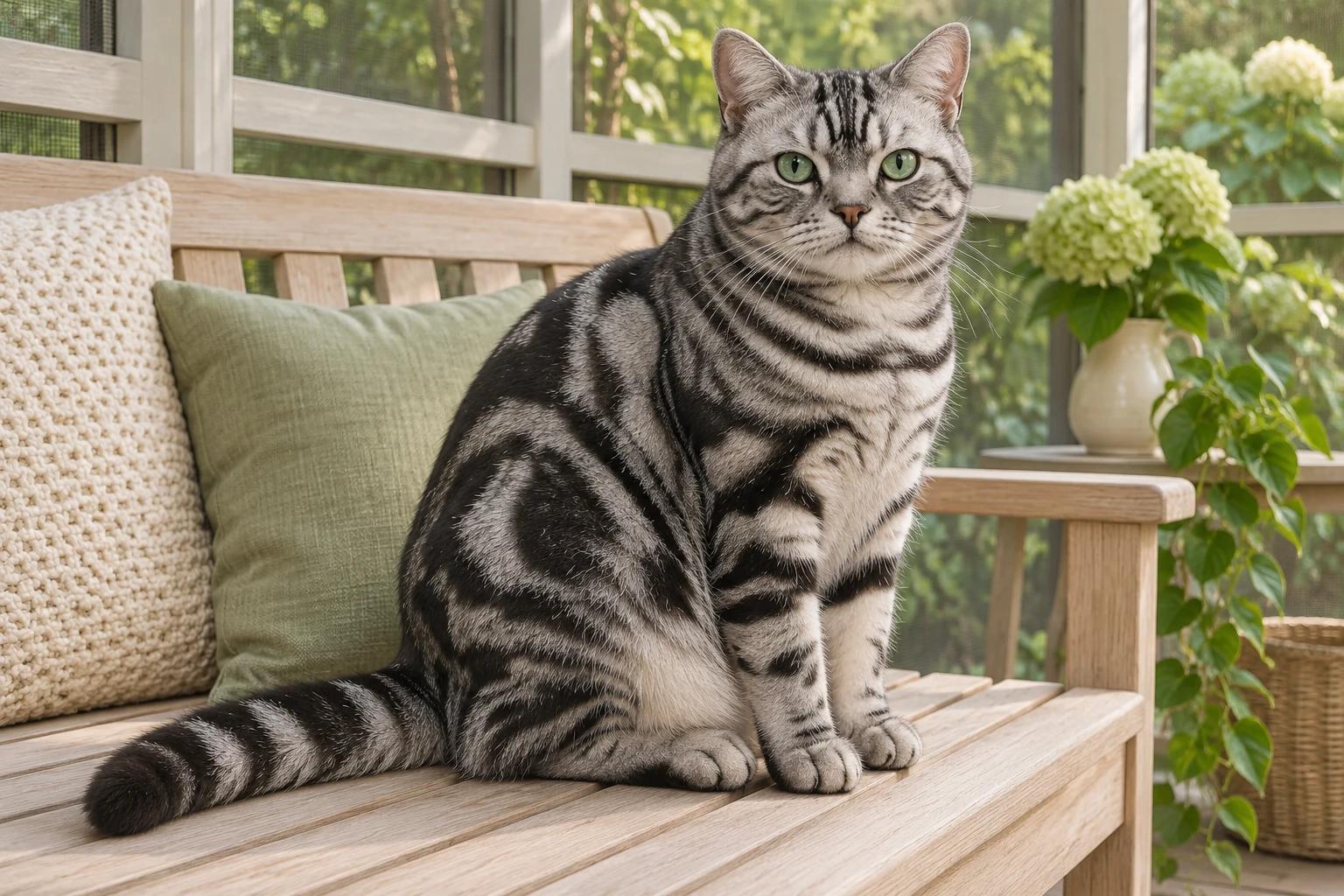
American Shorthair cat temperament is best understood as a relationship between companionship and independence, not a promise that every individual behaves identically. The current American Shorthair profile describes an even-tempered, playful cat with an independent streak. Those words provide a starting point for understanding ordinary life, but the animal's choices provide the detail.
American Shorthair cat temperament: company on its own feet
Following a familiar person between rooms can be companionship without a request to be carried. VCA's American Shorthair account describes that preference for walking rather than being picked up and cradled. It also mentions quieter chirps or squeaks instead of frequent loud conversation. These examples show that social interest need not be expressed through constant handling or noise.
Following is participation. The cat can choose to be in the same room without asking to be lifted. Do not turn a voluntary approach into a handling test every time it happens.
Read the whole cat, not one expression
Posture, eyes, ears and whiskers all contribute to the picture, as Cats Protection's guide explains. Relaxed features should be considered together and in context. A cat's face can communicate subtly, so a single attractive photograph does not provide a complete account of how it feels.
For an American Shorthair, watch the transition into an interaction. A comfortable approach, a pause nearby and a choice to remain are more informative than deciding that a certain eye shape always means friendliness. Physical appearance and current behavior are different kinds of information.
The guide also describes a slow blink and a slight turn of the head as a gentle exchange with a cat that is already comfortable. Avoid staring and do not insist on a matching response. This is an invitation, not a command. Paying attention to several small signals gives you more to work with than interpreting one movement in isolation or assuming that the breed's even-tempered description answers every question about the moment.
Let the cat help decide the length of contact
Battersea's interaction advice recommends letting the cat initiate touch and remain free to leave. Gently offer a hand and see whether the animal rubs against it. A cat that does not approach may simply prefer not to be touched then.
When contact is welcome, pause after a few seconds and see whether the cat reinitiates it. Cheeks, chin and head are often preferred to more sensitive areas such as the stomach or base of the tail. Individual preferences still matter, including how long and how firmly the cat wants to be stroked.
For an American Shorthair household, this turns affection into an exchange rather than a fixed allowance of petting. Being available does not mean continually touching the cat whenever it passes. Avoid interrupting eating, sleeping or an absorbing activity for a cuddle. A willing return after a pause tells you something different from merely remaining where a person has placed it. Give the individual room to make that distinction clear.
Scent is part of everyday communication
Ohio State's Indoor Pet Initiative explains the importance of smell in feline communication. Rubbing and scratching can leave scent information from glands on the body and paws. These behaviors are not simply decorative habits or evidence that a cat has failed to learn household manners.
When an American Shorthair rubs a familiar object, there is more happening than the visible motion alone. People tend to notice sounds and facial expressions first, but the cat's sensory world is not limited to the signals easiest for us to hear or photograph.
Provide appropriate objects on which the cat can carry out ordinary marking behavior, including scratching surfaces. The practical goal is not to remove every trace of feline communication from the home. It is to accommodate the animal's normal activities in suitable places. Understanding that distinction can make everyday behavior less mysterious without assigning a human motive to each action. The cat is not required to communicate exactly as a person would in order to share the household successfully.
A sturdy appearance is not a handling permission slip
American Shorthair cat characteristics include the stocky working-cat identity described on the current breed page. Adult females are listed at 8–12 pounds and males at 11–15 pounds. Those figures describe scale, not how much touching, lifting or excitement an individual welcomes.
An eleven-pound female and an eleven-pound male can both fit the published ranges while having different histories and preferences. Weight is useful for understanding physical size; it cannot replace information about the animal's experience with people. Avoid deciding that a substantial cat must be unusually tolerant simply because it looks robust.
American Shorthair cat behavior around other animals is similarly individual. The current page recommends gradual introductions and a quiet retreat, rather than treating breed reputation as proof of compatibility. Give each animal a realistic opportunity to adjust without expecting the new cat's supposed easygoing nature to resolve every interaction immediately.
The cat quiz helps you consider the kind of companionship you can offer. For a distinct practical topic, the adopted American Shorthair play guide discusses finding games an adopted adult chooses to join.
FAQ
Does an independent streak mean an American Shorthair needs no company?
An American Shorthair’s independence does not remove its need for company. The current profile asks owners to consider both company and independent rest, learning how the particular cat balances them in ordinary life.
Does adult size predict how tolerant the cat will be?
American Shorthair adult weight ranges describe physical scale. They do not establish an individual's preferences for handling or its experience with visitors and other animals.
Can a breed description tell me whether a particular adult will fit my household?
An American Shorthair breed description suggests household-fit questions but cannot answer them all. An adult's established experience with people and the actual environment you can offer matter alongside American Shorthair cat personality descriptions.
Sources behind this article
- VCA American Shorthair ↗
- Cats Protection body language ↗
- Battersea cat interaction ↗
- Ohio State social habits ↗
Article source checked: November 16, 2026. Source checked 2026-11-16
Keep reading

American Bobtail cat temperament
Read article →