Oriental Shorthair Cat Temperament: Reading an Expressive Cat
Understand Oriental Shorthair cat temperament through curiosity, vocal behavior, contact and retreat, with room for individual preferences.
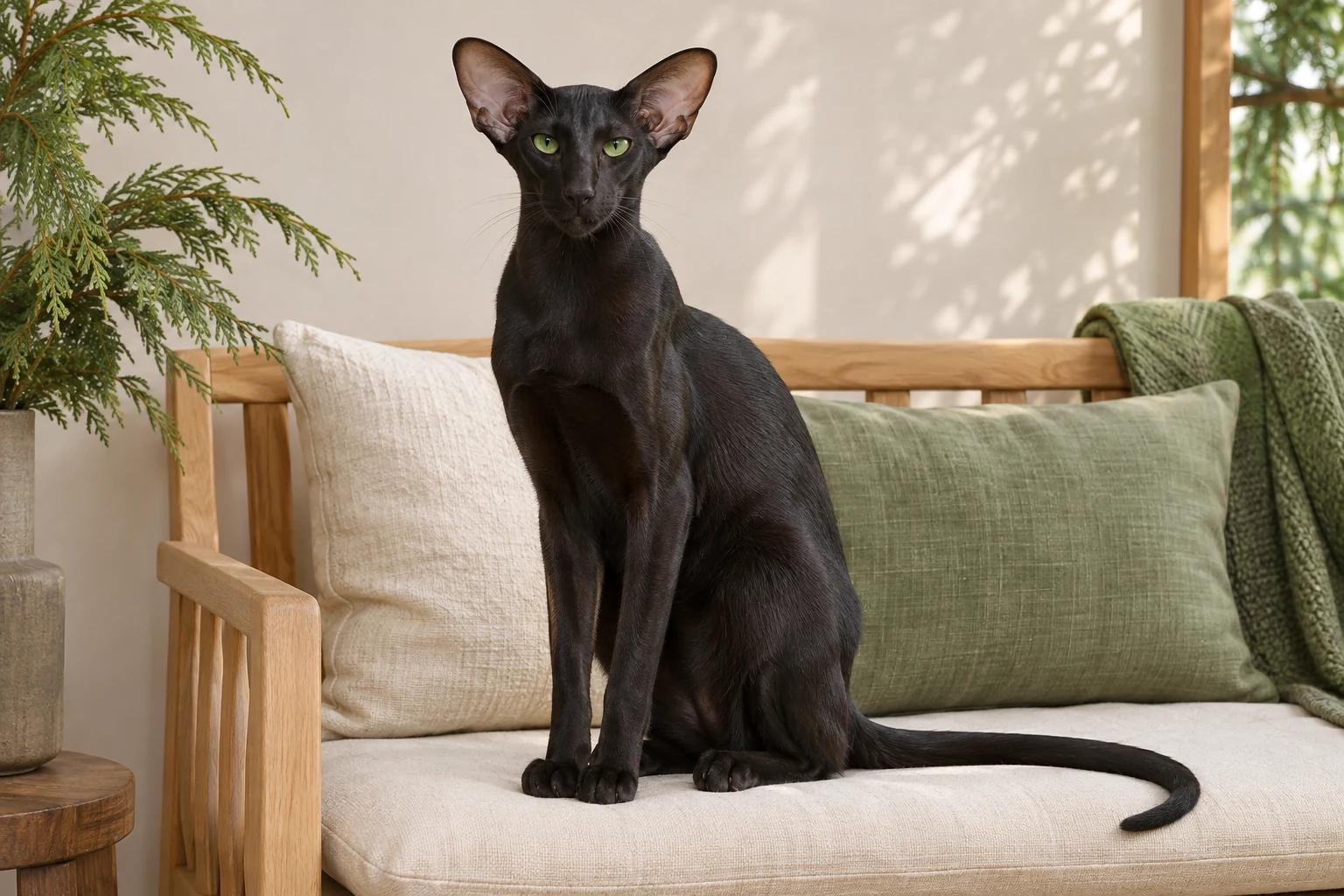
Oriental shorthair cat temperament is often described through enthusiasm: interest in people, vocal conversation and curiosity about whatever is happening nearby. That can be an appealing combination if you want an involved companion. It can also be misunderstood when a cat's wish to investigate is treated as disobedience or its wish to stop is treated as rejection. The starting point is to read the whole situation and give the individual clear choices.
This article explains oriental shorthair cat personality in everyday encounters. It complements the existing care-planning guide without repeating its household rota: the focus here is how to interpret participation, excitement and retreat.
Oriental shorthair cat temperament: interest is not a demand
TICA and CFA describe an interactive breed. The current Oriental Shorthair profile adds an important qualification: some individuals prefer familiar people. A breed-level reputation cannot tell you how this cat will respond to every visitor or setting.
Think of interest as an invitation to pay attention to the cat's behavior, not permission to take over the encounter. If it approaches your bag, it may be investigating the bag rather than asking to be picked up. If it rests beside your chair, it may want proximity without continuous touch. Those distinctions are easy to miss when you are expecting an exceptionally affectionate breed.
At an adoption meeting, ask the caregiver to explain the animal's usual signals. Allow it to approach at its own pace. You can gather useful information without provoking a response or interrupting a resting cat to see whether it tolerates you.
Notice the transition from curiosity to rest
An engaging cat does not need to remain available throughout the day. Watch what happens after a game or an exploration. Does it select a resting place, stay nearby or leave the room? Provide access to those options instead of treating the end of play as a problem to overcome.
A household can accidentally keep restarting an interaction because each person sees only a moment of it. One person offers a toy, another calls the cat over, and a visitor reaches for it as it tries to settle. Explain the animal's preferences to everyone so that a retreat remains meaningful.
This is especially relevant in a home attracted to the breed's social image. Enjoying company does not mean enjoying repeated interruption. A comfortable relationship includes unremarkable time together and undisturbed rest, not just the moments when the cat is visibly entertaining people.
Keep vocal behavior attached to its context
Oriental shorthair cat characteristics include a tendency toward conversation, but the sound itself does not explain why it happened. Consider location, timing and nearby activity. Ask what the caregiver has observed rather than importing a fixed translation from a video of a different cat.
For a prospective owner, the useful question is whether the household can accommodate this individual's established behavior. Ask about mornings, evenings and periods when people are busy. Be cautious about reassurance that all calling will disappear once a cat is settled, unless the person is describing a documented change in that particular animal.
For an owner, a new pattern warrants its own assessment. Contact your veterinarian about a sudden change or concern, especially if other behavior is different too. The breed's reputation should not become an explanation that prevents you from seeking help.
Give exploration a suitable setting
The site's profile describes an active, curious cat. That makes the layout of a room part of the temperament conversation. Before deciding that an animal is too intrusive, look at the available choices: is the most interesting observation point also the surface you repeatedly clear it from?
FelineVMA's indoor-cat guidance supports appropriate resources, safe places and opportunities for natural activity. A stable observation point can make shared space easier, while a genuinely quiet retreat gives another option. Secure dangerous materials and fragile objects instead of relying on a verbal instruction as the only boundary.
Choose changes with a clear purpose. For example, if the cat likes watching household movement, consider whether there is a suitable place to do so without blocking access or exposing it to a hazard. Observe its response before deciding the arrangement works. Furniture that looks attractive to a person may not offer the access or location the cat chooses.
Avoid turning uncertainty into a label
Oriental shorthair cat behavior can look different in a new home. A familiar person, smell or routine may be missing. Record what the cat actually does rather than describing it as spiteful, jealous or ungrateful. Those labels do not explain what adjustment or professional support might be useful.
Likewise, a cat that declines handling is not automatically aggressive. Give space and seek guidance about safe, appropriate interaction if you are unsure. Do not test tolerance by continuing until the animal gives a stronger response. Adults should guide children's behavior and protect the cat's resting places.
Other animals require their own introduction plan. An interactive Oriental Shorthair is not obliged to welcome a resident pet immediately. Ask about past experience, arrange suitable separation and resources, and obtain advice if the animals are uncomfortable. Compatibility is assessed between individuals rather than awarded by breed.
Ask for a behavior history you can use
Request examples from normal days, including what the caregiver would tell a sitter. Which interactions are welcome, what should be left alone, and what changes would prompt a call? A practical history is more valuable than a collection of flattering personality words.
Keep the distinction between understanding the animal and organizing people. The existing Oriental Shorthair companionship guide helps coordinate opportunities for contact. This guide helps you recognize that accepting, declining and changing an activity are all parts of the cat's participation.
Use the cat quiz to consider whether you enjoy a potentially expressive, involved companion. Then return to the specific cat's record and your own circumstances. You are building a relationship with an individual, and the strongest starting point is curiosity about that animal rather than certainty about a breed stereotype.
Frequently asked questions
Does an Oriental Shorthair always greet strangers?
No. The breed is described as social, but some cats prefer familiar people or need distance in a new setting. Let the individual choose whether to approach.
Does following a person mean the cat wants petting?
Not always. Investigation, proximity and touch are different forms of interaction. Notice the cat's response and pause rather than assuming all approaches request handling.
Should a talkative cat's new vocal pattern be ignored?
No. A sudden change or other concern deserves veterinary advice. A vocal breed reputation does not explain every new behavior.
Is a busy home automatically a good match?
No. Consider the actual opportunities for rest, retreat and comfortable contact. Activity around a cat is not the same as interaction it chooses to enjoy.
Sources behind this article
Article source checked: November 20, 2026. Source checked 2026-11-20
Keep reading
Oriental Shorthair Cat Size: A Lean Frame in Context
Read article →