Norwegian Forest Cat Temperament: Gentle, Friendly and Independent
Norwegian Forest Cat temperament explained: what CFA, GCCF and FIFe say, typical characteristics and behavior, and why these cats choose their own terms.
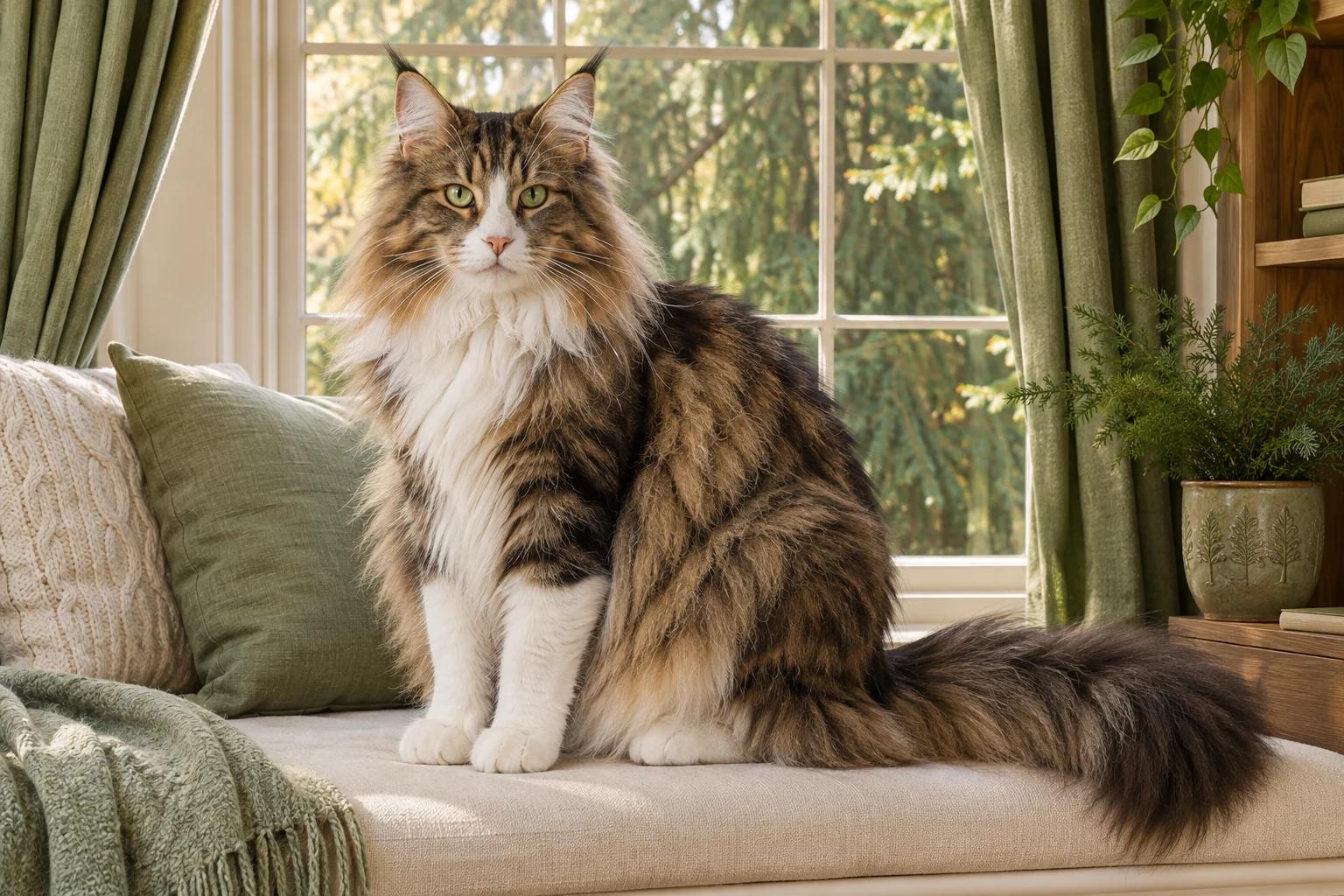
Norwegian Forest Cat temperament is described consistently by the major registries: gentle, friendly and affectionate, with a streak of independence. The GCCF sums it up as friendly and gentle, FIFe calls the breed "calm and friendly," and CFA describes an independent cat that chooses when to join in. That last point is worth knowing before you bring one home. This guide explains what each registry says, what our breed profile describes, how that plays out in daily life, and why individual cats can still differ.
Norwegian Forest Cat temperament at a glance
The Norwegian Forest Cat breed page scores the breed on a five-point scale. Higher means more of the named tendency, not "better."
| Trait | Score (out of 5) |
|---|---|
| Human interaction | 3 |
| Openness to new people | 3 |
| Playfulness | 3 |
| Adaptability | 3 |
| Responsiveness to training | 3 |
| Activity needs | 3 |
| Enrichment interest | 2 |
| Vocal frequency | 2 |
Our breed page says registry descriptions emphasize "gentle companionship with an independent streak, not obligatory lap-sitting."
What registries say about Norwegian Forest Cat personality
CFA: independent but interested in company
CFA describes an intelligent, adaptable cat that participates in family life without always seeking close contact. That leaves room for both companionship and time spent doing its own thing.
GCCF: gentle, friendly and a little reserved
The GCCF lists the breed's temperament as friendly and gentle. It describes Norwegian Forest Cats as independent and intelligent and says they enjoy a quiet home life. It also notes that, although they enjoy human company, some are reserved with unfamiliar people.
FIFe: calm and affectionate
FIFe presents a relaxed, friendly companion with affection for familiar people and continued interest in play. These are tendencies to consider when meeting a cat, not promises about every individual.
Where they agree
All three registries describe a gentle, friendly cat. CFA and the GCCF both mention independence, and the GCCF adds reserve with strangers. That combination matches our breed page's description.
Norwegian Forest Cat characteristics that shape behavior
A large, slow-maturing cat
CFA describes a large, sturdy cat and says the breed is fully mature at approximately age five. That describes physical growth, not a timetable for personality. Meet the individual cat rather than predicting temperament from age alone.
A natural climber
The GCCF says these cats enjoy climbing, and our breed page notes they often enjoy climbing. Many will choose high resting spots. Our guide to choosing climbing furniture for a Norwegian Forest Cat covers how to set those up safely.
Norwegian Forest Cat behavior at home
Close by, but not always on you
Company need not mean constant contact. Give the cat a choice between a nearby seat and a quieter space. Offering comfortable resting spots near where you spend time lets your cat be close without being held.
Respecting the lap decision
Let your cat approach and leave without being held in place. The Merck Veterinary Manual notes that whether an interaction feels positive depends on the cat's own view of it, and that physical punishment can damage the bond and lead to aggression.
With visitors
Openness to new people scores 3 out of 5, and the GCCF says the breed can be reserved with strangers. Some Norwegian Forest Cats will watch guests from a high perch before deciding whether to come down. Let them choose.
Play
FIFe describes a lifelong playful spirit, and the GCCF says these cats enjoy interactive games and can entertain themselves when you're out. The Merck Veterinary Manual recommends rotating several toys because cats get used to toys quickly.
A quiet voice
Vocal frequency scores 2 out of 5, so many Norwegian Forest Cats are fairly quiet. Individual cats can still be more talkative.
Children and other pets
Our breed page makes an important distinction: breed reputation cannot establish compatibility with children, dogs or another cat. Plan gradual, supervised introductions with separate resources.
Why individual Norwegian Forest Cats vary
Registry descriptions are generalizations. The Merck Veterinary Manual explains why individual cats differ:
- Genetics play a strong role in personality, especially genes from the father.
- Early experience matters. The key socialization period runs from about 2 to 7 weeks of age.
- Breed differences are modest. Cats have had less selective breeding than dogs, so behavioral differences between breeds are narrower.
When meeting a Norwegian Forest Cat, ask how the kitten was raised, what its parents are like, and how it reacts to visitors and handling. If your cat's behavior changes suddenly, talk with your veterinarian.
Is a Norwegian Forest Cat right for you?
A Norwegian Forest Cat may suit a household that wants a gentle, friendly companion and is comfortable with a cat that chooses when to be close. To compare the breed with others, take the My Breed Atlas cat quiz.
Sources
Checked 2026-11-17.
FAQ
What is the Norwegian Forest Cat temperament like?
Registries describe the Norwegian Forest Cat as gentle, friendly and affectionate, with an independent streak. CFA says it bonds with its people on its own terms, and the GCCF notes it can be reserved with strangers. Individual cats vary.
Are Norwegian Forest Cats lap cats?
Some are, but on their own terms. CFA says Norwegian Forest Cats may be lap cats, but they decide when to get on or off. Many prefer to stay near their people in a spot they choose, such as a nearby chair or bed.
Are Norwegian Forest Cats independent?
Yes, to a degree. The GCCF describes the breed as intelligent and independent, and CFA says these cats bond with their owners on their own terms. They generally enjoy company but like to choose when and how to be close.
Are Norwegian Forest Cats vocal?
Norwegian Forest Cats are generally fairly quiet. My Breed Atlas scores vocal frequency at 2 out of 5. That's a breed tendency, so some individual cats are more talkative than others.
Sources behind this article
- CFA – Learn more about the Norwegian Forest Cat ↗
- GCCF – Norwegian Forest Cat breed page ↗
- FIFe – Norwegian Forest Cat breed profile (PDF) ↗
- Merck Veterinary Manual – Social Behavior of Cats (Sun A. Kim, DVM, Cornell University; reviewed July 2025) ↗
Article source checked: November 17, 2026. Source checked 2026-11-17
Keep reading

American Bobtail cat temperament
Read article →