Highlander Cat Temperament: Social, Playful and People-Oriented
Highlander cat temperament explained: what registries document, typical characteristics and behavior, and why a wild look says little about personality.
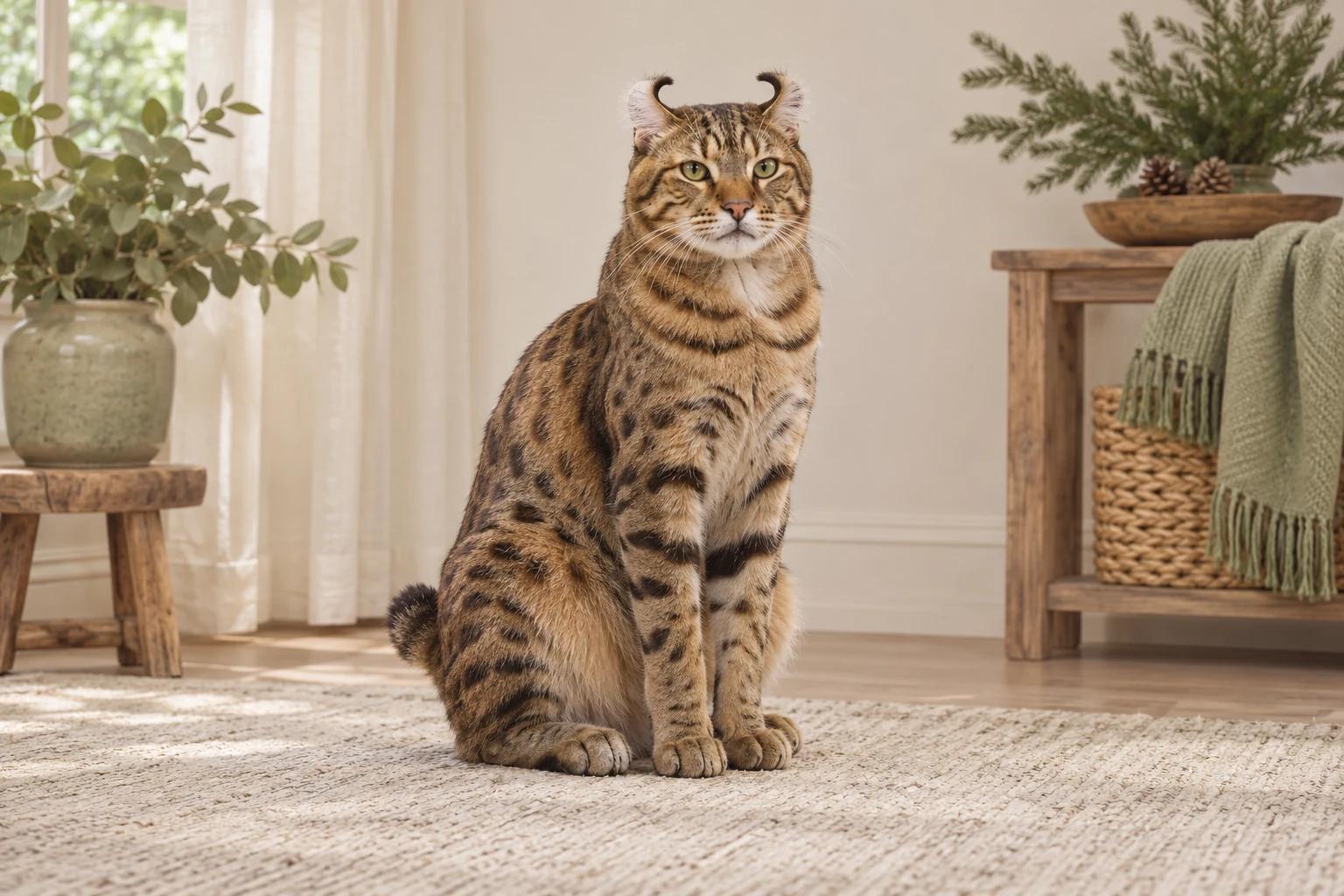
People often ask about Highlander cat temperament because of the breed's look. With curled ears, a short tail and an unusual, big-cat-like outline, it's easy to assume this is a wild or difficult cat. Registry documents say otherwise: TICA describes a domestic breed. TICA describes an energetic, playful cat that enjoys human company. This guide sets out what is documented, what our breed profile describes, and why each cat should be judged as an individual rather than by its appearance.
Highlander cat temperament at a glance
The Highlander breed page scores the breed on a five-point scale. Higher means more of the named tendency, not "better."
| Trait | Score (out of 5) |
|---|---|
| Human interaction | 4 |
| Openness to new people | 4 |
| Playfulness | 4 |
| Activity needs | 4 |
| Adaptability | 3 |
| Responsiveness to training | 3 |
| Enrichment interest | 2 |
| Vocal frequency | 2 |
Our breed page summarizes the temperament as "sociability and attention-seeking play, despite relatively quiet voices." It also describes Highlanders as physically energetic and fond of chase games.
What registries actually document
A domestic cat with a wild look
TICA describes the Highlander as a domestic breed with an appearance reminiscent of a big cat. The wild look is an appearance goal. It is not a description of behavior, and it doesn't mean the breed has wild-cat temperament traits.
Descriptions are not guarantees
A registry profile describes tendencies across a breed. It cannot promise how one cat will behave at home. Use it to form questions, then learn the answers from the individual cat.
Personality beyond appearance
TICA describes Highlanders as playful and interested in human company, including visitors. Those are breed tendencies, not a prediction about a particular meeting. Watch whether the individual cat approaches, hangs back or prefers a game before touch. Give it room to make that choice.
Highlander cat characteristics in daily life
Energy and interaction
The site’s description of chase games agrees with TICA’s energetic portrait. Think about the time you can share with a cat, not just the amount of floor space you have. A household can offer interesting games without assuming a cat will entertain itself all day.
Highlander cat personality is not a coat type
Short and long coats occur. Ask about grooming separately from play and social preferences. An animal’s appearance is not a substitute for learning how it responds to your household. Do not infer confidence from a large body or an unusual silhouette.
Ask for examples
Instead of asking whether a cat is friendly, ask what it does when someone arrives, how it joins a game and where it settles afterward. Specific observations help you distinguish an outgoing cat from one that enjoys familiar people but needs more time with visitors.
Highlander cat behavior at home
Attention-seeking play
The breed page describes attention-seeking play and recommends sturdy climbing and daily play. In practice, that can mean a cat that seeks you out for games rather than playing quietly alone. Interactive toys that let it chase and pounce can help.
The Merck Veterinary Manual notes that cats get used to toys quickly and recommends rotating several toys. That's a simple way to keep games interesting for an active cat.
Sociable with people
Human interaction scores 4 out of 5, and openness to new people also scores 4. That suggests many Highlanders are comfortable around both family and visitors. Still, give your cat a quiet retreat and let it choose when to approach.
A fairly quiet voice
Vocal frequency scores 2 out of 5. Our breed page specifically notes relatively quiet voices, so a Highlander may ask for attention more through behavior than sound.
Handling the ears and tail
Because the curled ears and short tail are unusual, people may be tempted to touch or test them. Our article on preparing a Highlander's pre-adoption veterinary questions recommends asking a veterinary professional for a handling demonstration rather than testing flexibility yourself.
Children and other pets
Our breed page notes that breed reputation cannot establish compatibility with children, dogs or another cat. Plan gradual, supervised introductions, and make sure each animal has its own resources and a way to step away.
Why individual Highlanders vary
Merck's general cat-behavior guidance describes both inherited and early-experience influences. It is not a temperament forecast for this breed.
When meeting a cat, ask for examples rather than labels. If someone describes the cat as friendly, what does that look like during an ordinary evening? Does it approach a seated visitor, join a game or simply choose a nearby chair? Those are different forms of company, and one may fit your household better than another.
Ask the same questions of everyone involved in the cat's care. A quiet meeting can look different from the usual morning routine. Find out what the cat chooses when it has space to move away, and what familiar activities it returns to. Write down the answers you need instead of filling gaps with a breed reputation.
If your own cat's behavior changes, talk with your veterinarian rather than assuming it is simply a personality trait.
Is a Highlander right for you?
A Highlander may suit a household that wants a sociable, playful cat and can offer daily active play and sturdy climbing options. Remember that the breed's wild look tells you nothing about an individual cat's temperament. To compare the Highlander with other breeds, take the My Breed Atlas cat quiz.
Sources
Checked 2026-11-17.
FAQ
What is the Highlander cat temperament like?
My Breed Atlas describes the Highlander as sociable, with attention-seeking play and a relatively quiet voice. It scores 4 out of 5 for human interaction, playfulness and activity needs. TICA describes a domestic, playful breed that enjoys human company.
Is the Highlander a wild cat?
No. TICA describes the Highlander as a domestic breed with a big-cat appearance. The wild look is an appearance goal and says nothing about an individual cat's behavior.
Are Highlander cats active?
Highlanders are generally active. My Breed Atlas scores activity needs at 4 out of 5 and describes the breed as physically energetic and fond of chase games. Daily interactive play and sturdy climbing options usually suit them.
Is every Highlander outgoing?
No. TICA describes a generally sociable breed, but individual experience and preferences matter. Ask about the specific cat’s behavior with familiar people and visitors, and let it choose when to approach.
Sources behind this article
Article source checked: November 17, 2026. Source checked 2026-11-17
Keep reading

American Bobtail cat temperament
Read article →