European Shorthair cat temperament: activity and interaction
Explore European Shorthair cat temperament, moderate activity and practical ways to understand individual play, observation and communication.
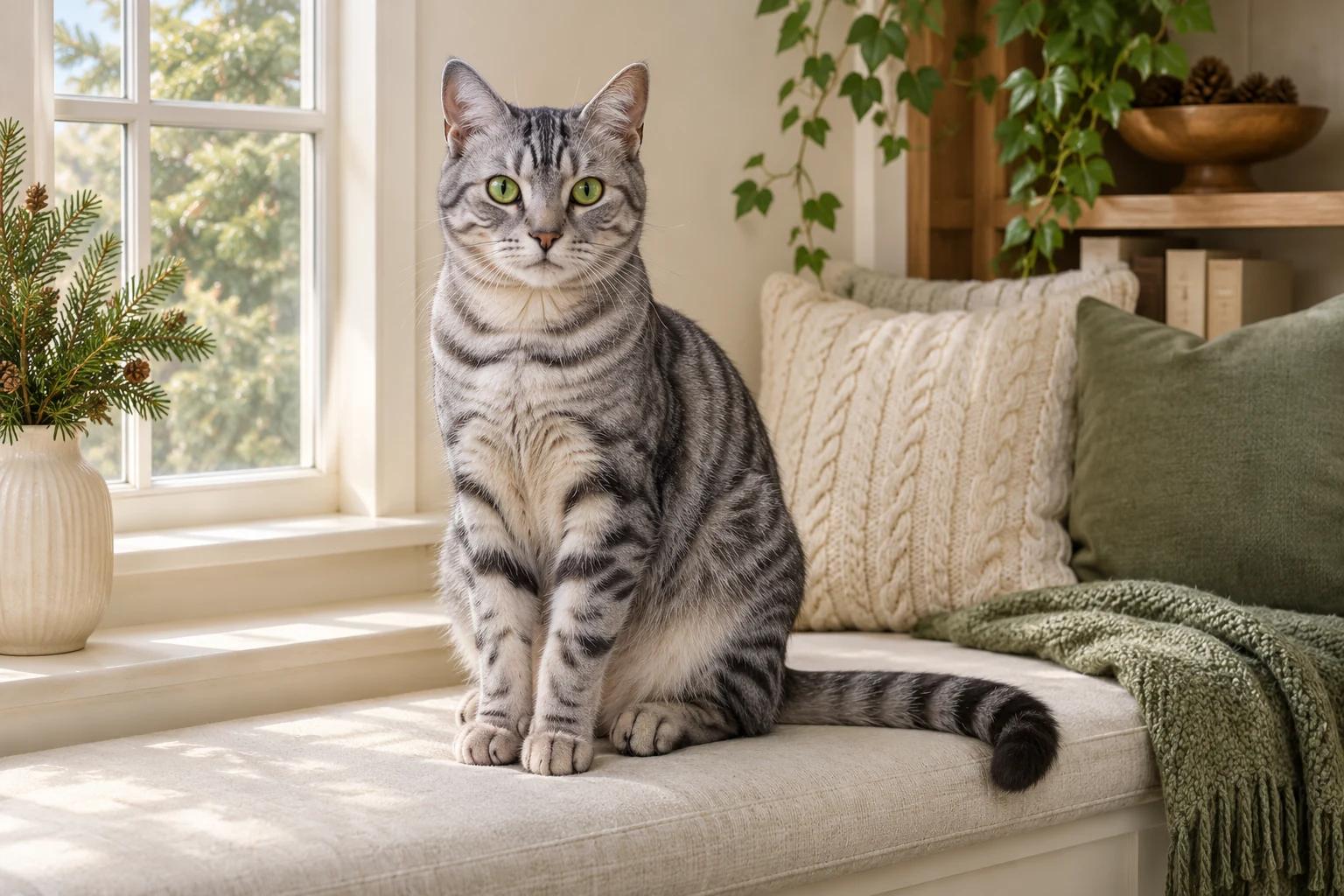
European Shorthair cat temperament is worth considering through ordinary encounters rather than a single label such as “easy.” What would you actually enjoy doing with your cat? What would count as a satisfying evening together? Those questions help turn a breed description into a meaningful ownership decision instead of an abstract ranking.
The European Shorthair profile is the starting point for the breed as a whole. Here, the focus is behavior: what its breed account describes and how general feline guidance can help you understand an individual. The practical suggestions below are not claims that a European Shorthair learns faster, communicates differently or needs less attention than every other breed.
European Shorthair cat temperament includes moderate activity
FIFe's European profile describes a balanced, adaptable cat with a medium activity level. It also describes curiosity, agility and an ability to occupy itself with a toy. That combination is more useful than imagining a permanent choice between a motionless companion and an animal that needs you to direct every moment.
For a European Shorthair, watch how independent activity actually unfolds. Does the cat return to an object after briefly leaving it? Does it investigate a new movement and then resume what it was doing? These observations put a recognizable shape around “moderate” without inventing a daily exercise quota.
FIFe also discusses secure outdoor interest, including the attraction of insects in a fenced garden. That is not permission to assume an ordinary garden boundary will contain the individual. If outdoor access is part of your plans, the enclosure must genuinely be secure.
This European Shorthair cat personality account allows engagement and self-directed occupation. It does not promise that any toy, any environment or any schedule will suit every member of the breed.
A window seat can be an activity, not an absence of one
Ohio State's Indoor Pet Initiative explains the value of elevated places from which cats can observe their surroundings. A perch can support looking, sitting or sleeping; it need not be an elaborate purchased tower. The guidance includes sturdy furniture positioned to provide a view through a window.
For a European Shorthair, this offers a concrete alternative to judging involvement only by movement across the floor. A cat watching the garden is doing something different from a cat chasing a toy. You can make room for both without turning every quiet interval into a prompt for another game.
Consider the actual view when choosing the position. A platform behind a curtain cannot offer the experience of a surface with a view. Different viewpoints provide different angles; rearranging furniture may remove a view.
Let the cat investigate a new perch rather than insisting it remain where you put it. Ohio State suggests making an alternative appealing with a familiar toy or treat, while allowing the cat to approach it independently.
Read the expression as a whole
Cats Protection's body-language guide distinguishes curious and relaxed postures. Its examples of curiosity include forward-pointing ears and whiskers; relaxed examples include softer eye positions, relaxed whiskers and forward, less pointed ears. These are general feline signals, not unique European Shorthair cat characteristics.
This distinction can help during an ordinary encounter. When your cat turns toward something, consider the ears, eyes, whiskers and situation together rather than treating attention itself as a request from you. Observation is more informative than assigning a complete emotion from one isolated movement.
The same guide recommends avoiding a fixed stare. When the cat is relaxed around you, a slow blink followed by turning your head slightly aside is one possible quiet response. A returned blink is not a performance to demand, and an absent response is not a failed relationship.
For European Shorthair cat behavior, use these signals to describe what you see more precisely. “Ears forward while watching the doorway” communicates an actual observation; “always friendly” skips the circumstances that make the observation useful.
Try one clear, voluntary learning task
A small training exercise offers another form of interaction. VCA's clicker and target guide explains how a brief marker can identify an action before its reward arrives. First pair the chosen click or short word with a valued food reward so it has meaning; use a sound that does not alarm the cat.
For a simple nose target, VCA describes holding a small treat inside a closed hand. Mark the moment the nose touches the fist, then release the reward. Once the cat understands that action, present an empty fist and reward from the other hand after the touch. Progress follows the animal's response, not a fixed number of attempts.
This is a general training method you can try with a willing European Shorthair, not a test of the breed's intelligence. Keep the action small and clear. Touching a nearby hand is the starting task; following it across the room is a later extension. Separating those steps keeps your request understandable instead of moving the goal while the cat is still learning it.
Choosing a companion is also a choice about what you want from everyday life. Our cat breed quiz helps frame that broader decision. If the individual is an adult with missing background information, the separate European Shorthair adoption guide addresses that situation. Neither replaces getting acquainted with the cat in front of you.
FAQ
Does moderate activity mean no interest in toys?
No. FIFe describes self-directed toy activity alongside the breed's moderate activity level.
Does a perch have to be a cat tower?
No. Ohio State also suggests suitable sturdy furniture with a view.
Must training use a mechanical clicker?
No. VCA also describes a brief, distinct verbal marker paired with reward.
Sources behind this article
- FIFe European breed profile ↗
- Ohio State Indoor Pet Initiative: Perches ↗
- Cats Protection: Cat body language ↗
- VCA: Clicker and target training ↗
Article source checked: November 16, 2026. Source checked 2026-11-16
Keep reading
European Shorthair cat size: weight, frame and growth
Read article →