Donskoy Cat Size: Weight, Height and Build Explained
Donskoy cat size explained: adult weight ranges, build, why no height is listed, and questions about body condition to discuss with your veterinarian.
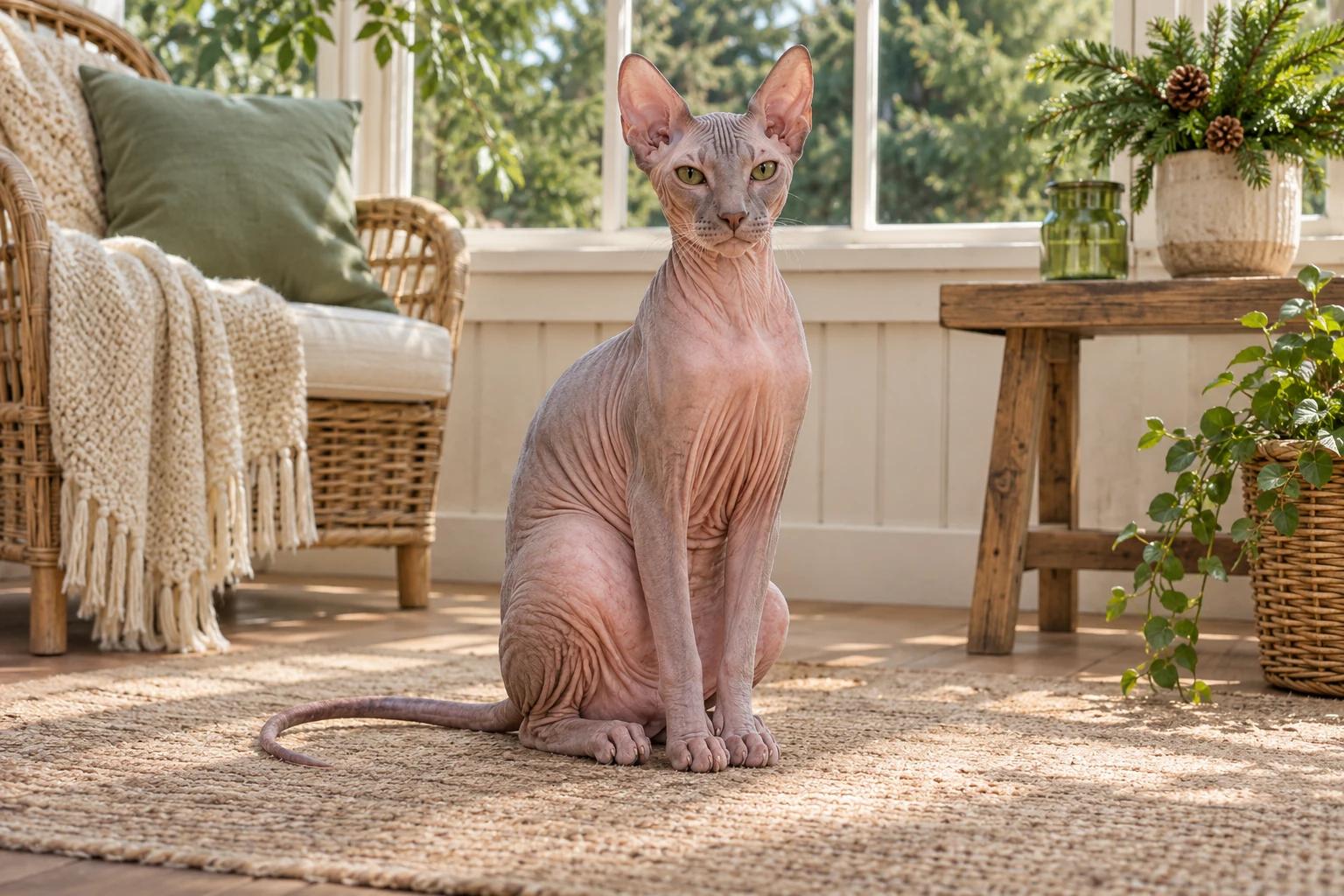
Donskoy cat size is easy to misjudge. Many Donskoys have little or no hair, so their outline can look quite different from a coated cat's, even at a similar weight. This guide covers how much Donskoy cats usually weigh, what the breed standard says about their build, why we don't publish a height figure, and how your veterinary team can assess your cat's individual body condition. Keep in mind that breed ranges are only a starting point. Individual cats can fall above or below them.
Donskoy cat size at a glance
Here is what the Donskoy breed page lists for adults:
| Adult reference | Range |
|---|---|
| Overall adult weight | 6–12 lb |
| Adult females | 6–10 lb |
| Adult males | 9–12 lb |
| Build | Medium, sturdy |
| Height | Not listed |
In short, the Donskoy is a medium-sized cat with a solid, muscular frame. It isn't a giant breed or a tiny one.
What the breed standard says about Donskoy cat size
TICA has given the Donskoy championship status since 2016, according to the World Cat Congress's comparison of member registries. TICA's written breed standard (revised in 2008) describes the Donskoy's size with words, not numbers. It gives no weight or height figures at all, only proportions and build.
Overall size and body
The standard calls the Donskoy "of medium size." It describes the torso as medium in size and medium to medium-long in length. The body should be dense, muscular, and strong-boned, with a wide chest and hindquarters. The standard says it should feel "hard and muscular, not delicate," with medium boning.
Legs, neck, feet and tail
- Legs: in proportion to the body, with firm muscle. The back legs are slightly longer than the front legs.
- Neck: medium length, rounded, and well muscled. The standard describes it as "powerful, especially in males."
- Feet: medium-sized.
- Tail: medium-long, in proportion to the body.
What the standard penalizes
The standard penalizes a body that is too cobby or too foreign. In cat show terms, that means too short and stocky, or too long and slender. Under TICA's show rules, a cat that is markedly smaller than is typical for the breed can be disqualified. Both points support the same picture: a balanced, medium cat.
Donskoy cat weight: males vs females
The standard says males are generally larger than females. It describes the male as more muscular and "significantly larger" than the female. Males also tend to have thicker necks, wider shoulders, and broader heads, while females may have slightly finer bones.
Our breed page reflects this. Females are listed at 6–10 lb and males at 9–12 lb. Notice that the two ranges overlap at 9–10 lb, so a large female and a small male can weigh about the same. A number on the scale won't tell you a cat's sex. It also won't tell you whether that cat is at the right weight for its frame.
Donskoy cat height: why we don't list a number
TICA's official standard describes proportions rather than publishing a numerical height. My Breed Atlas does not list a height on its breed page either, so this article does not supply an estimate. A weight range cannot be converted into a height measurement.
If you need a measurement for a carrier, crate, or cat door, measure your own cat. Your cat's actual dimensions will be more useful than any breed average.
How big do Donskoy cats get, and when?
The cited TICA standard does not give an age at which a Donskoy reaches adult weight. We therefore do not use it to create a month-by-month growth chart or promise that an individual kitten will reach its adult size on a particular birthday.
What the standard does describe is how a young Donskoy's coat can change. In velour-coated cats, the body coat disappears gradually during the first year, and any leftover hair is usually gone by age two. In flocked cats, leftover fur is expected to be gone by age two. Because of these changes, a young Donskoy may look quite different as an adult. That's one reason not to judge a kitten's future size from photos.
Talk with your veterinarian about how to monitor your kitten's growth and whether it is developing as expected.
Ask your veterinarian about individual size and body condition
A breed range shows what's typical. It can't tell you whether a particular cat is too thin, too heavy, or just right. Veterinary teams use a body condition score (BCS) for that.
According to VCA Animal Hospitals:
- BCS estimates how much fat a cat carries compared with its muscle and bone. It's checked by looking at the cat and feeling specific areas, such as the ribs, spine, and hips.
- Cats are scored on either a 5-point or a 9-point scale. Write the score as a fraction, such as 3/5 or 5/9, so it's clear which scale was used.
- A cat's ideal weight is worked out by combining its BCS with its actual weight. VCA recommends weighing the cat each time BCS is checked and keeping a running record.
For a Donskoy, ask your veterinary team to record both numbers at routine visits. If your adult cat weighs more or less than our listed range, that isn't necessarily a problem. It's simply a good question to bring to your veterinarian, who can examine your cat.
Keeping a simple log also helps with other parts of Donskoy care. Our article on planning a Donskoy's bathing routine with a veterinary team explains how to keep care notes your vet can review.
Is a medium-sized Donskoy right for you?
A sturdy, medium-sized cat suits many homes, but size is only one part of the decision. Our breed page scores the Donskoy 4 out of 5 for both human interaction and activity needs, and its skin needs regular care. To compare the Donskoy with other breeds based on your own preferences, take the My Breed Atlas cat quiz.
FAQ
How big do Donskoy cats get?
Donskoy cats are medium-sized. My Breed Atlas lists adults at 6–12 lb overall, with a sturdy, muscular build. TICA's breed standard describes the Donskoy as a medium-sized cat with a dense, strong-boned body. It says males are generally larger than females.
How much does a Donskoy cat weigh?
Adult Donskoys usually weigh 6–12 lb. My Breed Atlas lists females at 6–10 lb and males at 9–12 lb. Individual cats can fall outside these ranges, so ask your veterinarian to check your cat's body condition score along with its weight.
How tall is a Donskoy cat?
TICA's official breed standard does not publish a numerical Donskoy height, and My Breed Atlas does not list one. If you need your cat's height for a carrier or cat door, measure your own cat.
Are male Donskoy cats bigger than females?
Yes, generally. TICA's standard describes males as more muscular and significantly larger than females, with thicker necks and wider shoulders. My Breed Atlas lists males at 9–12 lb and females at 6–10 lb, so the ranges overlap at the edges.
Sources behind this article
- TICA Donskoy breed standard, revised June 18, 2008 ↗
- World Cat Congress: Donskoy breed comparison ↗
- VCA Animal Hospitals: Body Condition Scoring in Cats ↗
Article source checked: November 17, 2026. Source checked 2026-11-17
Keep reading
Donskoy cat temperament: company, contact and curiosity
Read article →