Colorpoint Shorthair cat personality: voice, play and company
Explore Colorpoint Shorthair cat personality through vocal interaction, play, companionship and careful interpretation of everyday communication.
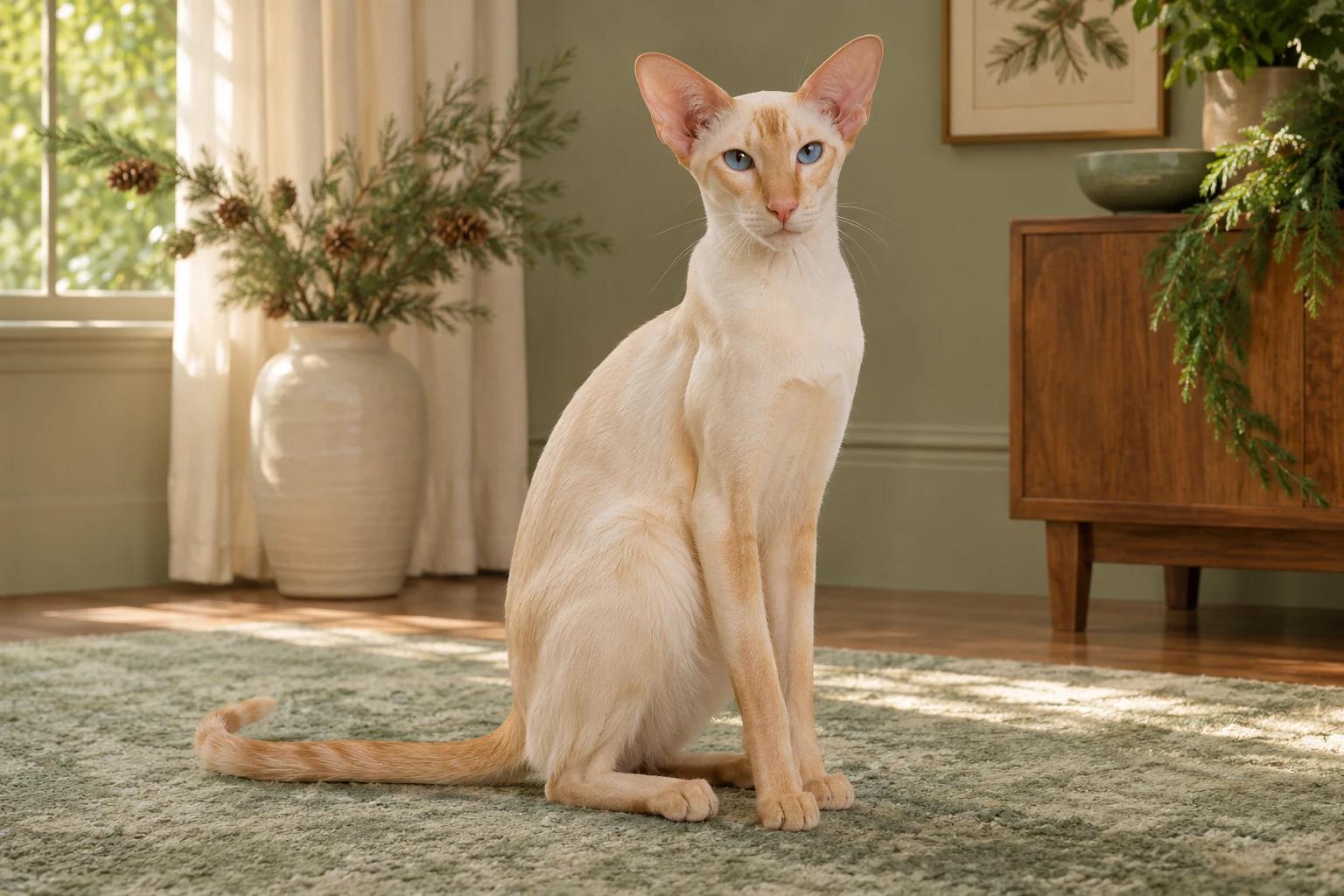
Colorpoint Shorthair cat personality deserves more than a list of adjectives. For a prospective owner, a word such as “vocal” needs unpacking. How often a cat calls, how loud each call sounds and what happens around it are different questions. Understanding those distinctions is more useful than treating one adjective as a complete description.
Colorpoint Shorthair cat personality is participatory
CFA describes Colorpoints as communicative, inventive cats that want involvement with their people. It mentions homemade play objects, including crumpled paper, alongside commercial toys. The appeal is participation rather than passive decoration: an owner should be interested in the interaction, not only the animal's appearance.
CFA also describes persistent requests for attention. That does not mean every call has an identical meaning, or that the cat is automatically requesting to be lifted. Look at what is happening as well as listening. A breed description can prepare you for a conversational companion without supplying a translation for each sound. Nor does the description establish that one Colorpoint will vocalize more than another individual cat.
Notice what kinds of activity attract this cat
VCA's Colorpoint profile describes an active cat interested in high places, mentally engaging toys and learning tricks. These are different kinds of activity. Watching from a perch, manipulating something and performing a familiar learned action should not all be reduced to “running around.”
For someone meeting a Colorpoint, ask which activities the particular animal already chooses. A description of learning tricks is more informative when accompanied by an example of the behavior itself. Does the cat approach a particular object, change position or follow a familiar cue? The concrete action helps you understand the existing skill without inventing a training level from a breed label.
High-place preferences also deserve their own consideration. Where does this animal choose to settle when it has options? Observe the actual perch and the route to it rather than assuming every raised surface is equally attractive. VCA's account supports providing an active, engaging life; it does not supply a universal jumping height or a fixed number of exercise minutes. Those would be separate claims that this breed description does not establish.
Companionship is part of the choice
Zoetis's profile emphasizes the Colorpoint's interest in being with its owner. Treat that as a reason to consider ordinary shared time, rather than as a literal guarantee that a cat will stay beside someone every minute.
Company can happen in different positions. A cat beside your chair, on the chair with you or following you into another room is physically sharing space in different ways. Think about which forms of closeness you enjoy. Someone who wants an animal present while reading may feel differently about an animal occupying the exact book they are trying to read.
The useful choice is not whether closeness is universally good or bad. It is whether that particular interaction fits the relationship you want. A companionship-oriented description should prompt realistic expectations of shared time, not a promise of constant touching. Zoetis itself notes that individual traits vary with experience and care. Meet the animal and consider its established habits; a brief breed summary cannot specify the exact distance it will prefer from you during every activity.
A look toward you is information, not a command response
In Merola and colleagues' social-referencing study, many cats looked between their owner and an unfamiliar object. The study examined whether cats used a person's emotional message around an ambiguous fan. It was general cat research, not a study demonstrating a Colorpoint-specific ability.
The findings support paying attention to those looks, but not assuming that a cat will automatically adopt its owner's assessment of a situation. Effects on behavior were limited, and the experiment did not establish that reassurance makes any unfamiliar object acceptable to every cat.
For everyday Colorpoint Shorthair cat behavior, the distinction is useful: looking at you, looking back at something and approaching it are separate observations. None alone proves that the cat understood an instruction. Do not recreate the experiment by deliberately frightening your pet or presenting a fan as a test. Its value here is interpretive, helping an owner resist turning a brief exchange of looks into a much stronger claim about obedience or emotional understanding. Describe what the cat actually did before attaching a larger explanation to it.
Separate calling rate, pitch and duration
When discussing Colorpoint Shorthair cat characteristics, use “frequent,” “high-pitched,” “loud” and “long” for different properties. Frequent calls occur often. Pitch concerns how high or low a sound seems. Loudness concerns its intensity as heard, while duration concerns how long it lasts. A high-pitched call need not be a long call, and a series of short calls need not be one continuous sound.
These distinctions make an ordinary description clearer without requiring equipment or assigning a cause. “Three short calls while I stood at the doorway” describes an event; “always noisy” compresses timing, sound and interpretation into one judgment. Neither statement by itself establishes what the cat wanted. Avoid turning your preferred adjective into a diagnosis or a comparison that the observation cannot support.
For preparation around fireworks or celebrations, use the separate noisy-household-event guide. The Colorpoint Shorthair profile and cat match quiz offer broader starting points.
Frequently asked questions
Does “vocal” mean every sound is loud?
Describing a Colorpoint Shorthair as “vocal” does not mean every sound is loud. Calling frequency and loudness differ: specify whether you mean many calls, a loud call, a long call or a particular pitch.
Can a short observation show that a cat is always noisy?
A short observation of a Colorpoint Shorthair shows what happened during that encounter, not that the cat is always noisy. A description tied to its circumstances is more precise than an absolute statement.
Is a personality label the same as a behavior?
A Colorpoint Shorthair personality label summarizes an interpretation, rather than identifying a specific behavior. Describe an observable action, such as entering a room or stopping at a doorway, to explain broad labels.
Sources behind this article
- CFA Colorpoint Shorthair ↗
- VCA Colorpoint Shorthair ↗
- Zoetis Colorpoint Short Hair ↗
- Merola and colleagues: social referencing and cat-human communication ↗
Article source checked: November 16, 2026. Source checked 2026-11-16
Keep reading
Colorpoint Shorthair size: weight, proportions and adult build
Read article →