Birman cat temperament
Explore Birman cat temperament through everyday company, playful interests and individual communication rather than assuming a guaranteed lap cat.
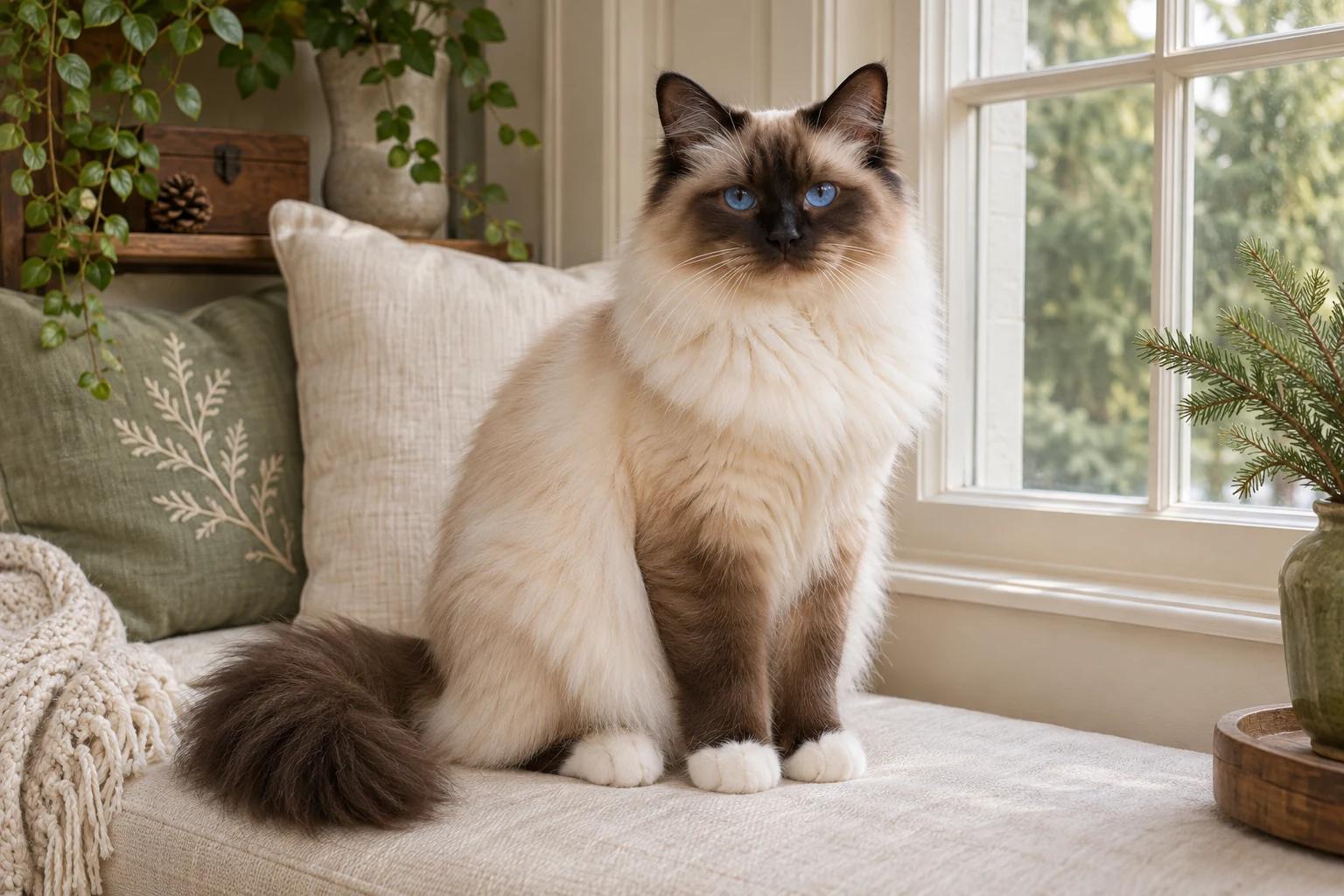
Birman cat temperament is best considered through everyday participation, not a promise that a particular cat will sit on every visitor's lap. The current Birman profile asks how the individual requests contact and how it indicates a break. Those are more useful questions than whether its photograph looks suitably gentle.
Birman cat temperament includes a playful side
TICA's Birman account describes following people through the day alongside an interest in chasing balls, fetching and interactive thinking toys. These are possibilities to explore, not a checklist every Birman must complete. A cat can seek company through movement as well as through a period of rest beside someone.
When considering Birman cat personality, find out which activity the animal already chooses. Does it pursue a rolling ball, work at an interactive toy or return to a familiar person between activities? The answer is more useful than assuming that a companionable reputation means a permanently stationary companion.
If a Birman does not fetch, that does not make its other play less worthwhile. You are looking for an activity the cat actually wants to repeat, rather than trying to confirm a breed anecdote. Equally, a favorite game does not need to occupy every encounter. Let play be one part of the relationship instead of the demonstration required whenever somebody asks what the breed is like.
Quiet company is still a form of involvement
VCA's Birman profile describes a gentle, inquisitive cat that seeks company in a quiet manner and speaks in soft tones. This is a description of a tendency, not a guarantee that every individual will be silent or respond identically to every person.
For a prospective owner, look beyond the volume of the greeting. Notice whether the cat chooses to spend time near a familiar person and what it does while there. An inquisitive companion may be interested in the activity itself; it need not interrupt loudly for its involvement to count.
A softer request is still something to notice. Learn the individual’s ordinary ways of seeking contact instead of treating a broad description as a rule that a different response must be wrong.
Read more than the sound of a meow
VCA's explanation of feline communication describes chemical messages, visual signals, sounds and physical contact. Cats can rub their heads or noses together, while rubbing against objects leaves scent information. Communication is therefore not limited to a vocal exchange that people can easily hear.
This helps put Birman cat behavior in perspective. A household observer who records only meows is missing much of what happens between animals. A brief physical greeting and a sound made toward a person are different events; they should not be collapsed into one score for sociability.
Observe the whole interaction and its circumstances rather than assigning a fixed translation to a single gesture. Who approached, what happened next and whether the animals remained together are relevant parts of the sequence. The aim is to become more attentive, not to build a dictionary that claims every movement has one universal meaning. Your Birman's interactions deserve to be understood as events involving particular individuals in a particular setting.
Private space is compatible with a companionable reputation
Ohio State's account of the hiding instinct explains that cats need places where they can feel safe from people, noise and other animals. An elevated location can provide a view of the surroundings. If an existing high hiding spot is unsuitable, provide a safe alternative rather than simply removing the option.
For a Birman, this is a useful counterweight to expectations of constant availability. A place with some visual cover can still allow the cat to watch. It does not need to be an exposed display shelf chosen because people would like a better view of the animal.
Consider the actual location rather than height alone. A space beside frequent household activity may not provide the separation you intended. The purpose is to make a genuinely usable option available, not to place the cat there as an experiment. An owner can value companionship while also recognizing that the animal needs somewhere to be out of the immediate flow of interaction.
Keep physical facts separate from character judgments
The current adult reference bands are 6–10 pounds for females and 10–15 pounds for males. They tell you about physical scale, not how much social confidence a particular cat has. Ten pounds lies in both reference bands. You cannot use that number to decide whether an individual will welcome an unfamiliar visitor.
Birman cat characteristics also need a clear context. An account of a kitten's behavior months ago is not the same evidence as a description of the adult animal today. Ask which period a concrete example refers to. This is particularly important when several people have known the cat at different ages or in different homes: they may be describing different circumstances rather than disagreeing about the same event.
A breed profile is not a record of this animal's experience with your household. The Birman first-night room guide addresses arrival preparation separately. Use the cat quiz to reflect on the kind of relationship you are hoping for, without treating a quiz result as a prediction about a particular cat.
FAQ
Does adult weight tell me whether a Birman is confident with visitors?
Birman adult weight bands describe physical scale, not confidence or experience with visitors.
Must every Birman fetch to fit the breed description?
A Birman need not fetch: the game is optional, not a measure of the cat’s value as a companion.
Should an old kitten description outweigh current observations?
An old Birman kitten description should not outweigh current observations; establish the example’s age and setting. Current observations concern the animal you are actually meeting.
Sources behind this article
Article source checked: November 16, 2026. Source checked 2026-11-16
Keep reading

American Bobtail cat temperament
Read article →