Bengal cat temperament
Understand Bengal cat temperament through exploration, individual social preferences and a home that allows both activity and retreat.
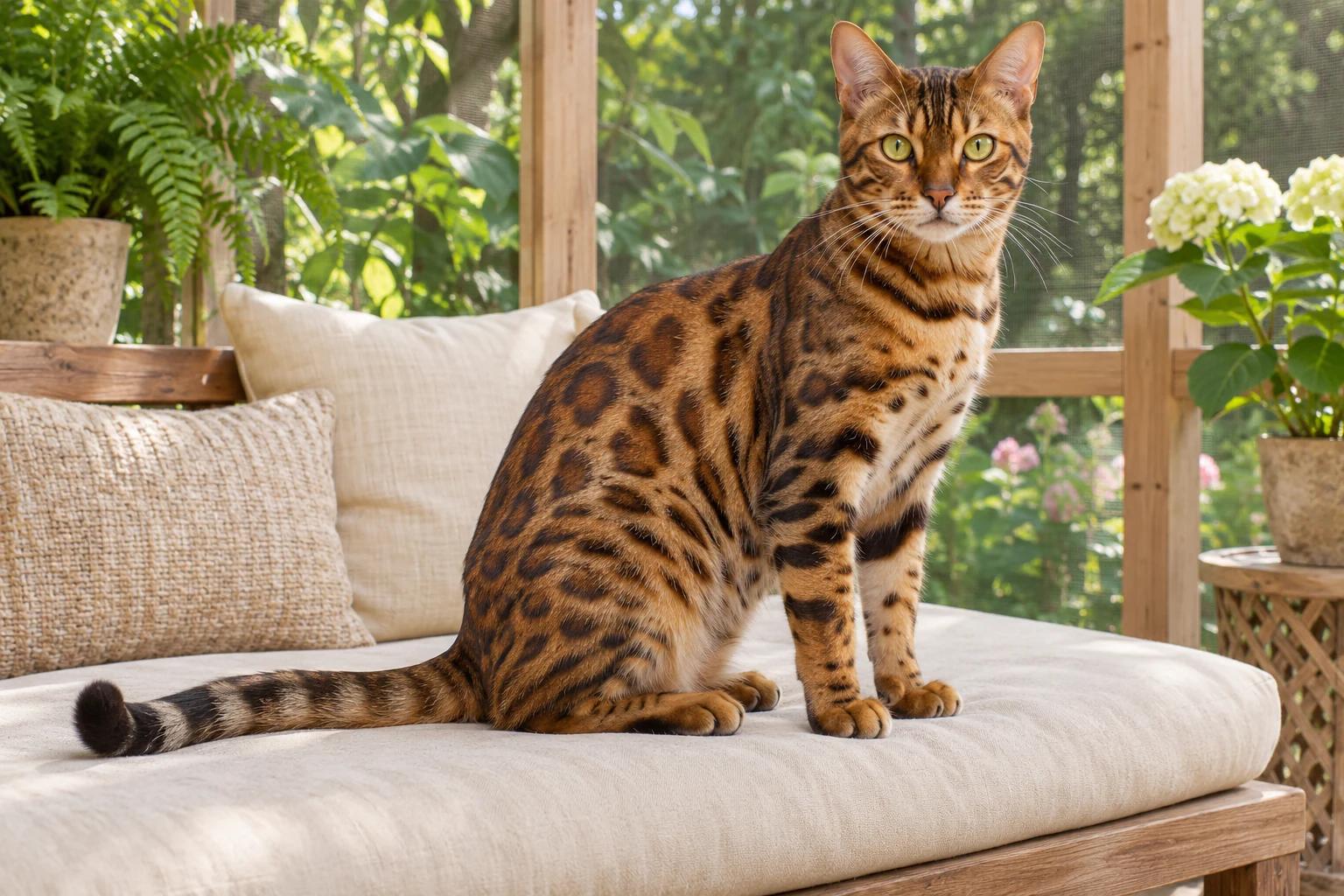
Bengal cat temperament deserves attention before coat pattern becomes the deciding factor. The current Bengal profile asks prospective owners to consider active interaction and learn about the individual animal. A photograph cannot tell you what that cat does during a normal afternoon, which activities it returns to or how it responds when a person is busy.
Bengal cat temperament: company can involve doing something together
TICA's Bengal account describes considerable individual variation, including more outgoing cats and others preferring quieter lives. It also distinguishes an interest in activity from wanting to be held during it. A cat can enjoy participation with people without choosing a lap at every opportunity.
This is useful when you meet a Bengal that approaches and then moves on to investigate something. The approach need not be converted into an extended cuddle to count as a friendly interaction. You can be part of what the cat is doing without asking it to stop doing it.
A shared activity and a quiet rest can occur at different times. Learn the actual pattern of participation instead of trying to label the cat permanently affectionate or independent from one encounter.
Exploration makes storage part of the practical relationship
VCA's Bengal profile describes alert observation and learning around doors and cabinets. Its examples make an important practical point: what looks like cleverness can also give the cat access to somewhere you did not intend.
A door that stays shut when pulled straight outward may still open when its handle moves. Assess the actual closure, not merely the appearance of a closed cupboard.
Check doors that protect household items rather than assuming a familiar-looking handle is beyond the animal's interest. If a cupboard contains things the cat should not reach, use an appropriate secure arrangement. The aim is not to test whether the Bengal can defeat it; it is to keep the contents inaccessible.
A cat opening a door is not automatically asking for a harder puzzle. It may simply have learned an effective action. Decide which access is acceptable and which needs prevention, instead of rewarding an entertaining demonstration and then becoming frustrated when it is repeated. That distinction makes it easier to appreciate an observant companion without letting the home become an unsupervised experiment with every storage space available.
Offer routes through a space, not just objects in a pile
GCCF's Bengal account identifies boxes, tunnels, activity structures and high shelves as possible opportunities for an active cat. These offer different experiences: moving through a tunnel is not the same activity as surveying a room from above.
Check that each feature is usable: a tunnel blocked by furniture cannot function as a route. Secure structures and accessible levels matter more than the sheer number of objects. An unused item may need a different position, not a forceful introduction.
An active cat still needs a place where interaction stops
Ohio State's refuge guidance describes a quieter area with the cat's necessities, including food, water, litter, scratching and resting opportunities. The cat should be able to enter and leave freely, and other household members should not bother it there.
This matters for a Bengal precisely because a reputation for involvement can tempt people to keep seeking another response. A retreat should not become the place where someone follows the cat to restart a game. Its purpose is to make quiet time genuinely available.
Choose an area away from constant traffic, while retaining practical access to what the cat needs. A room is not an effective refuge if the animal must leave it immediately to reach every essential resource. Explain the boundary to people sharing the home: availability for interaction is not unlimited. Respecting a quiet location lets an active relationship include rest without treating the pause as an unexpected defect in temperament.
Keep breed reputation separate from the individual history
Bengal cat personality cannot be calculated from adult weight. The current reference bands are 6–12 pounds for females and 9–15 pounds for males. A heavier cat is not automatically more confident with visitors, and a lighter cat is not necessarily less assertive about familiar activities. The numbers describe physical scale.
Bengal cat characteristics in this profile concern the established domestic breed. They are not an assessment of every hybrid generation. Keep the animal's actual identity and documented background clear rather than using a striking appearance as evidence of its ancestry or behavior. An ordinary owner choosing a companion should know which individual is being described.
Bengal cat behavior also needs to be understood in context. A familiar household and an unfamiliar meeting place are not identical situations. Ask for concrete examples from ordinary life, then recognize that your own home will present a new setting. This is more informative than trying to compress every possible response into one breed-wide adjective.
The cat quiz can help clarify your preferences. The Bengal play-rotation guide addresses the separate task of organizing everyday games.
FAQ
Is a photograph enough to assess the particular cat?
A Bengal photograph records appearance at one moment, not the animal’s history or its responses in different everyday situations.
Can weight tell me whether a Bengal will welcome visitors?
Bengal female and male weight ranges describe physical scale, not responses to visitors. They do not record experience with unfamiliar people.
Is the domestic-breed profile an assessment of every hybrid generation?
The Bengal domestic-breed profile concerns the established breed, not every hybrid generation. Verify the particular animal's identity rather than inferring it from coat appearance.
Sources behind this article
Article source checked: November 16, 2026. Source checked 2026-11-16
Keep reading

American Bobtail cat temperament
Read article →