Cat breed · Indian Ocean coastal regions and Southeast Asia in the account
Abyssinian: Health
Abyssinian health
Health observations and family records
Inherited rdAc retinal degeneration and PK deficiency have both been documented in Abyssinians. They concern different parts of the cat’s health: sight and red blood cells. A result for one does not cover the other.
A familiar route becomes harder
Tell your veterinarian if your cat begins bumping into familiar furniture or hesitating on steps it normally uses. Describe the change and the lighting without setting up a test or assuming the rdAc result explains it.
Energy changes deserve their own account
Unusual tiredness or weakness can have several causes. Mention when it started and whether it keeps happening; a PKLR DNA report is useful history, but it does not measure the cat’s current red blood cells.
Familial kidney amyloidosis
In some Abyssinian families, a protein called AA amyloid has built up in kidney tissue and damaged kidney function. This is one possible cause of chronic kidney disease, not an explanation for every kidney problem, and it is different from fluid-filled kidney cysts. Contact the vet for a lasting increase in thirst or large litter clumps, unintended weight loss, declining appetite or vomiting. Ask for same-day advice for repeated vomiting or a marked drop in eating. Collapse or severe weakness needs emergency care. If your cat repeatedly strains and passes only drops or no urine, go to an emergency vet immediately. Don’t assume it is part of kidney disease. Bring the diagnosis for any affected relative, if available, and a weight and appetite timeline. Ask which blood and urine checks and blood pressure measurements would help monitor kidney function. If kidney disease is found, ask what can and cannot be said about its cause without further testing and whether knowing the cause would change care. Keep fresh water and an easy-to-reach litter tray available. Ask which weight, appetite or litter changes should prompt an earlier check, and get a written plan for diet, medications if needed, and monitoring. Do not change food abruptly or give fluids or supplements without guidance.
Family history and screening
Ask for separately identified CEP290 rdAc and PKLR reports for the parents, and any clinical eye or anemia records in close relatives. The study authors recommend PK testing; that is research advice, not a guarantee about an individual cat.
Questions for your veterinarian
- Which findings were clinically confirmed in this family?
- Which condition does each report actually assess?
Choosing a kitten? Ask to see both parents’ results, with the animal’s name and the date on each report. If you’re adopting an adult, ask which records come with that individual.
Health sources
- Primary genotype survey and ophthalmic study, Menotti-Raymond et al., Tables 1–2
- Primary PKLR clinical genetics, Grahn et al. 2012
- UC Davis laboratory assay
- Cornell veterinary owner guidance
- Cornell Feline Health Center · Anemia
- Abyssinian pedigrees
- iCatCare kidney care
- Cornell lower urinary emergency
Screening evidence and limits
UC Davis identifies CEP290 rdAc PRA as a recessive retinal condition relevant to Abyssinians, and PK deficiency as a separate inherited cause of anemia. A carrier result is different from an affected genotype. Ask a veterinarian to interpret the named tests and any eye examination history; a panel is not a substitute for understanding which diseases it measures.
Rescues & sheltersPrint or citeBreed articles
Other profile sections and family fact sheet
Life with a Abyssinian
A household that enjoys interactive play and climbing opportunities may appreciate this active cat.
Explore home life →Active investigation and high perches.
Explore daily care →Occasional gentle brushing or combing removes loose hair from the short ticked coat.
Explore daily care →Print or cite this breed
Abyssinian family fact sheet
Breed-level references are a starting point. Ask about the individual animal’s routine and care needs.
- Build
- Medium-sized with a short, ticked coat
- Female
- 6–9 lb
- Male
- 7–12 lb
- Reference lifespan
- 14–17 years or more
- Adult size
- Adult weight often falls around 6 to 12 pounds.
Company
A household that enjoys interactive play and climbing opportunities may appreciate this active cat. Ask what the individual does when play pauses and whether it seeks touch or prefers to investigate nearby. Affection does not necessarily mean a willingness to sit on a lap.
Play & enrichment
Active investigation and high perches. Offer climbing and interactive games in a safe environment; observe the individual rather than turning the description into a fixed exercise quota.
Coat care
Occasional gentle brushing or combing removes loose hair from the short ticked coat. The related Somali has a different coat and needs its own care routine.
Everyday responsibilities
Plan food, supplies, routine care and veterinary visits. Agree who handles the everyday jobs and who covers absences.
Adult help
An adult should remain responsible for care, supervise children’s interactions and arrange help when needed.
My Breed Atlas. Abyssinian breed profile. https://mybreedatlas.com/cats/breeds/abyssinian
Read this profile’s sources →Adult ranges and source qualifications
- Build
- Medium-sized with a short, ticked coat
- Female
- 6–9 lb
- Male
- 7–12 lb
- Reference lifespan
- 14–17 years or more
Reference ranges describe the breed, not a prediction for an individual.
Daily care
Play & enrichment
Active investigation and high perches. Offer climbing and interactive games in a safe environment; observe the individual rather than turning the description into a fixed exercise quota.
More about everyday care
Provide places to retreat, separated resources, chances to play and predictable interaction. These are feline needs, not breed compatibility scores.
Coat, grooming & daily care
Occasional gentle brushing or combing removes loose hair from the short ticked coat. The related Somali has a different coat and needs its own care routine.
Training & communication
Reward a behavior the cat chooses with something it values. Build tasks in small steps, including approaching a carrier or a grooming tool. Stop when the cat is frightened, unwell or in pain; ask your veterinarian about cooperative care.
Food, routine & costs
The everyday ownership plan
Planning for this breed
Check that the home offers usable elevated places and that someone enjoys active interaction. Do not choose this profile on the assumption that affection means prolonged lap sitting.
Meals and body condition
Discuss portions and body condition with your veterinarian instead of using the registry weight range as a feeding target. Smaller meals and appropriate food puzzles can support natural feeding behavior. Give each cat a separate feeding station.
Time and costs
Before committing, budget for food, litter, equipment and continuing veterinary care. Agree who handles play, cleaning, grooming and care during absences. Obtain local estimates for the individual’s care instead of relying on an invented breed cost.
Home life
Temperament & companionship
A household that enjoys interactive play and climbing opportunities may appreciate this active cat. Ask what the individual does when play pauses and whether it seeks touch or prefers to investigate nearby. Affection does not necessarily mean a willingness to sit on a lap.
Home life & introductions
Prepare a quiet transition room with food, water, litter, hiding places and scratching options. Introduce resident cats gradually and proceed when both are comfortable. Breed reputation cannot establish compatibility with children, dogs or another cat.
Offer a quiet retreat and let the cat control its distance. Supervise children and introduce resident animals gradually; individual history matters more than a breed reputation.
Personality & care details
Personality & care profile
Breed tendencies vary by individual. Higher means more of the named tendency, not better.
What everyday life tends to involve
These notes describe a tendency for the breed. Every animal is an individual.
- Play
- Several play sessions through the day fit this cat.
- Coat care
- Brushing a few times a week fits this coat.
- Loose hair
- Loose hair tends to stay light. Brushing a few times a week fits this coat.
- Company
- Many like to stay close or keep some time to themselves.
- Adult size
- Adult weight often falls around 6 to 12 pounds.
- Time alone
- Long stretches alone are a poor fit. They want company nearby. A second cat is one way households cover a long stretch.
YOUR EVERYDAY LIFE
How could this breed fit your life?
See household examples or compare this breed with answers you chose to save. The examples show combinations where this breed appeared among the first five results. Other combinations can work too.
Saved matching preferences stay in this browser, never on your account. They expire after 30 days and are removed the next time this feature reads them. Health answers, children’s ages and free-text notes are not saved. This section does not reproduce those personal care notes.
History & sources
Heritage & appearance
Meet the Abyssinian
Adult ranges are reference examples, not targets or predictions for an individual cat.
Heritage & appearance
The name reflects early exhibition links with imports from Abyssinia, now Ethiopia; it is not proof of an ancient Egyptian origin. CFA discusses evidence pointing farther east.
More about this breed’s history
What the early stud book recorded
Abyssinians appeared in the National Cat Club’s stud book in 1896, although many early entries lacked the name of one or both parents. (GCCF Breed Advisory Committee: Abyssinian breeding policy)
Full breed details
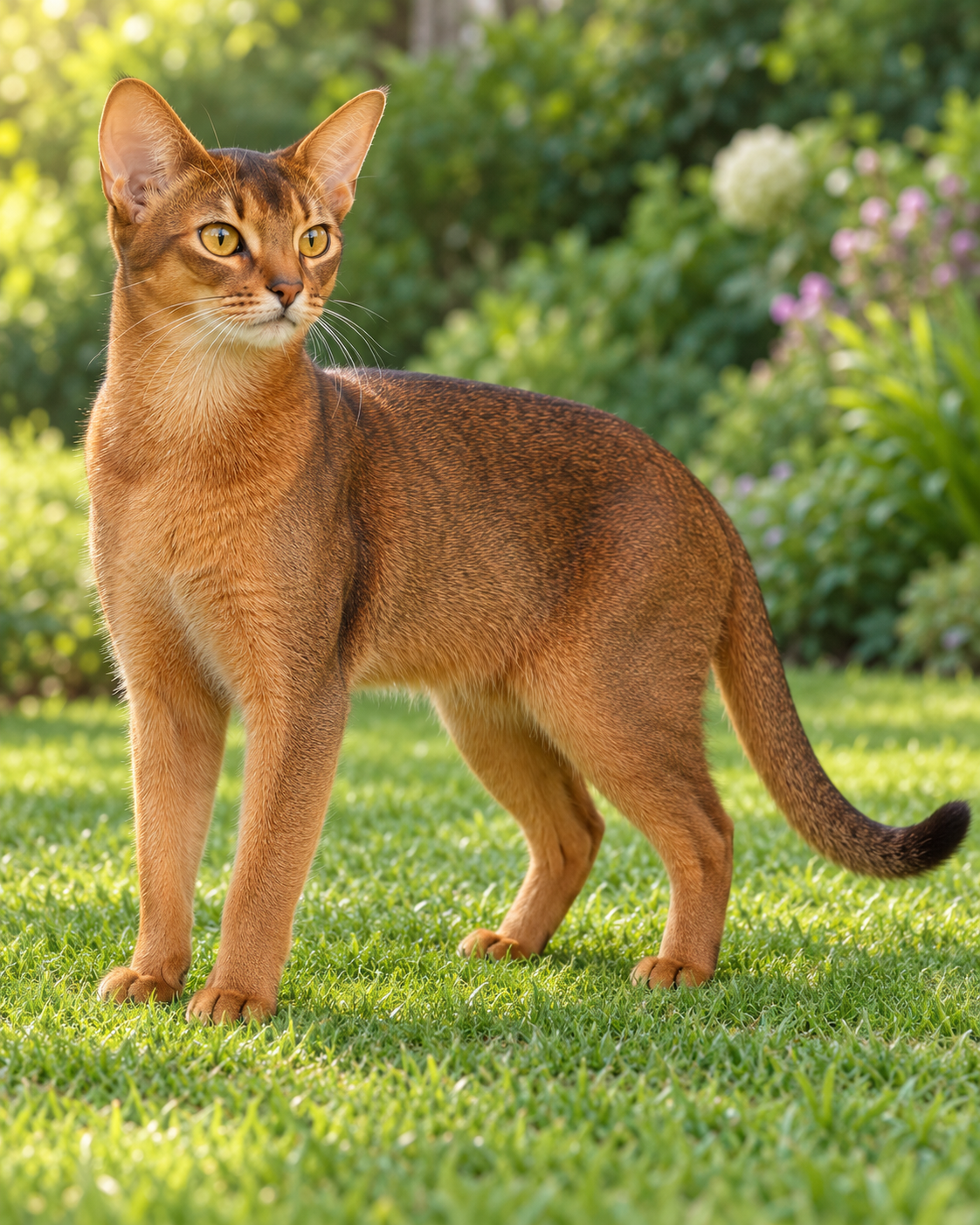
A shorthaired cat with a ticked coat and a light, muscular outline. Persistent curiosity, high activity and a preference for elevated places.
- Adult weight
- Females: 6–9 lb; males: 7–12 lb.
View all Abyssinian articles →
View sources and checked dates →References & editorial notes
Adult-weight sources
Female: 6–9 lb; Male: 7–12 lb
direct: TICA adult breed profile explicitly gives female 6-9 lb and male 7-12 lb; full mature adults. Amharic-language search completed; cited weight text is English.
- Progressive Retinal Atrophy (PRA rdAc)
- Erythrocyte Pyruvate Kinase Deficiency
- Abyssinian
- CFA 2026–2027 Breed Standards
- Recognised breeds
- Standing Rules Version C, 3 June 2026, section 701.4.1
- Using Positive Reinforcement to Train and Support Your Cat
- Making the Commitment to Adopt a Cat
- How to Feed a Cat
- Introducing a New Cat Into Your Home
- Meeting the Physical and Emotional Needs of Indoor Cats
- Abyssinian breed introduction
- Progressive Retinal Atrophy (PRA rdAc) Checked 2026-10-20.
- Erythrocyte Pyruvate Kinase Deficiency Checked 2026-10-20.
- Abyssinian Checked 2026-10-20.
- CFA 2026–2027 Breed Standards Checked 2026-10-20.
- Recognised breeds Checked 2026-10-20.
- Standing Rules Version C, 3 June 2026, section 701.4.1 Checked 2026-10-20.
- Using Positive Reinforcement to Train and Support Your Cat Checked 2026-10-20.
- Making the Commitment to Adopt a Cat Checked 2026-10-20.
- How to Feed a Cat Checked 2026-10-20.
- Introducing a New Cat Into Your Home Checked 2026-10-20.
- Meeting the Physical and Emotional Needs of Indoor Cats Checked 2026-10-20.
- Abyssinian breed introduction Checked 2026-10-20.
Breeders & rescues
Questions to bring
- Are rdAc PRA and PK-deficiency results both documented, with carrier and affected findings clearly distinguished?
- Which climbing and play activities hold this cat's interest?
- Are PRA and PK-deficiency results available with verified identities?