Russian Blue Cat Temperament: Reserve, Curiosity and Familiar Company
Understand Russian Blue cat temperament through familiar company, curiosity and retreat while respecting individual preferences and changed behavior.
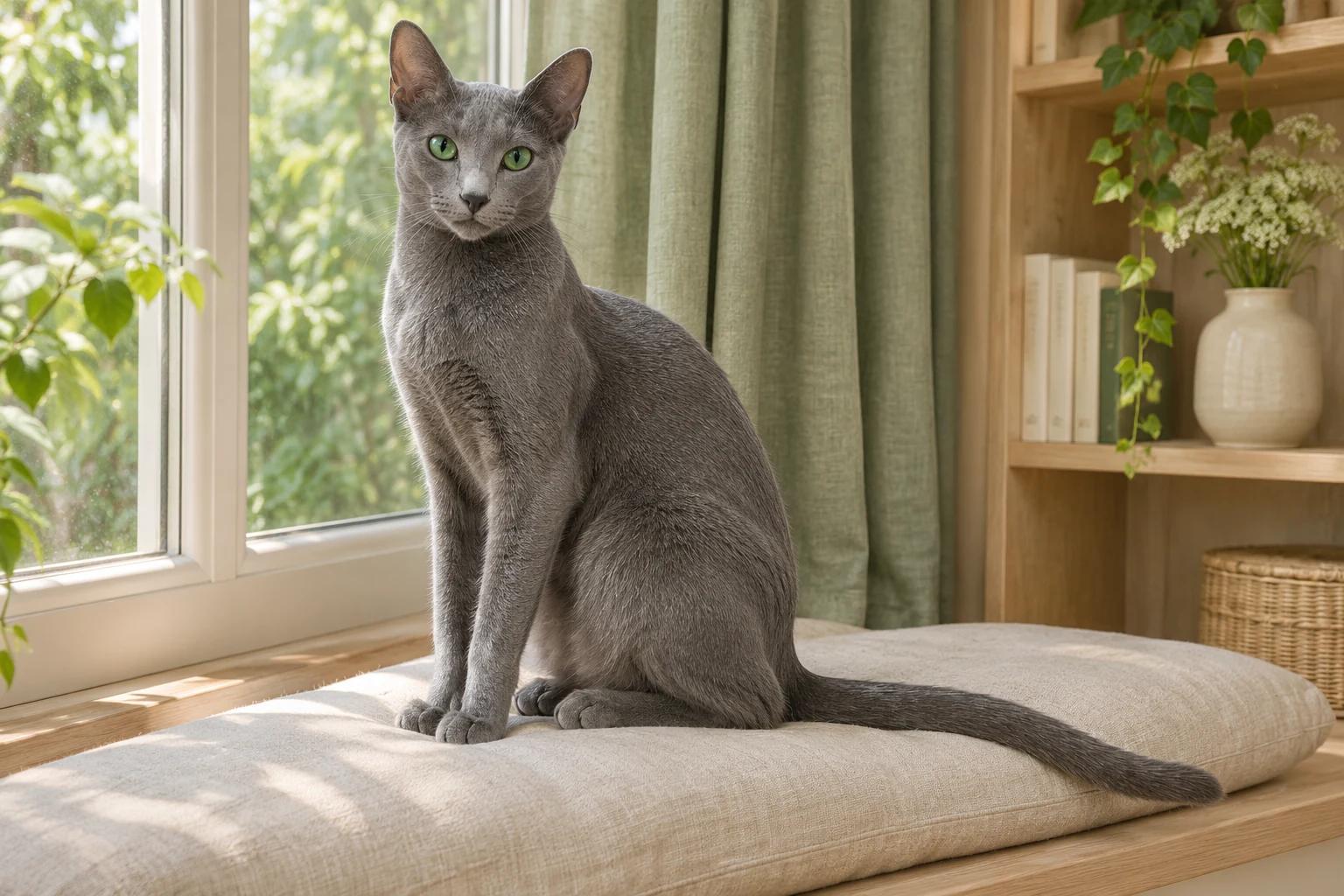
Russian blue cat temperament is often described as affectionate with familiar people and more reserved in unfamiliar situations. Those tendencies can coexist. A cat that watches a guest quietly may be playful with its caregiver later, and a comfortable greeting does not promise the same response at every visit. Understanding the individual requires patience with both contact and distance.
This article explores russian blue cat personality as part of daily life and an ownership decision. It stays separate from the existing short-stay planning guide and does not label reserve as a problem that must be trained away.
Russian blue cat temperament: learn both sides of the story
CFA describes curiosity and affection as well as caution around unfamiliar people. The current Russian Blue profile asks prospective owners to learn how a cat behaves with familiar caregivers and visitors. One setting alone gives an incomplete account.
Ask for ordinary examples: where the animal rests while someone works, how it initiates a game and what it does when a guest enters. Those details are easier to use than a promise of loyalty or a label such as shy. They also help you distinguish observed behavior from a caregiver's interpretation.
At a meeting, give the cat time to remain at a comfortable distance. You do not need to obtain a cuddle to learn something useful. Ask whether the room and circumstances are familiar and whether the behavior you see is usual for that situation.
Let an approach remain the cat's choice
A quiet person sitting nearby can offer an opportunity without pursuing the animal. If the cat approaches, avoid assuming it wants every kind of touch. Investigation, resting close and accepting petting are different experiences.
Pause during contact and notice whether the cat chooses to continue. If it moves away, let it leave without following. A breed reputation for devotion should not make the animal responsible for completing an interaction a person hoped to have.
Explain that arrangement to guests and children. Adults should supervise and keep resting places undisturbed. A home can welcome a reserved companion without organizing repeated encounters intended to prove that the cat has become sociable enough.
Curiosity may be easier to see in a familiar room
Russian blue cat characteristics include interest in surroundings and games in the registry account. A new setting may not reveal those preferences immediately. Ask what the individual explores or plays with when comfortable, then consider how your home can provide suitable opportunities.
FelineVMA's indoor-cat guidance treats resources, retreat, play and positive contact as parts of a wider environment. A quiet retreat is not the opposite of enrichment. It gives the cat another choice while it learns about people and activity elsewhere in the home.
Secure hazards rather than expecting curiosity to stay within an unspoken boundary. If the animal investigates a cupboard, review its access and contents instead of labeling it mischievous and relying only on verbal correction. Practical arrangements can support a relationship without making every exploration a conflict.
Do not treat quietness as an explanation for every change
Russian blue cat behavior can be easy to overlook when the household expects a restrained companion. Notice changes in familiar contact, activity or movement, not just dramatic events. A cat that stops approaching a favorite person has given you information even if it remains silent.
Describe what happened and seek veterinary advice when concerned. Do not decide that a new avoidance is simply a normal breed trait. The source of a change may require assessment, and this guide cannot diagnose it from a brief description.
Concrete notes help: the cat left when a hand approached a particular area, avoided a familiar route or did not return to a game. Avoid testing the response repeatedly to make the evidence more convincing. Follow professional advice about what observations are useful next.
Introductions need more than a reputation
A cat comfortable with one familiar animal may still need careful preparation to meet another. Ask about the actual history, including the setting and time involved, rather than recording a general assurance that Russian Blues get along with pets.
Provide appropriate separation and resources and obtain advice on a gradual introduction. Each animal needs access to retreat and care without being forced into contact. A quiet cat should not have to defend its resting place to demonstrate that it can share a home.
The same care applies to visitors. Avoid surrounding a retreat or encouraging everyone to call the animal at once. An uneventful visit in which the cat chooses distance can be acceptable; the household does not need a staged greeting as proof of success.
Match expectations before adoption
Discuss how much interaction people hope for and how they respond when a cat declines. Someone wanting a companion to show to every visitor may have different expectations from someone content with quiet nearby company. Neither wish should be resolved by promising a temperament the individual has not shown.
Include ordinary care in the conversation. Ask which grooming and handling are familiar and what support is needed if they become difficult. Affection for one person is not a substitute for a workable care plan when that person is away.
The separate Russian Blue short-stay article addresses temporary arrangements rather than defining personality. Use its planning questions when needed without assuming that a breed label determines whether relocation or home-based help is best.
Keep the individual visible in the final decision
The cat quiz can organize your preferences, but it cannot predict a greeting or resolve every unknown. Bring its prompts back to the actual care history and the observations you were able to make.
Ask what the caregiver would most want a new household to understand during the first week. A practical answer about preferred distance, familiar games or a difficult task is more useful than a perfect-sounding description. A sustainable relationship gives the cat room to be interested, affectionate or quietly separate without having to prove the breed's reputation.
Frequently asked questions
Are Russian Blues always shy?
No. Breed accounts describe tendencies, including reserve in unfamiliar situations and interest with familiar people. Ask about the individual across more than one setting.
Does a cat approaching a visitor want to be held?
Not necessarily. Investigation, nearby company and lifting are different experiences. Let the animal's response guide contact and allow it to leave.
Can a sudden avoidance be dismissed as reserve?
No. Discuss a new or concerning change with your veterinarian. A breed description cannot establish that the animal is comfortable or explain the cause.
Should every guest try to socialize the cat?
No. Protect retreat and offer appropriate opportunities without repeated pressure. The cat need not perform a greeting for a visit to be managed thoughtfully.
Sources behind this article
Article source checked: November 20, 2026. Source checked 2026-11-20
Keep reading

American Bobtail cat temperament
Read article →