Lykoi cat temperament: understanding company and play
Explore Lykoi cat temperament through social contact, active play and responses to visitors, with practical distinctions for getting to know an individual.
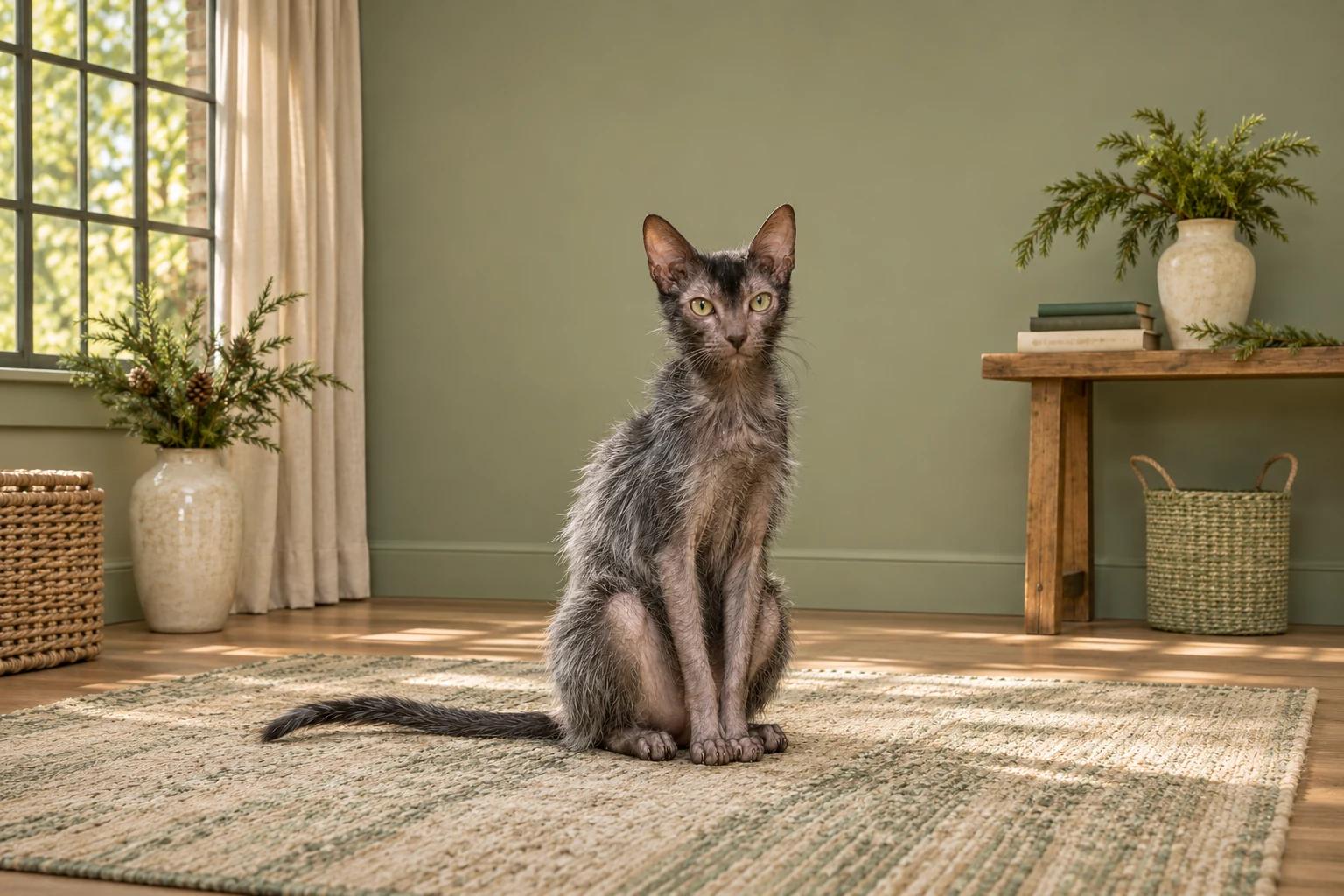
Lykoi cat temperament is described here through three registry accounts and a separate veterinary play guide. Each contributes a different part of the discussion. The breed descriptions supply context, while the practical guide addresses an activity owners can try with cats generally.
The Lykoi breed profile introduces the breed. This guide takes a closer look at the meanings behind everyday descriptions: what counts as interaction, what a game involves and what you can learn when meeting a particular cat. Reading about Lykoi cat characteristics is not a pass-or-fail test. It is to make your questions specific enough that the answers describe the cat in front of you, rather than an imaginary representative of every Lykoi.
Lykoi cat temperament includes independent play
TICA's Lykoi account describes a cat that enjoys people but can also find satisfaction playing alone. It describes searching, chasing and fetching, with active engagement often preferred to remaining on a lap.
That combination is useful when thinking about Lykoi cat personality. Time spent absorbed in an object is not necessarily a rejection of the person sharing the room. The activity itself may be what holds the cat's attention. A cat can finish exploring a toy and subsequently choose a different kind of interaction.
Ask what happens during a familiar game rather than whether the cat is simply “dog-like.” Does it follow the object, investigate where it went or bring it back? Those answers describe distinct actions. They do not require treating a feline as a small dog or assuming that every Lykoi will perform a retrieval.
An owner who enjoys watching a cat work something out may appreciate this aspect of the breed. Company need not always mean occupying the same seat or participating in exactly the same activity.
A visitor and a familiar person are different situations
LOOF's breed account describes initial wariness when an unfamiliar person arrives, alongside curiosity that keeps the Lykoi interested. It also describes cats choosing the top of a cat tree to survey their surroundings.
For someone meeting a Lykoi, an elevated observer is not an absent participant. You can see whether the cat remains interested without insisting that it come down and greet you at floor level. Looking toward a visitor and walking up to that visitor are different stages of an encounter.
This is a more useful way to interpret Lykoi cat behavior than judging sociability by the first few seconds after the door opens. Compare the response to you with the response to a familiar person already in the room. The difference may be part of the encounter, not a contradiction in the description.
A high viewpoint also lets the cat remain present without joining the closest activity. In a household, that gives “being with everyone” a broader meaning than sitting among their hands and feet.
Affection is not an appearance-based prediction
FIFe describes Lykoi as affectionate toward their owners and receptive to human affection. Its temperament account explicitly contrasts the breed's dramatic visual impression with its companionable personality.
The useful lesson is not that appearance should make you expect the opposite behavior. It is that the visual impression is the wrong evidence for deciding how the animal relates to people. Neither an intimidating-looking portrait nor a particularly endearing one establishes a specific cat's preference for contact.
When discussing a Lykoi's affectionate side, ask for examples involving its familiar people. Does the description refer to encounters that the cat starts, or to contact it accepts when someone else approaches? Both can matter, but they are not identical descriptions of the relationship.
Do not turn a positive breed account into a requirement that the cat demonstrate affection on demand. “Affectionate” is useful shorthand only when it leads back to the animal's actual relationships. It is not a promise that a stranger will receive the same response as an established companion.
Keep the game separate from your fingers
VCA's general feline play guidance recommends directing predatory games toward toys rather than hands and feet. It also recommends games in which the cat can eventually catch the object. These are feline play principles, not a special Lykoi training experiment.
In practice, choose a game in which your hand operates the toy without becoming the thing being pursued. A wand creates that separation. Let the cat's successful catch be part of the activity instead of repeatedly removing every chance to reach the object.
VCA also cautions that brief play followed by rest does not necessarily mean a cat dislikes its toys. That prevents an owner from interpreting every pause as a need to buy something different or intensify the game. The length of the encounter can change without the toy becoming worthless.
Wand toys are for supervised interaction and should not be left with an unattended cat. The distinction between a shared game and an object left available afterward is important even when both involve the same toy.
For a different aspect of ownership, see the Lykoi coat-change diary. The cat breed quiz can help organize your wider preferences.
Frequently asked questions
Does a Lykoi always want lap time?
A Lykoi may prefer an active game; TICA describes both human company and independent play.
Is a cautious first greeting unusual for a Lykoi?
LOOF describes initial Lykoi wariness toward unfamiliar people alongside curiosity about the newcomer.
What does an affectionate Lykoi description mean?
FIFe's Lykoi account describes affection toward owners, not a guarantee of identical contact with everyone.
Sources behind this article
Article source checked: November 16, 2026. Source checked 2026-11-16
Keep reading
Lykoi Cat Size: Weight, Height and Build Explained
Read article →