LaPerm cat temperament: company, play and everyday choices
Explore LaPerm cat temperament through everyday company, toy play and individual preferences, with breed accounts separated from general feline research.
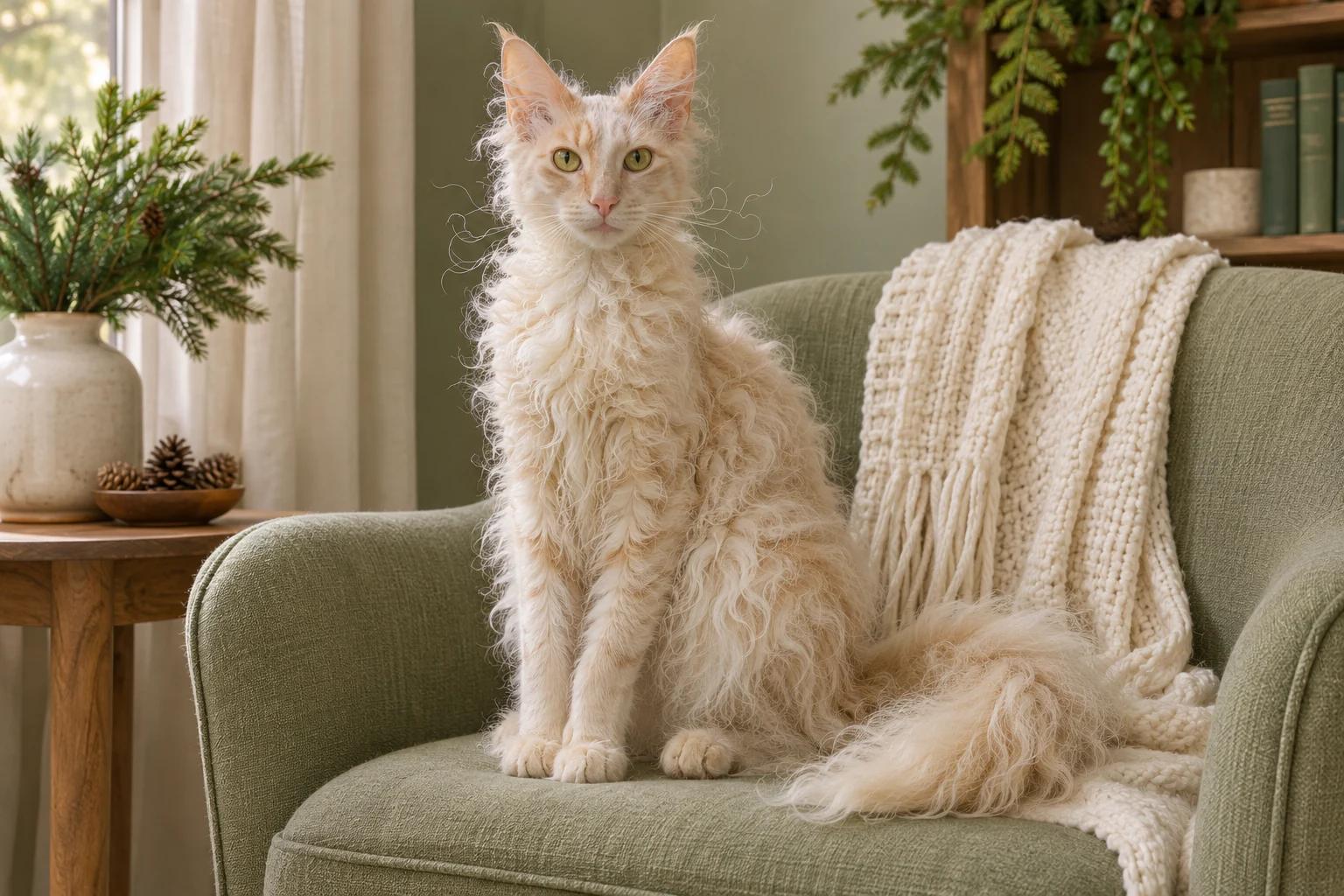
LaPerm cat temperament is easier to understand through specific actions than through a string of flattering adjectives. “Personality” describes an overall impression; “behavior” describes something the animal actually does. Keeping those meanings separate makes a breed account more useful when you are considering a particular cat.
Start with the LaPerm breed profile, then ask what the description would mean in your home. A photograph identifies the animal you are discussing, but it cannot supply an account of an ordinary day. Nor does one attractive moment explain every part of that day. The questions below separate different kinds of interaction rather than treating one performance as a complete personality test.
LaPerm cat temperament: company can be an active choice
TICA's LaPerm account describes cats that follow their people and sometimes tap a passing person's legs for attention. This describes approaching a person during ordinary activities.
For an owner, the useful distinction is between proximity and a particular form of contact. A LaPerm following you from one room to another may be seeking involvement without having selected your lap. Notice where the cat chooses to stop. Standing beside you, settling nearby and moving on again are different outcomes, not different grades of affection.
TICA also recommends a tall cat tree as a place from which the LaPerm can survey its surroundings. An elevated viewing place offers another way to share a room. A cat watching from there need not be brought down to prove that it wants company.
This picture of LaPerm cat personality leaves room for movement and observation alongside closeness. It is more useful than expecting every friendly encounter to end with the same pose.
A toy game is not an obedience examination
VCA's LaPerm profile describes interest in hunting toy mice, learning commands and tricks, and playing fetch. These are possibilities, not requirements.
The practical difference between chasing and retrieving matters. A cat can rush after a toy mouse, catch it and remain with it. That is a completed chase even if the person hoped to receive the toy back. Calling the cat unsuccessful would confuse the owner's chosen endpoint with what the animal actually did.
Similarly, an interest in learning does not tell you that a cat already understands a particular word. Ask which actions an individual has learned and what signal is used. “Knows a trick” is less informative than seeing the specific action and its cue together.
These LaPerm cat characteristics suggest possibilities for shared activity without establishing an intelligence ranking. A cat that prefers the chase to the return is not thereby less capable than one that retrieves. Choose the activity you can both participate in, rather than treating each session as an audition.
Notice when the invitation comes from the cat
The LaPerm Cat Club describes some LaPerms bringing their toys to people to request play. Its account also describes playful behavior continuing into adulthood. Notice the invitation before deciding on a game.
A toy arriving beside your chair gives you something more specific to respond to than the label “energetic.” The animal has supplied an object and approached a person. You can acknowledge that particular interaction without assuming that every arrival beside the chair has the same purpose.
The club also describes LaPerms as tactile cats that enjoy stroking and may purr loudly. Treat that as a description of possible interaction, not an instruction to hold the cat in place. There is a meaningful difference between contact the cat returns to and contact maintained only because the person prevents departure.
Together, these observations make room for the LaPerm as an initiator. An adult cat's contribution to the relationship can include proposing an activity, rather than merely accepting whatever the owner has scheduled.
What general fetching research can, and cannot, explain
A survey by Forman and colleagues collected reports about 1,154 fetching cats from 924 owners. Most owners reported that fetching appeared without deliberate training. Cats were also reported to initiate and end sessions more often than their owners.
This was research about cats already reported to fetch, not a LaPerm trial. It cannot establish how likely a LaPerm is to retrieve, or how a non-fetching LaPerm should be taught. The responses came from owners, not controlled demonstrations in which researchers presented identical objects and cues to every cat. That matters when reading the findings: the survey describes reported household experience, rather than proving a standardized level of performance. Its useful contribution is narrower: spontaneous participation and trained performance are not interchangeable explanations for the same outward action.
For someone interpreting LaPerm cat behavior, that distinction prevents an unnecessary assumption. A returned toy does not by itself show that a verbal cue was learned. Conversely, the absence of a return does not demonstrate a training failure when no such lesson took place.
For coat questions rather than behavior, read LaPerm curls and knots. When considering your broader preferences, the cat breed quiz provides a separate starting point.
Frequently asked questions
Must a friendly LaPerm sit on my lap?
A LaPerm can seek company by following or observing nearby; lap sitting is not the only form of involvement.
Does a LaPerm have to play fetch?
A LaPerm may prefer chasing toy mice to returning them. VCA's breed description is not a required performance checklist.
Can an adult LaPerm still initiate play?
The LaPerm Cat Club describes playful adults and some LaPerms bringing toys to people to request a session.
Sources behind this article
Article source checked: November 16, 2026. Source checked 2026-11-16
Keep reading
LaPerm cat size: adult weights and proportions
Read article →