Khao Manee cat temperament: company, play and communication
Explore Khao Manee cat temperament, from shared games to quiet interaction, with practical settling-in guidance and clearly separated feline research.
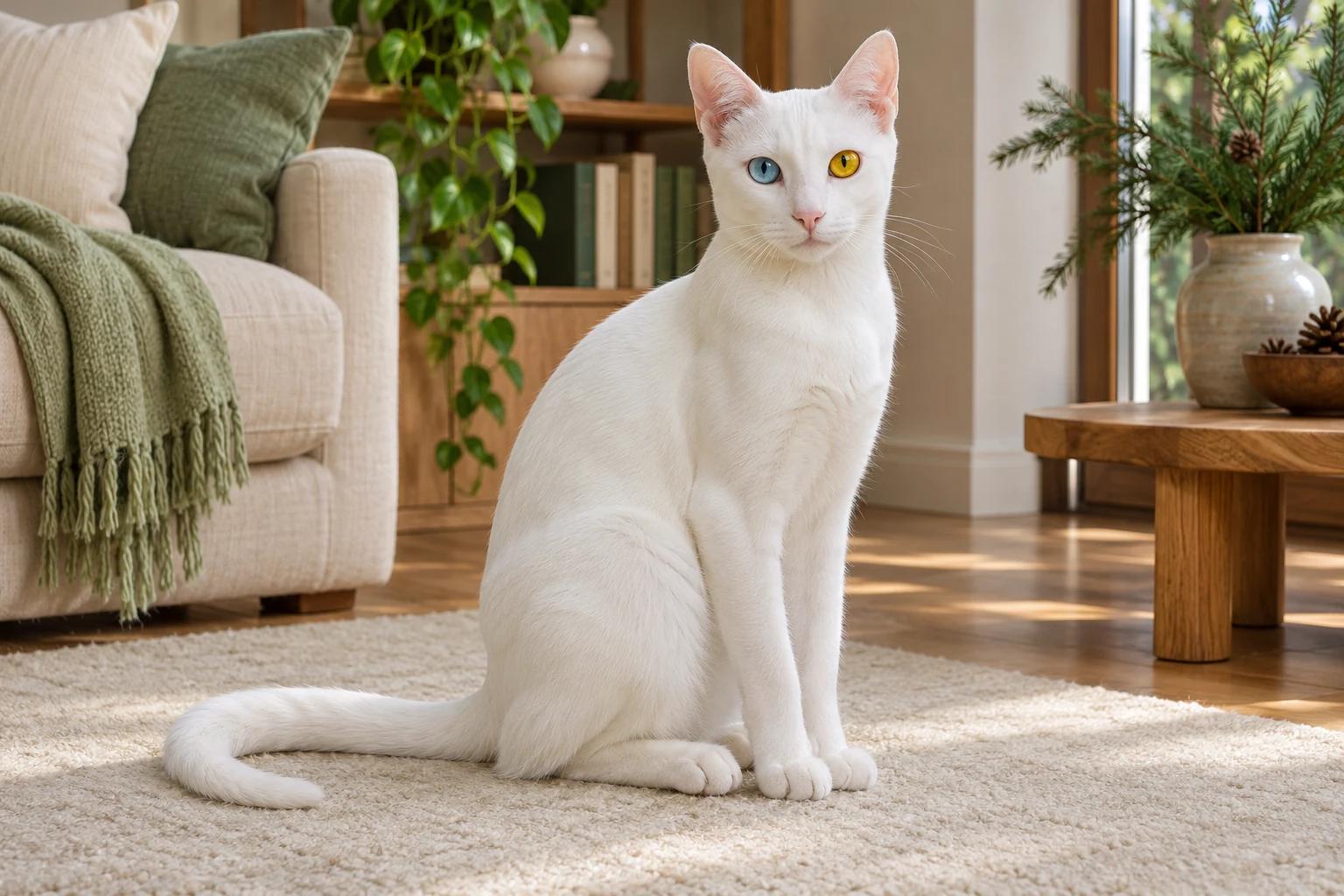
Khao Manee cat temperament is most useful as a starting point for a relationship, not a script you expect an animal to perform. When reading about Khao Manee cat characteristics, ask what you mean by a good match before reducing that question to a single adjective. The time you want to share with a cat, the kinds of interaction you enjoy and the expectations you bring to a new pet all deserve consideration.
The Khao Manee profile provides the broader breed overview. This closer look separates the registry's account from practical guidance for cats generally and from experimental research. None of those sources should be mistaken for a personal assessment of the kitten or adult in front of you. The aim is to make your expectations more precise, not to give every Khao Manee an identical personality score.
Khao Manee cat temperament includes shared activity
TICA's breed account describes a curious, playful cat interested in people, including shared fetch games and exploration. Its personality description also includes settling beside an owner after activity. These are compatible descriptions, not mutually exclusive labels of “active” or “affectionate.”
When considering Khao Manee cat personality, picture involvement rather than a pet that supplies entertainment without your participation. A shared game involves your responses as well as the cat's actions. Resting together describes another kind of time, with less movement but continued proximity.
The useful question is which parts of that pattern appeal to you. Someone who likes interacting with a cat during the day may welcome the breed's described engagement. Someone who wants companionship only at a single appointed moment should think carefully about that expectation.
TICA's descriptions are tendencies, not a demand that your cat retrieve a toy or settle in a particular position. Learn which activities the individual chooses rather than using one game as a test of whether it has the correct temperament.
Give a new arrival a manageable first meeting
Cats Protection's arrival guidance recommends placing the carrier on the floor in the prepared room, opening it and allowing the cat to emerge without crowding or lifting it out. This is general settling-in advice, not a special Khao Manee training exercise.
Once the cat is out, get down to its level and let it approach. If it chooses to hide, sit quietly nearby rather than pulling it into an introduction. The charity also recommends introducing family members gradually, one at a time, after the cat has become confident with you.
For a Khao Manee owner, the practical change is to replace a group welcome with a sequence of individual meetings. Give the animal an opportunity to encounter one person before adding another. This makes the first interaction something the cat can approach, rather than an event imposed around it.
Keep that initial setting separate from your judgment of long-term temperament. Arrival in a new room is a particular circumstance, not an audition in which a cat must immediately demonstrate its breed description.
Quiet facial interaction is worth understanding
Humphrey and colleagues studied slow-blink sequences in domestic cats. Cats narrowed their eyes more during interactions involving human slow blinks, and in a second experiment had higher approach scores after an unfamiliar experimenter slow-blinked than after a neutral expression.
A slow-blink sequence involves partly closing the eyes, with a longer narrowing or closure. This is a possible quiet interaction to offer your Khao Manee, not a stare to sustain until the animal responds. In the study, cats were tested at home and could disengage; the first experiment's trials ended when a cat walked away.
The researchers did not establish a Khao Manee-specific effect. Nor did they prove that one blink reveals an entire emotional state. Their findings concern a particular exchange between cats and people, with limitations including variation in gaze direction and the way owners performed the movements.
Use that distinction to keep your response proportionate: an observed exchange can be interesting without becoming a claim that you have decoded everything your cat feels.
A toy preference is not a personality verdict
Bol and colleagues' enrichment study offered four plant materials, including catnip and silver vine, to 100 domestic cats. Responses differed between individuals and materials. Some cats that did not respond to catnip responded to another option.
Importantly, the researchers did not test breed associations, because most participants were domestic short-haired cats or mixes. They also found no association between response and their categories of shy, intermediate or affectionate behavior. That makes the study relevant to interpretation, not a basis for predicting Khao Manee cat behavior from breed alone.
If a Khao Manee ignores a catnip toy, that response does not establish that the animal is generally unplayful or uninterested in people. You have learned something about that interaction, not measured every aspect of its temperament.
The study is not a recipe for collecting plants, preparing extracts or giving supplements. Responses to enrichment and social behavior are different observations. Do not let enthusiasm for one product become your definition of a sociable cat.
Use the cat breed quiz for broader preference matching. The Khao Manee shade and sun protection article addresses a separate practical subject.
Frequently asked questions
Must a Khao Manee enjoy fetch?
No. TICA describes fetch among Khao Manee activities, but that does not make retrieving compulsory for every individual.
Does slow blinking prove a Khao Manee is happy?
No. The slow-blink research supports a possible positive interaction, not a complete reading of a Khao Manee's emotional state.
Does ignoring catnip mean a Khao Manee is unsociable?
No. The plant-enrichment study did not link responsiveness with its social-behavior categories, and it did not establish a Khao Manee-specific response.
Sources behind this article
- TICA Khaomanee ↗
- Cats Protection: Bringing a Cat Home ↗
- Humphrey and colleagues: cat eye narrowing and communication ↗
- Bol and colleagues: feline responses to plant enrichment ↗
Article source checked: November 16, 2026. Source checked 2026-11-16
Keep reading

American Bobtail cat temperament
Read article →