Japanese Bobtail cat temperament: understanding the individual
Explore Japanese Bobtail cat temperament through exploration, play and communication, with practical examples and clearly scoped feline research.
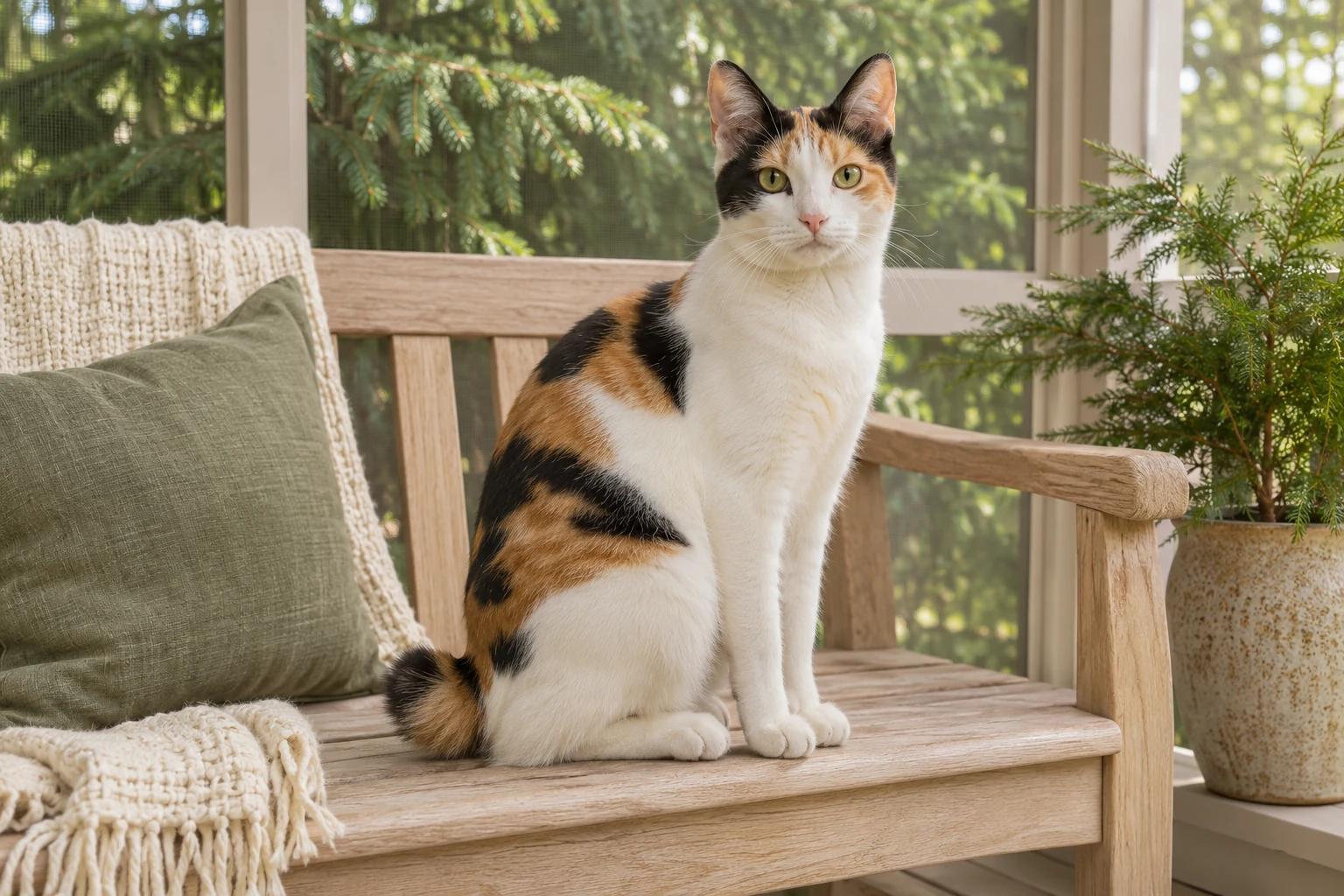
Japanese Bobtail cat temperament is more useful as a description of everyday behavior than as a list of flattering adjectives. “Intelligent,” for example, does not tell an owner what an afternoon together will involve. The practical question is what this particular cat chooses to do and how you will participate.
The Japanese Bobtail breed profile provides the broader ownership picture. Here, distinguish the breed accounts from general feline learning and communication research. They offer different kinds of information, and neither should be presented as a test result for a cat you have not met.
Japanese Bobtail cat temperament includes an investigative streak
TICA's breed account describes cats that explore cupboards and seek elevated viewpoints, alongside interest in games and human company. It describes brief lap visits rather than assuming that the animal will stay settled there for a long period.
That gives Japanese Bobtail cat personality a concrete shape: proximity to people can coexist with wanting to investigate something else. Moving away from a lap to explore does not automatically contradict the description of an affectionate companion. It may be a different activity within the same afternoon.
For the owner, think about where that investigative interest goes. A cupboard and a high viewpoint are different attractions: one contains things to inspect, while the other changes what can be seen. Ask which places the individual returns to and what captures its attention there, rather than treating all exploration as one burst of energy.
These examples help you picture living with the breed without making prolonged stillness the only acceptable expression of companionship.
Carrying, chasing and returning are not the same game
VCA's Japanese Bobtail description includes carrying objects in the mouth, enjoying fetch and chasing feather-wand toys. It also describes interest in learning commands and tricks.
These examples help unpack Japanese Bobtail cat behavior. A cat that picks up an object may be enjoying possession of it rather than offering an immediate return. A chase involves following movement; fetch includes bringing an object back. Do not assume that enthusiasm for the first part proves the entire sequence has been learned.
When a caregiver says the cat “plays fetch,” ask what actually happens: does it bring the object toward the person, drop it nearby, or carry it somewhere else? Each answer describes a different interaction you might enjoy together. None requires treating the animal as a failed retriever.
Ask about the Japanese Bobtail's familiar tricks. Ask which action and cue are familiar. A history of learning one task is more informative than an unsupported promise that the cat will understand anything immediately.
An activity can be learned one part at a time
Chris and Linda Shaffer's CFA agility article distinguishes learning separate obstacles from learning a fixed sequence. Their account describes teaching the individual obstacle, then changing the arrangement. It also emphasizes practicing passage from both directions.
For a Japanese Bobtail owner, that offers a useful way to think about an interested learner without turning an energetic reputation into an instant competition plan. A familiar tunnel and a completely new course are not equivalent tasks. Understanding one part of an activity does not establish that every combination will already make sense.
The article's example begins with a very low hurdle that a cat may walk over. The initial lesson is the action and cue, not achieving an impressive jump. This is general training experience, not a Japanese Bobtail-specific experiment or a reason to set a height target.
Keep the difference between learning and performance clear. An activity can be worthwhile at home without being a public demonstration, and a breed description does not require you to turn play into a timed event.
A familiar voice is part of a relationship, not a universal command
An abstract by de Mouzon and colleagues reports playback experiments with sixteen companion cats. The cats distinguished speech addressed to them from speech addressed to adults when the speaker was their owner. The same distinction was not apparent with unfamiliar speakers.
This is general feline research, not a finding about Japanese Bobtails alone. It does not establish that cats understand every word or that one special tone guarantees a response. The result concerns discrimination between speech styles in a relationship and experimental setting.
For someone considering Japanese Bobtail cat characteristics, the useful point is that communication includes a familiar person's side of the exchange. An unfamiliar visitor saying the same phrase is not necessarily recreating the interaction the cat usually has with its owner.
Do not use one meeting to decide that a cat has contradicted its entire description. Ask how ordinary interactions unfold with familiar people, and keep that history separate from the observation you have just made.
For a separate practical topic, the Japanese Bobtail carrier-at-home guide addresses making travel equipment familiar. The cat breed quiz can help you compare broader ownership preferences.
Frequently asked questions
Must an affectionate Japanese Bobtail stay on a lap?
No. TICA describes Japanese Bobtails taking brief lap visits alongside exploration and other activity; prolonged lap time is not the only form of company.
Does carrying a toy mean my Japanese Bobtail already plays fetch?
Not necessarily. A Japanese Bobtail carrying an object and returning it to you are different parts of an interaction.
Was the speech study a Japanese Bobtail-specific experiment?
No. The speech study involved companion cats generally, not a Japanese Bobtail-only sample, and does not supply a breed-specific communication score.
Sources behind this article
- TICA Japanese Bobtail ↗
- VCA Japanese Bobtail ↗
- CFA agility training by Chris and Linda Shaffer ↗
- de Mouzon and colleagues: cat-directed speech, published abstract ↗
Article source checked: November 16, 2026. Source checked 2026-11-16
Keep reading
Japanese Bobtail cat size: weights and body proportions
Read article →