Japanese Bobtail cat size: weights and body proportions
Understand Japanese Bobtail cat size with current adult weights, a slender muscular frame and a careful look at what tail and growth research can tell you.
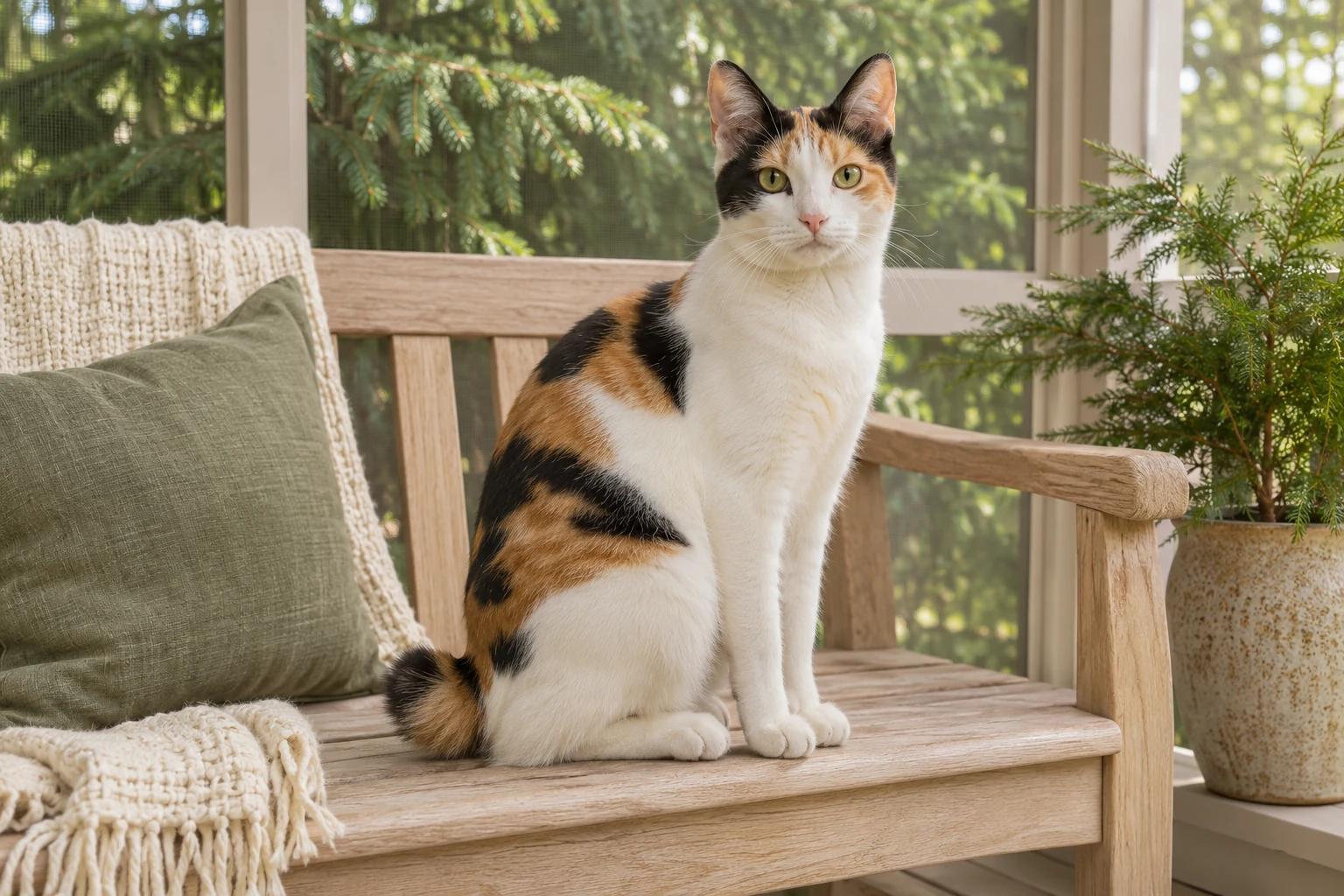
Japanese Bobtail cat size needs more than a single maximum weight. The current adult reference separates females and males, and the overlap between them is small but real. Keep that distinction when comparing an adult you can meet with a description of the breed, rather than treating the largest listed figure as everyone's destination.
Japanese Bobtail cat size: the current adult weight ranges
The current Japanese Bobtail profile lists adult females at 5–7 pounds and males at 8–10 pounds. Rounded into metric units, these are approximately 2.3–3.2 kilograms for females and 3.6–4.5 kilograms for males.
When answering “how big do Japanese Bobtail cats get?”, the combined range is 5–10 pounds. However, that shorthand loses the sex qualification. 10 pounds is the top of the listed male range, not the top of the listed female range.
The two ranges meet at eight pounds. An adult at that weight could fall within either reference, so the measurement alone cannot identify the animal's sex. A seven-pound female and a ten-pound male also both fall within their respective ranges; neither represents a target that every cat of that sex must reach.
Japanese Bobtail cat weight is therefore a useful starting point, not a verdict on an individual. If you need to know what a particular measurement means for your cat, ask the veterinarian assessing that animal rather than trying to select a preferred number from the range.
A slender frame can still be muscular
The WCF Japanese Bobtail Shorthair standard describes an elongated, slender body with developed muscle, long legs and oval paws. The head is as broad as it is long, forming an equilateral triangle with softly contoured edges. Large upright ears sit widely apart, with slightly rounded tips.
These details explain the difference between mass and proportion. “Slender” describes the outline; it does not mean that the cat lacks muscle. “Long-legged” describes the limbs in relation to the body; it does not supply a fixed Japanese Bobtail cat height in inches.
A view of the whole animal can show those relationships more clearly than a close-up of the head. Notice the relation between torso and limbs, then the shape of the head above them. No single feature is a substitute for all the others.
WCF also describes a short, soft, silky coat with little undercoat in this shorthair standard. That wording concerns this coat variety, not every longhaired Japanese Bobtail. Keep the scope attached: a shorthair description should not quietly become a universal measurement or coat description for the entire breed family.
The shortened tail is a structure, not a scale for the whole cat
Pollard and colleagues' Japanese Bobtail study examined cats descended from a pedigreed Japanese Bobtail crossed with other cats. The researchers used radiographs to investigate the structure behind different tail presentations. Their results documented variation in both the number of tail vertebrae and the placement of bends.
This is relevant to size because the outward length of a tail does not describe every aspect of its underlying structure. Different arrangements of bones can contribute to different visible shapes. The study's observations are not a formula for calculating an animal's adult body weight from its tail.
Its research population also matters: these were related cats in breeding trials, not a representative survey measuring every Japanese Bobtail. Do not turn a count or average from that group into a compulsory number for a household pet.
For an owner, separate three questions: what the tail looks like, what the cat weighs, and how long its torso is. They are different descriptions of the same animal. The paper helps explain anatomical variation; it does not make a short tail a shortcut for predicting the dimensions of the rest of the cat.
Growth studies need defined measurements and an appropriate population
A study by Parés-Casanova and colleagues examined 68 domestic cats of undefined breed composition in Arauca, Colombia. It recorded body length, pelvic and head circumferences, limb lengths and weight, alongside ages reported by owners.
The researchers defined body length from the nose to the junction at the base of the tail. That is a useful illustration of why the endpoints matter: a body-length measurement is not automatically a nose-to-tail-tip measurement. Different definitions can produce different numbers without either person having made an arithmetic mistake.
The study also modeled growth using cats of different ages. It was not a Japanese Bobtail growth chart, and it did not follow your kitten. Its findings should not replace this breed's current adult references or establish a guaranteed age at which a particular Japanese Bobtail reaches full size.
The practical lesson is to distinguish the quantity being measured, the population studied and the question being answered. An adult weight range, a defined body length and a model of growth are related information, but they are not interchangeable answers to “how big?”
The cat breed quiz explores broader ownership preferences. For the separate practical subject of familiarizing this breed with travel equipment, see the Japanese Bobtail carrier-at-home article.
Frequently asked questions
What is the current adult female Japanese Bobtail weight range?
Adult female Japanese Bobtails are listed at 5–7 pounds, approximately 2.3–3.2 kilograms, on the current breed profile.
What is the current adult male Japanese Bobtail weight range?
Adult male Japanese Bobtails are listed at 8–10 pounds, approximately 3.6–4.5 kilograms, on the current breed profile.
Can an eight-pound Japanese Bobtail fit either adult range?
Yes. Eight pounds falls within both the listed female and male Japanese Bobtail ranges. The number alone does not determine the cat's sex.
Sources behind this article
- WCF Japanese Bobtail Shorthair standard ↗
- Pollard and colleagues: Japanese Bobtail vertebral morphology ↗
- Parés-Casanova and colleagues: domestic cat growth ↗
- TICA adult reference — adult-weight reference ↗
Article source checked: November 16, 2026. Source checked 2026-11-16Article source checked: November 18, 2026. Source checked 2026-11-18
Keep reading
Japanese Bobtail cat temperament: understanding the individual
Read article →