Havana Brown cat temperament: curiosity in everyday life
Explore Havana Brown cat temperament through paw-based curiosity, vocal expression and practical interaction, with general cat research clearly identified.
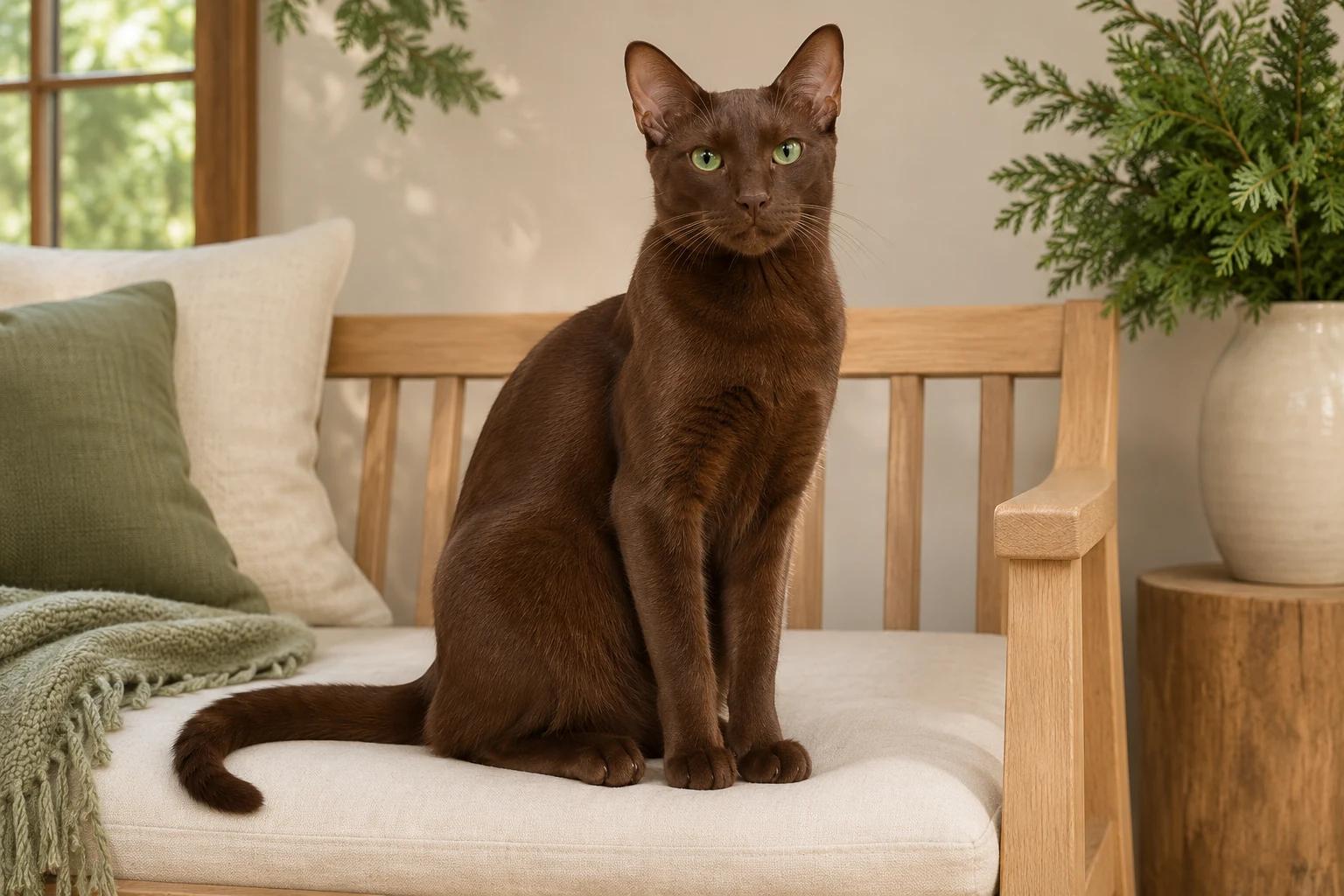
Havana Brown cat temperament has some memorable expressions: investigating objects with the paws and communicating in chirps or trills rather than relying on a meow. Those descriptions come from VCA's breed account, and are starting points for understanding an individual, not tricks every cat must perform.
The Havana Brown profile provides the broader ownership introduction. Here, Havana Brown cat behavior is considered through two different kinds of evidence: published accounts about the breed and practical guidance developed for cats generally. The distinction matters when deciding what to expect. An owner's anecdote can illustrate something that happened without showing how common it is, while a general method can be useful without proving a distinctive breed trait.
Havana Brown cat temperament: watch the paws as well as the voice
VCA describes Havana Browns examining an object by holding it between both paws. An owner may see an object being steadied, turned or brought closer rather than merely watched from a distance. It does not mean every paw movement is a request to be picked up or a command you should try to reproduce.
Its account also describes a relatively understated voice. A chirp or trill is still communication; a cat need not deliver a loud meow to be noticed. Listen to the particular sounds your Havana uses rather than assuming a quiet moment means there is nothing to attend to. The distinction is about expression, not a promise of silence all day.
Keep interesting paper out of reach
A 1998 CFA article by Richard Bilello offers a concrete owner's example: one of his Havana Browns took papers, cards and money from his wife's bag. He also described the cats leaving bite marks in paper and cardboard. This is a breeder's account, not a survey measuring how often all Havanas behave that way.
The practical application is straightforward. A handbag with an open top is not reliable storage for something you cannot afford to lose or have marked. Put documents away before the cat has access to them, rather than leaving loose corners projecting. The same applies to a photograph lying on a desk: do not make its preservation depend on predicting the cat's next investigation.
This anecdote gives a specific meaning to household curiosity without turning it into a universal trait. You need not offer valuable paper to discover whether your own cat resembles the author's. Protect the object first; ordinary life will provide plenty of less consequential information about the individual.
Make friendly contact a two-way interaction
General feline research offers a useful approach to contact, without making it a special Havana Brown method. A 2021 human–cat interaction study tested guidance built around choice, attention and touch with cats in a rehoming centre.
Remain seated and offer a hand, allowing the cat to approach and make contact. If it does not rub against you, do not assume it is asking to be stroked. When stroking is welcome, briefly pause to see whether the cat invites more. Let it move away without following.
The guidance concentrates touch around the cheeks and base of the ears, rather than assuming every body region is equally welcome. For an owner, the important change is to stop treating duration as the goal. A few chosen strokes can be an interaction in their own right. This study was not a Havana-only trial, and its practical guidance does not establish a breed-wide fondness for handling. It provides a way to respond to the cat actually participating. In the study, the guided interactions included less physical contact overall but more rubbing against people, illustrating why uninterrupted petting is not necessarily the best measure of connection.
Offer an easy problem, not an intelligence test
A veterinary review of food puzzles distinguishes stationary puzzles, from which food is retrieved, and mobile designs that release food when moved. It emphasizes matching difficulty to the individual and introducing an easy task first. This is general cat-enrichment guidance, not evidence that Havanas outperform other breeds.
For a beginner, an accessible opening is more useful than a complicated mechanism. A rolling puzzle should release food with little movement; a stationary design should not demand an elaborate sequence before the cat can succeed. Using the cat's usual food beside its feeding place can make the object an optional exploration rather than an abrupt replacement of everything familiar.
Watch whether the cat prefers moving an object or reaching into a stationary one. A preference for one design is not a ranking of intelligence. The review notes individual differences in how cats interact with puzzles, including using the nose or paws. Start with what this cat can readily do, without equating difficulty with cleverness.
For a wider comparison, try the cat breed quiz. The separate Havana Brown sitter handover guide covers temporary care arrangements. Veterinary concerns about your cat belong with your veterinarian, not a temperament label.
Frequently asked questions
Does Havana Brown cat personality include a quiet voice?
Havana Browns may communicate through chirps and trills. VCA's description is not a promise that an individual will never meow.
Will every Havana Brown take papers from a bag?
Paper-taking is one breeder's reported Havana Brown example, not a universal trait. Keep important papers inaccessible rather than testing the anecdote.
What do food puzzles reveal about Havana Brown cat characteristics?
A Havana Brown's puzzle preference shows how that individual chooses to explore. It does not provide a breed intelligence score.
Sources behind this article
- VCA Havana Brown ↗
- CFA Havana Brown article1998 ↗
- Haywood et al. human-cat interaction study ↗
- Dantas et al. food puzzles review ↗
Article source checked: November 16, 2026. Source checked 2026-11-16
Keep reading
Havana Brown cat size: weight, frame and proportions
Read article →