Havana Brown cat size: weight, frame and proportions
Understand Havana Brown cat size with male and female weight ranges, body proportions and a clear distinction between weight, height and physical fit.
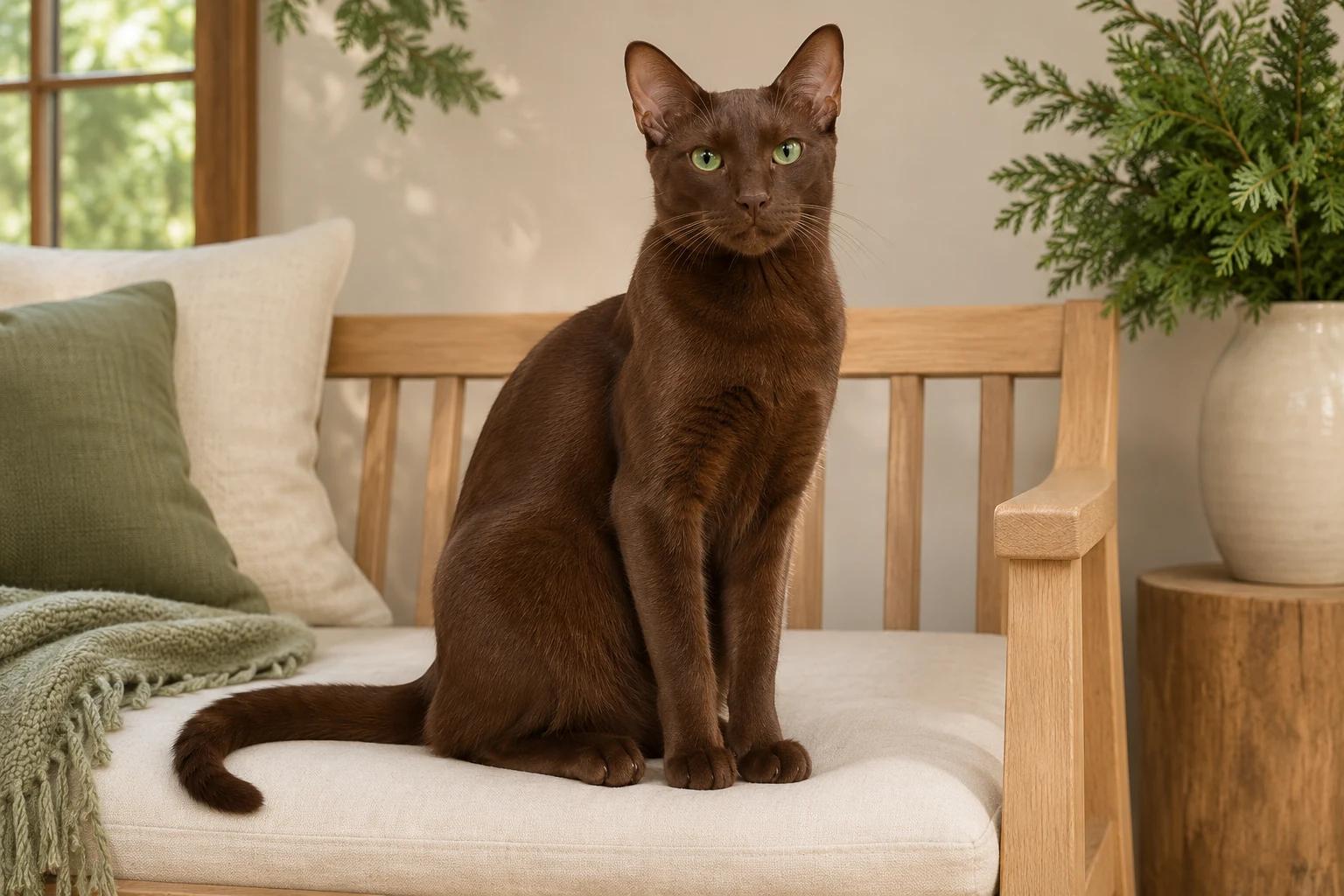
Havana Brown cat size is easiest to understand by separating adult weight from the proportions of the frame. The current Havana Brown profile lists females at 6–8 pounds and males at 8–10 pounds. Those sex-qualified ranges are more informative than giving every prospective owner a single ten-pound expectation.
Havana Brown cat size in pounds and kilograms
The female range converts to approximately 2.7–3.6 kilograms; the male range to approximately 3.6–4.5 kilograms. These are rounded conversions of the same figures, not a second set of measurements. Read the label alongside the number: an eight-pound Havana Brown sits at the upper end of the listed female range and the lower end of the listed male range.
For someone asking how big do Havana Brown cats get, that overlap is worth noticing. The profile does not describe two completely separate weight categories. Nor does its combined six-to-ten-pound span mean that every female should eventually reach ten pounds. Adult figures also should not become a timetable for a kitten. They give an expectation for the eventual adult, rather than a month-by-month growth target.
A firm frame without an exaggerated outline
The CFA description places the Havana between a heavily compact body and an extremely slender one. Firm musculature matters to that description. Females can appear more delicate than males, while the overall impression remains balanced rather than fragile. Legs are relatively long for the body, with the hind legs slightly longer than the forelegs.
Look at the relationship between torso and limbs, not simply the outline of a brown patch of fur. A side view shows where the body sits above the legs; a standing front view helps separate the width of the torso from the position of the forelegs. Neither view supplies a weight. The useful combination is an actual weight plus a description of the frame, rather than treating apparent delicacy as a number on a scale.
Head proportions belong in the size description too
The LOOF standard describes a head longer than it is wide, proportionate to the body, with a flat forehead and marked change into the nose. Its strong, square muzzle is a distinctive part of the outline. A firm chin completes that lower face. This is not a uniformly round head whose apparent width tells the whole story.
The large ears have rounded tips, sit apart and lean slightly forward in profile. These details help explain why a head-on portrait and a side view can create different impressions of the same animal. From the front, the ears and muzzle are conspicuous; from the side, the forehead-to-nose transition becomes clearer. Look at both when learning the breed's appearance.
LOOF also describes a medium-length muscular neck. Keep the head, neck and torso in the same observation rather than estimating the animal's overall size from a close portrait. The head is one component of the cat, not a substitute for seeing its complete standing shape.
Why an adult range is not an individual prediction
A pilot study by Kienzle and Moik examined weights in pedigreed and non-pedigreed cats. Its published abstract reports that males and females of one breed did not always fall into the same size class. In some breeds, individuals of the same sex occupied different classes too. This is general feline evidence, not a Havana Brown growth study or a replacement for the breed's current figures.
Its useful contribution here is the distinction between a category and an individual. Knowing breed and sex narrows a question; it does not supply an exact adult weight for a particular kitten. A proposed adult weight should therefore be presented as an estimate, not as something guaranteed by the breed name.
This also keeps comparisons honest. A range is not an average, and its upper endpoint is not the size of the typical animal. Without a measured population and its distribution, a precise claim about what most Havana Browns weigh goes beyond the information available here.
Height and width describe different physical demands
Havana Brown cat height cannot be calculated from pounds. A 2024 study of cats negotiating openings illustrates why dimensions deserve separate attention. Thirty companion cats were included in its analysis; none was listed as a Havana Brown. The animals approached tall, narrowing openings differently from openings that became progressively lower. Short openings prompted more hesitation, and taller cats were more likely to seek another route.
This does not establish a Havana-specific ability, a recommended opening size or permission to test how tightly a cat can squeeze. It shows that horizontal and vertical constraints are not interchangeable. A cat's response to a low passage need not tell you how it would respond to a narrow, taller passage.
For an owner interpreting size information, the distinction is practical: weight describes mass, while an opening has separate height and width. Do not use a weight range as proof that a particular passage will be comfortable. Let the cat choose an unobstructed alternative rather than encouraging a squeeze to demonstrate its flexibility.
For household matching beyond dimensions, use the cat breed quiz. The separate Havana Brown sitter handover article covers another ownership task. Ask your veterinarian about an individual cat's appropriate weight.
Frequently asked questions
What is the listed Havana Brown cat weight?
Havana Brown adult females are listed at 6–8 pounds and males at 8–10 pounds on the current breed profile.
Is there one Havana Brown adult weight for both sexes?
Havana Brown size information is more useful with its sex labels intact. The listed ranges meet at eight pounds, but their endpoints differ.
Does a ten-pound figure describe a Havana Brown kitten?
Havana Brown adult weight figures describe adults, not a kitten's present size or a deadline for reaching a particular weight.
Sources behind this article
- CFA Havana Brown ↗
- LOOF Havana Brown standard ↗
- Kienzle and Moik adult cat weight study abstract ↗
- Pongrácz body-size awareness study ↗
Article source checked: November 16, 2026. Source checked 2026-11-16
Keep reading
Havana Brown cat temperament: curiosity in everyday life
Read article →