European Burmese cat personality: participation without pressure
Explore European Burmese personality through social participation, changing play preferences and voluntary contact, with practical feline guidance.
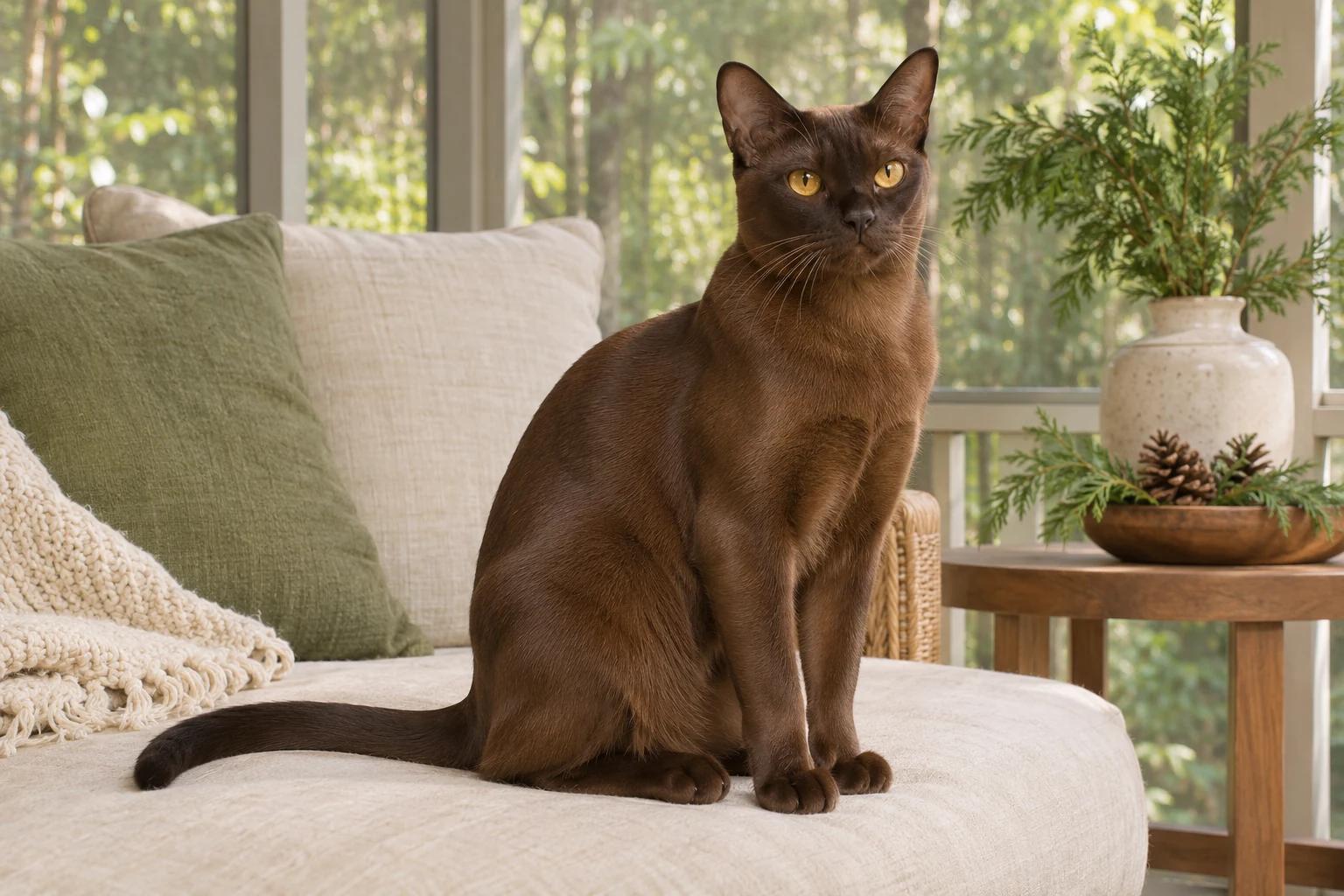
European Burmese cat personality is best understood through what the individual actually does with you. A description such as “good company” leaves important questions unanswered: what happens during an ordinary evening, what sort of interaction does the cat choose, and what do you enjoy doing together? The useful answer is not a promise that every animal with the same breed name will behave identically.
This guide separates breed accounts from practical advice that applies to cats generally. That distinction matters when turning European Burmese cat characteristics into expectations for a real relationship.
European Burmese cat personality includes participation
The Burmese Cat Club's account concerns the British Burmese tradition. It quotes Joyce Seville's club leaflet describing a strongly social cat that wants to participate in family activities, while emphasizing that each individual has a personality of its own. The same account evokes bursts of activity rather than presenting the cat as a decorative presence.
That is a useful way to think about living with a European Burmese: being in the room is not always the same as being involved. The cat might investigate what you are doing, join an activity or settle nearby. Notice the particular form of participation rather than expecting a familiar adjective to explain everything.
Ask a current caregiver for examples rather than imposing a timetable.
Playfulness can remain relevant beyond kittenhood
The FIFe Burmese profile describes a social, playful breed that can retain its playfulness at an older age. It is a breed account, not a prediction of how any particular European Burmese will behave at a specified birthday.
For an owner, the useful implication is not to think of play as something that belongs only to kittens. An adult's favorite activity still deserves attention. Do not assume that adopting an adult means adopting an animal with no interest in games, or that its current repertoire will be obvious from its age alone.
Ask about the actual sequence: what attracts the cat's attention, what it does next and when it loses interest. Two adults of the same age may have different preferences. An account of a game played yesterday is more informative than calling one cat “young at heart.”
This also helps avoid a false choice between a playful kitten and a purely sedentary adult. You are choosing an individual whose interests you can learn, not an age category with a fixed personality. The breed description invites you to look for continuing interest, without demanding any particular performance.
Let close contact remain voluntary
RSPCA Australia's guidance on hugging distinguishes affectionate contact from restraint. It advises letting an animal initiate interaction, watching its response and pausing to see whether it wants more. This is general guidance, not a claim that European Burmese need a different set of handling rules.
Offer gentle contact rather than enclosing the cat in a tight embrace. A cat that has approached you should still be able to leave. During a pause, moving away is a reason to let the interaction end; leaning into you can indicate interest in continuing.
That pause is a practical part of the interaction, not an examination the cat has to pass. You do not need to hold it still while deciding whether it is affectionate enough. Equally, choosing to stop does not erase the earlier choice to approach.
This distinction is useful. Shared contact works as a sequence of choices rather than a promise of unlimited access. Let the individual show you which kind of contact it wants now.
Give the game an object, not your fingers
Cats Protection's play guidance recommends toys that let cats stalk, chase, pounce and bat. Fishing-rod toys keep the game away from your body, and the cat should periodically be allowed to catch the toy. A larger kicker toy offers a different kind of physical interaction.
For your European Burmese, these are concrete alternatives to waving fingers or toes as targets. Move the toy, not your hand as prey. A chase-and-catch game and holding a kicker are different opportunities; the cat does not have to enjoy both equally.
Short games are acceptable. Cats Protection also advises checking toys for wear and not leaving cats alone with items they could swallow or become tangled in. Put the fishing-rod toy away when your shared game ends rather than leaving its string available unsupervised.
This guidance gives you something useful to do with an interested cat without inventing a breed-specific exercise quota. The purpose is an appropriate game, not a competition. Keep the toy and the interaction suited to the individual in front of you.
Use descriptions to ask better questions
The European Burmese profile is the starting point for the wider breed picture. Our cat breed quiz can help you compare your preferences without converting them into promises about an individual.
When discussing European Burmese cat behavior, distinguish what you have seen from what someone expects. “I watched this happen” and “I was told this is typical” are different kinds of information. Both can contribute to a conversation, but they should not silently replace one another. For the separate subject of a multi-cat feeding arrangement, read separate meals for a European Burmese.
Frequently asked questions
Are an observation and a prediction interchangeable?
No. Keep what you watched separate from what someone expects will happen.
Does approaching me mean the cat wants a hug?
No. Allow contact without restraint and leave the cat free to end it.
Should I use my hands as play targets?
No. Use an appropriate toy rather than fingers or toes.
Sources behind this article
- Burmese Cat Club: The Burmese Cat ↗
- FIFe Burmese breed profile ↗
- RSPCA Australia: Should I hug my dog or cat? ↗
- Cats Protection: Cats and play ↗
Article source checked: November 16, 2026. Source checked 2026-11-16
Keep reading
European Burmese cat size: adult weight, proportions and growth
Read article →