Egyptian Mau cat personality: familiar company and individual choices
Understand Egyptian Mau cat personality through everyday greetings, learning and individual preferences, with general feline research clearly identified.
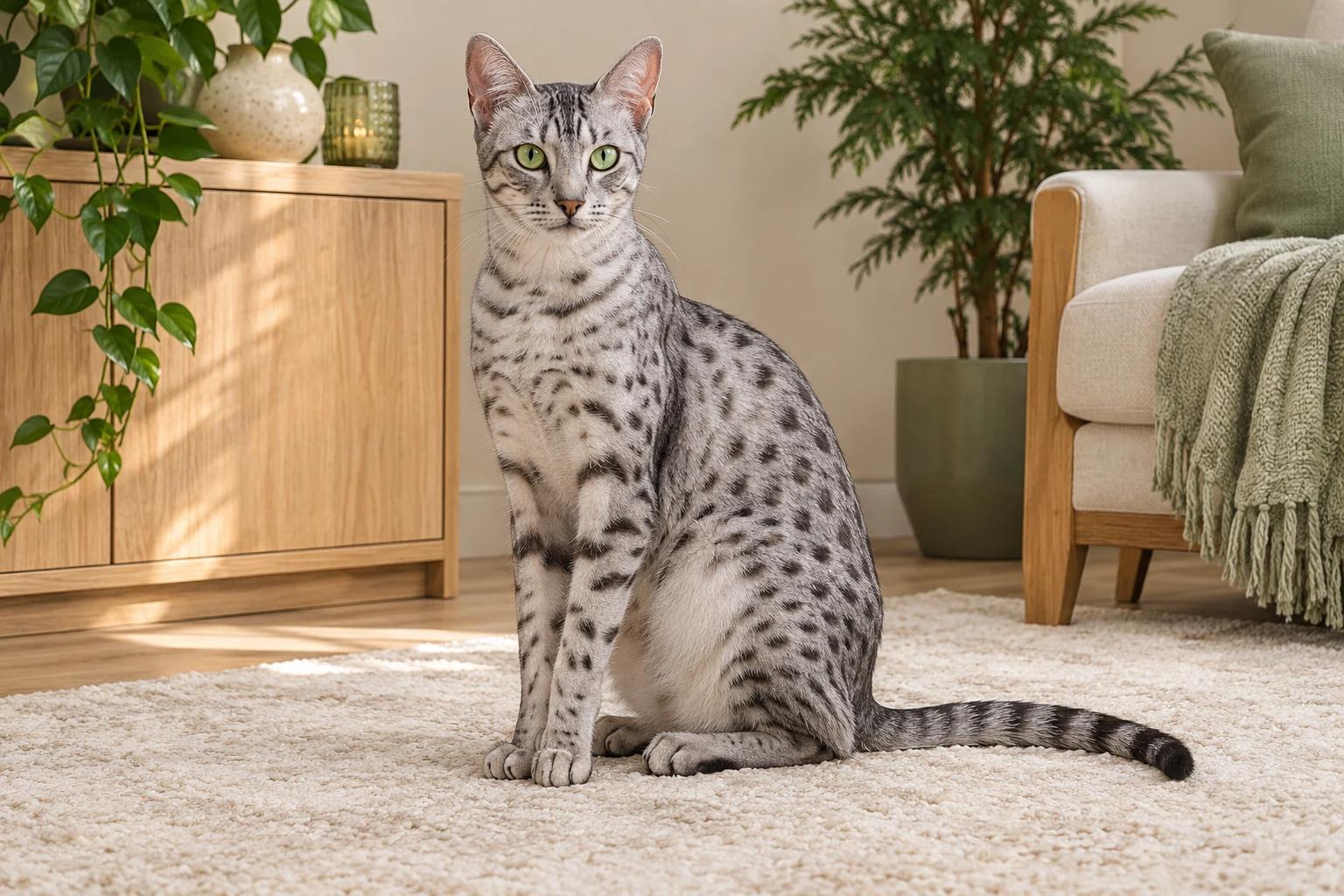
Egyptian Mau cat personality is more useful as a description of a relationship than as a list of flattering adjectives. What does the individual do when you return, when something interests it or when you offer an interaction? Those observations turn a breed description into information you can use. They also keep Egyptian Mau cat characteristics from becoming expectations that every cat must satisfy in exactly the same way.
Egyptian Mau cat personality shows up in ordinary greetings
VCA's Egyptian Mau account describes a cat that may take time to form friendships but becomes devoted to familiar people. Its examples include greeting a person at the door, bringing a toy to initiate play and making chirping or chortling sounds to attract attention.
Companionship is not only measured by lap time. A toy carried toward you can be an invitation to do something together. A greeting at the door is a different interaction again. Neither has to turn into a handling session to count as engagement.
Notice the context. Did the cat arrive with an object, look toward something happening nearby or simply approach as you entered? Describing that sequence is more informative than deciding that every sound translates into the same request.
VCA's examples do not promise that every Mau will bring toys or greet every arrival. They offer things to notice in your own cat. Let the familiar pattern of your relationship become apparent rather than requiring an individual to perform all the examples in a breed account.
Treat persistence as something to understand
In her Egyptian Mau Club account, Anne Gregory describes Maus as intelligent, quick to learn and sometimes stubborn. Read that as an experienced breed description, not a measured intelligence ranking or an explanation for every disagreement.
“Stubborn” can hide several different observations. A cat may repeatedly return to an object, continue investigating after you lose interest or decline the alternative you expected it to choose. Those are not identical behaviors, even if a person uses the same label for all three.
For a prospective owner, the useful question is whether you enjoy living with an animal whose choices will not always match your immediate plan. Quick learning is not the same as understanding an unspoken household rule. Nor does persistence establish that the cat is trying to win an argument.
When describing Egyptian Mau cat behavior to another person, say what happened: where the cat went, what it interacted with and what happened next. That provides a clearer starting point than “it knows perfectly well.” You can take the breed's reputation seriously without assuming that a human interpretation of motive is a fact.
Find out which kind of interaction matters
A 2017 study by Vitale Shreve and colleagues compared adult pet and shelter cats' preferences across human interaction, food, toys and scent. The final comparison included thirty-eight cats. Nineteen favored the social option, fourteen food, four toys and one scent; the difference between the social and food groups was not statistically significant.
This was general cat research, not a study of Egyptian Maus. Its useful contribution here is that preferences varied, including within the broad idea of human interaction. The social choices included talking, petting and play with a person.
For an owner, “my cat likes attention” is therefore an incomplete description. The next question is what sort. A game and a stroke are different offers, even though both involve you. An individual may choose one when the other is available.
Do not turn the research into a home contest between yourself and a bowl. You need not recreate its experimental conditions. Instead, use the distinction to avoid assuming that one familiar form of attention is the only meaningful way to interact with your Mau.
Sniffing is investigation, not a personality verdict
A 2025 study by Miyairi and colleagues presented thirty domestic cats with samples carrying their owner's odor, an unfamiliar person's odor and a blank control. The cats spent longer sniffing the unfamiliar human odor. The authors interpreted this as evidence of discrimination between familiar and unfamiliar human smells, while noting that recognizing a specific person by odor still required further study.
This finding does not establish exceptional Egyptian Mau senses, nor does it turn sniffing duration into a measure of affection. It is general feline research with a narrower conclusion.
When your Mau investigates something carrying an unfamiliar smell, the observation need not become “suspicious,” “unfriendly” or “in love with the visitor.” Investigation is an activity in its own right. You cannot infer a complete relationship from that moment.
There is no need to collect scent samples or stage a test. The practical point is to give your interpretation appropriate limits. Not every pause to investigate is a social judgment, and a shorter investigation of something familiar does not mean the familiar person matters less.
Build a picture without demanding a performance
The Egyptian Mau profile provides the broader breed reference, and our cat breed quiz can help compare your own preferences. For the separate question of guests entering your home, see meeting visitors with an Egyptian Mau. This article concerns understanding the cat you live with, rather than turning an introduction into a test of its breed description.
Frequently asked questions
Must a Mau sit on a lap to show involvement?
Egyptian Maus may engage through greetings, toy invitations and vocalizing.
Does human attention always mean petting?
Egyptian Mau attention can include talking and play, not only petting.
Does longer sniffing prove greater affection?
Longer sniffing cannot prove Egyptian Mau affection; the odor study examined discrimination.
Sources behind this article
- VCA Egyptian Mau ↗
- Egyptian Mau Club: Breed facts and figures ↗
- Vitale Shreve et al.: Cat preferences ↗
- Miyairi et al.: Responses to human odor ↗
Article source checked: November 16, 2026. Source checked 2026-11-16
Keep reading

American Bobtail cat temperament
Read article →