Drentsche Patrijshond temperament at home
Explore Drentsche Patrijshond temperament, thoughtful introductions, household routines and questions to ask before choosing a Drent.
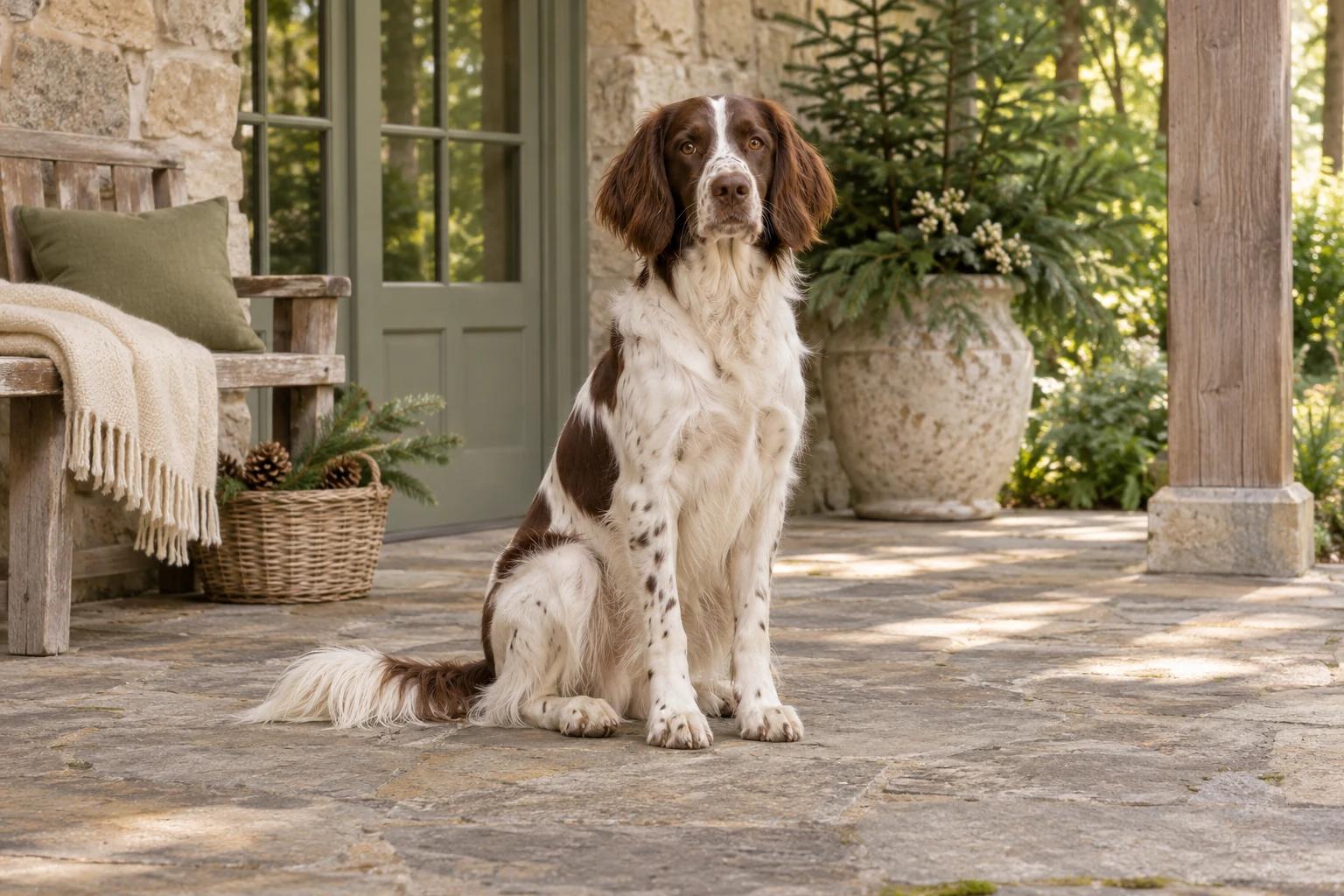
Drentsche Patrijshond temperament is best understood through ordinary shared life, not just a photograph of an elegant brown-and-white dog. A prospective owner needs to know how a Drent meets visitors, handles a changed routine and occupies itself between outings. Those details reveal more about the match than a description such as “intelligent” can on its own.
Begin with the Drentsche Patrijshond profile, then arrange to spend time around adult dogs. The aim is not to find a flawless example of a breed. It is to decide whether the particular dog's habits fit the life you can actually provide.
Drentsche Patrijshond temperament: gentle does not mean passive
The FCI breed standard describes gentleness, loyalty and intelligence, while allowing initial reserve. It specifically discourages forceful training. These are useful expectations for the tone of your relationship, not a promise that the dog will be compliant in every setting.
For example, a dog can learn readily in the kitchen and become absorbed by movement beyond the garden fence. It may enjoy familiar people while taking time to approach a visitor. Neither contrast requires a dramatic personality label. Look at the setting, what the dog has already learned and whether the task you are asking for is clear.
When researching drentsche patrijshond personality, ask an owner for a recent, ordinary example. “What happened when someone came to repair the washing machine?” produces more useful information than “Is your dog friendly?” You learn where the dog waited, whether it could settle and how much help the owner supplied.
A useful visitor plan starts before the door opens
Give a new Drent a predictable place to be while you welcome people. That might be a comfortable room separated by a gate, with the option to observe from a distance. Invite visitors to let the dog approach rather than following it around or reaching over its head.
A first meeting need not become a handling test. The visitor can sit down and talk to you while the dog explores the room. If the dog chooses distance, preserve that distance. Introductions are still introductions when they do not end with petting.
Record what makes meetings easier. Does the dog prefer people seated rather than standing? Is the hallway too narrow for a comfortable approach? Does a familiar person being nearby help? These observations give you a practical welcome routine instead of a repeated attempt to prove the dog is sociable.
Children also need a clear plan: supervised contact, no interference with food or sleep, and a retreat they leave alone. A breed description cannot make an individual interaction safe. Adults must manage the space rather than expecting the dog or child to work everything out.
Give curiosity something to do
The American Kennel Club's breed introduction places the Drent in a versatile farming and hunting background. For a companion household, the useful question is what thoughtful activity will replace simply having work available outdoors.
You might set out a small search for a familiar toy in one room, practice bringing an object to a mat, or teach the dog to wait while you hide something in an easy location. These are proposed household games, not a substitute for specialist working instruction. Keep the setup simple enough that both of you understand the goal.
End while the dog can still succeed. Then put the equipment away and make rest possible. If every interaction becomes another exciting challenge, you have not shown the dog what a quiet part of the day looks like. An outing, a short task and a settled household period can each have their own place without turning the schedule into a competition.
Our existing article on the Drent's working search sequence examines field behavior separately. Everyday companionship is a broader question than whether a dog shows a particular working movement.
Read behavior without rushing to a label
Useful drentsche patrijshond characteristics include responsiveness and an interest in purposeful engagement, but an owner still needs to distinguish confusion from refusal. Suppose your dog leaves its bed when you walk into another room. Did you teach it to remain while you moved away, or only to lie down when you stood beside it?
Make the next request easier and more precise. Reward a brief stay while you take one step away, return, and release the dog. Build from something you can both recognize. Repeating a cue more loudly does not explain the missing part of the exercise.
For drentsche patrijshond behavior that concerns you, keep a short factual record: what happened immediately beforehand, where everyone stood, and how the situation ended. Avoid conclusions such as “jealous” when the observable event was pushing between two people on a sofa. The record gives a qualified reward-based professional something concrete to assess. Sudden changes in behavior or comfort belong in a conversation with your veterinarian.
Can your weekday support the dog you meet?
Walk through a normal Tuesday before committing. Who takes the dog outside first? Where will it rest during calls? Who can provide care when work overruns? Where will wet equipment and a damp feathered coat be dealt with after an outing?
Test household expectations against each other. One person may want a quiet companion nearby while another encourages a game every time the dog approaches. Agree on what happens during meals, at the door and when someone needs uninterrupted time. Consistency is easier when the rules are few and practical.
Ask the breeder or rescue about the actual dog's experience with time alone, travel, grooming and other animals. Request descriptions, not guarantees. For an adult dog, knowing its established routine can be especially valuable. For a puppy, ask how the family assesses temperament over time rather than selecting solely from one lively visit.
Use the breed match quiz to identify gaps in your plan, then discuss those gaps with people who know the dog. The strongest match is one where the less glamorous parts of ownership also sound manageable.
FAQ
Is a Drentsche Patrijshond naturally outgoing with strangers?
A Drentsche Patrijshond may be reserved initially. Let the individual dog approach at its own pace, and ask about its previous visitor experiences. Enthusiastic greetings are not the only acceptable outcome of a first meeting.
Does intelligence make a Drent easy to live with?
Intelligence does not replace teaching. A Drent still needs clear household routines, opportunities to learn and practice in different settings. Evaluate whether you enjoy providing that guidance rather than expecting a clever dog to infer every rule.
What should I observe when meeting adult Drents?
Watch transitions: arrival, the end of a game, a visitor sitting down and the start of quiet time. Ask the owner what help the dog receives. Those details give a more realistic picture of everyday companionship than a brief greeting alone.
Sources behind this article
Article source checked: November 15, 2026. Source checked 2026-11-15
Keep reading
Drentsche Patrijshond size: a practical fit guide
Read article →