Cherubim Cat Personality: What Is Documented and What Varies
Cherubim cat personality explained: what TICA's standard says, typical characteristics and behavior at home, and why every cat is an individual.
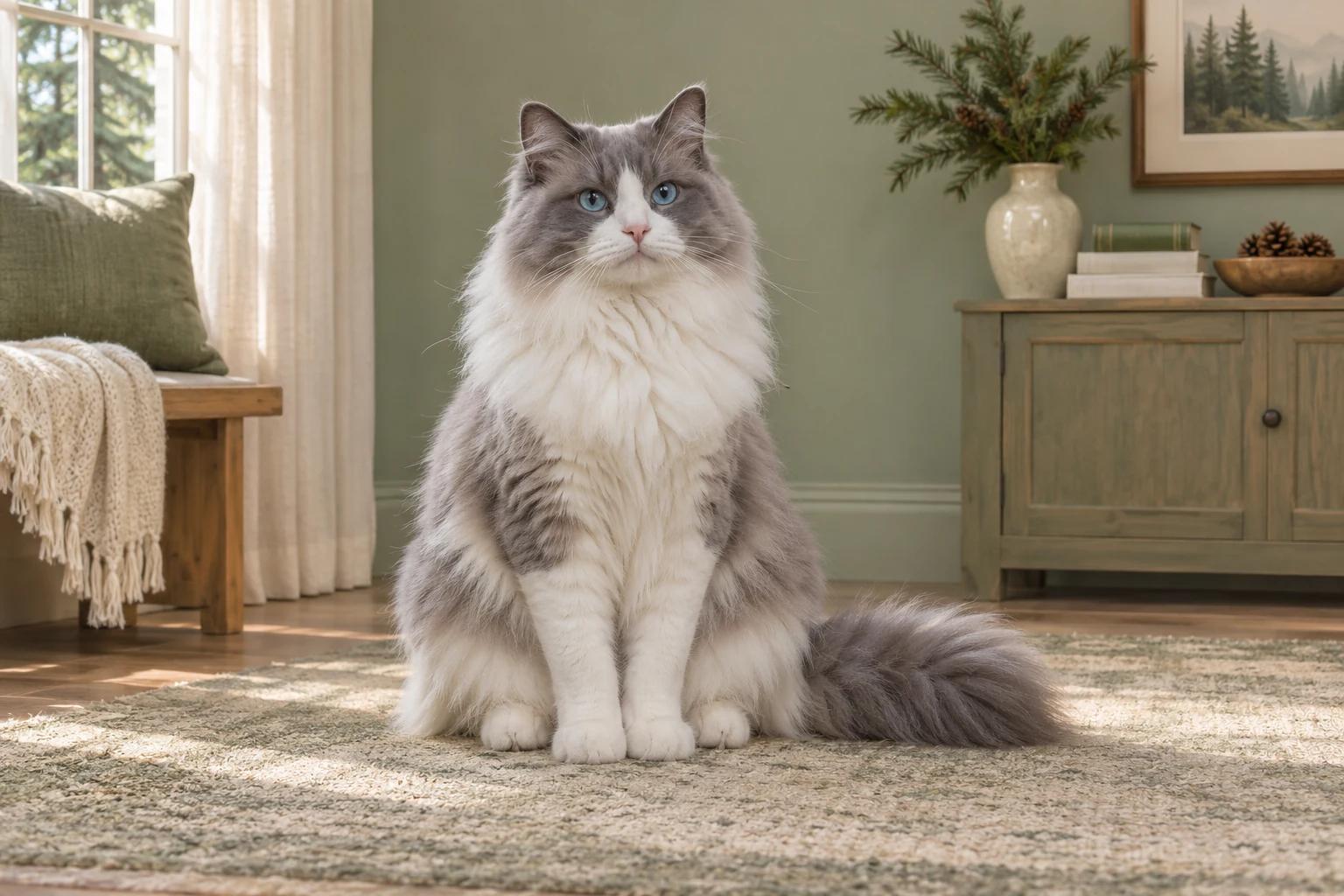
If you are researching Cherubim cat personality, you will notice that there isn't much breed-specific information yet. That's because the name is new. TICA lists the Cherubim (CB) as a championship breed in its Ragdoll Breed Group, and the current standard took effect on May 1, 2025. A lot of what you'll read online is borrowed from Ragdoll descriptions or from much older uses of the word "Cherubim." This guide sorts what is actually documented from what is assumed, so you can set realistic expectations. Remember that breed tendencies are only a starting point, and every cat is an individual.
Cherubim cat personality at a glance
The Cherubim breed page scores the breed on a five-point scale. These scores describe general tendencies. They don't predict how any one cat will behave.
| Trait | Score (out of 5) |
|---|---|
| Human interaction | 4 |
| Openness to new people | 3 |
| Adaptability | 3 |
| Activity needs | 3 |
| Playfulness | 3 |
| Responsiveness to training | 3 |
| Enrichment interest | 2 |
| Vocal frequency | 2 |
Overall, this describes an affectionate cat that is calm but playful, with moderate activity needs and a fairly quiet voice. It may need some time to warm up to strangers.
What the breed standard says about temperament
TICA's Ragdoll Breed Group standard covers both the Ragdoll (RD) and the Cherubim (CB). It mostly describes appearance, but it includes a few lines about temperament that apply to both breeds.
A "sweet personality"
The standard's general description includes a sweet personality in its picture of the ideal cat. This is the only direct personality wording in the standard. It does not use words like "docile," "floppy," or "goes limp when held."
"Unchallenging" in the show ring
The standard also says temperament must be "unchallenging." A cat being judged may show fear, try to get away, or complain out loud, but it may not threaten to harm anyone. Any definite challenge disqualifies the cat.
This rule describes how a cat must behave while a judge handles it. It does not promise how a cat will behave at home, with visitors, or around other animals.
Cherubim vs Ragdoll: what's shared and isn't documented
The Cherubim and the Ragdoll are closely related. TICA's 2024 proposal that created the breed group describes both as a large, semi-longhaired cat of moderate type. The differences it lists are coat color, eye color, and pattern. Ragdolls are pointed with blue eyes, while Cherubim come in mink, sepia, and traditional (solid) colors. The proposal makes no claim that the two breeds differ in temperament. In its review, TICA's Genetics Committee noted that the breed-group distinction concerns alleles of a single gene.
What this supports: Because the two breeds share a standard, an ancestry, and a temperament requirement, it's reasonable to expect a lot of overlap.
What it doesn't support: The cited registry documents do not establish a behavioral difference between Cherubim and Ragdoll cats. Popular Ragdoll lore, such as the idea that these cats go limp when picked up, isn't in TICA's standard and is not established for Cherubim by the sources cited here. It's best to treat those stories as unconfirmed.
A name with an older history
The word "Cherubim" has been used before. TICA's breed-group proposal explains that Ann Baker's breeding lines used the phrase "Registrar of Cherubim Cats" on their registration documents. Older articles about "Cherubim cats" may be describing that earlier population rather than TICA's current CB breed. As the breed page explains, today's Cherubim is a separate registry identity, not a new name for Ragdolls.
Cherubim cat characteristics that shape behavior
Some physical traits affect how a Cherubim lives day to day.
A large, slow-maturing cat
TICA's standard says the breed grows large and heavy. It also says these cats mature slowly and may not reach their full weight and size until about four years old. Full color can take about three years to develop. The breed page lists adult weights of 10–20 lb, with females at 10–15 lb and males at 15–20 lb.
In practice, this means a two-year-old may still be filling out. When choosing scratching posts, cat trees, and perches, look for options that will stay steady under a large adult.
A semi-long coat
The breed page describes a semi-longhaired coat. It recommends regular tangle checks and gentle combing, with a routine suited to the individual coat.
Cherubim cat behavior at home
Play and activity
The breed page describes Cherubim as calm but playful. They benefit from toys, places to scratch, and some activity every day. The Merck Veterinary Manual says cats lose interest in a toy quickly. It recommends rotating several toys instead of leaving the same ones out. The enrichment score is a broad reference, not a reason to withhold play or assume which toys an individual will enjoy.
Affection and new people
The breed scores 4/5 for human interaction and is described as affectionate. Its score for openness to new people is a more moderate 3/5. Some Cherubim greet visitors right away, while others watch from a distance first. Give your cat a quiet place to retreat, and let it decide when to approach.
The Merck Veterinary Manual says cats handle relationships with people much as they do with other cats. They use distance, friendly signals like rubbing, and warning behaviors like hissing. Whether an interaction feels positive depends on how the cat sees it. The manual advises against physical punishment because it can harm the bond and lead to aggression.
Voice
With a vocal score of 2/5, the breed page rates Cherubim as fairly quiet. That's a breed tendency, so an individual cat may still be more talkative.
Children and other pets
The breed page says compatibility with children and other pets isn't guaranteed. Plan gradual, supervised introductions, and make sure the cat always has a way to step away.
Why individual Cherubim cats vary
A breed label tells you less about personality than many people expect. The Merck Veterinary Manual makes several relevant points:
- Genetics matter. Genes play a strong role in a cat's personality, especially genes from the father.
- Early experiences matter. The key socialization period runs from about 2 to 7 weeks of age. Meeting people, other animals, and new things during this window helps prevent fearfulness.
- Breeds differ less than you might think. Cats have gone through less selective breeding than dogs, so differences in behavior between cat breeds are narrower.
If you're meeting a Cherubim, ask about that specific cat. How was it handled as a kitten? What were its parents like? How does it react to new people? When a cat moves to a new home, record its handling preferences along with the rest of its care routine. Our guide to Cherubim identity and care records explains how to keep that information organized.
Is a Cherubim a good fit for you?
If you want a large, affectionate, fairly quiet cat with moderate play needs, the Cherubim may be worth a closer look. Be ready for a cat that takes years to mature and may be cautious with strangers. To see how the breed fits your lifestyle, take the My Breed Atlas cat quiz.
FAQ
Are Cherubim cats affectionate?
My Breed Atlas scores the Cherubim 4 out of 5 for human interaction and describes the breed as affectionate. TICA's standard describes the ideal Cherubim as having a sweet personality. Individual cats still vary, and early socialization and genetics shape how cuddly a particular cat becomes.
Is a Cherubim's personality the same as a Ragdoll's?
TICA puts both breeds under one breed group standard with the same temperament requirement. The documented differences are color, eye color, and pattern, not personality. The cited registry documents do not establish a behavioral difference, but Ragdoll-specific stories should not be assumed to apply to every Cherubim.
Are Cherubim cats vocal?
The Cherubim is generally on the quieter side. My Breed Atlas scores its vocal frequency at 2 out of 5. This is a breed tendency rather than a rule, so some individual Cherubim are more talkative than others.
How much play does a Cherubim cat need?
The Cherubim is described as calm but playful, scoring 3 out of 5 for both activity needs and playfulness. The breed profile recommends daily activity, interactive toys and scratching areas. Let the individual cat's interest guide play rather than treating a breed score as a fixed timetable.
Sources behind this article
- TICA Ragdoll Breed Group standard, updated May 1, 2025 ↗
- TICA Ragdoll Breed Group rationale and proposed standard changes ↗
- Merck Veterinary Manual: Social Behavior of Cats ↗
Article source checked: November 17, 2026. Source checked 2026-11-17
Keep reading
Cherubim cat size: adult weight, build and development
Read article →