Balinese cat activity level
Explore Balinese cat activity level through voluntary games, useful perches and achievable food puzzles, without a fixed exercise quota.
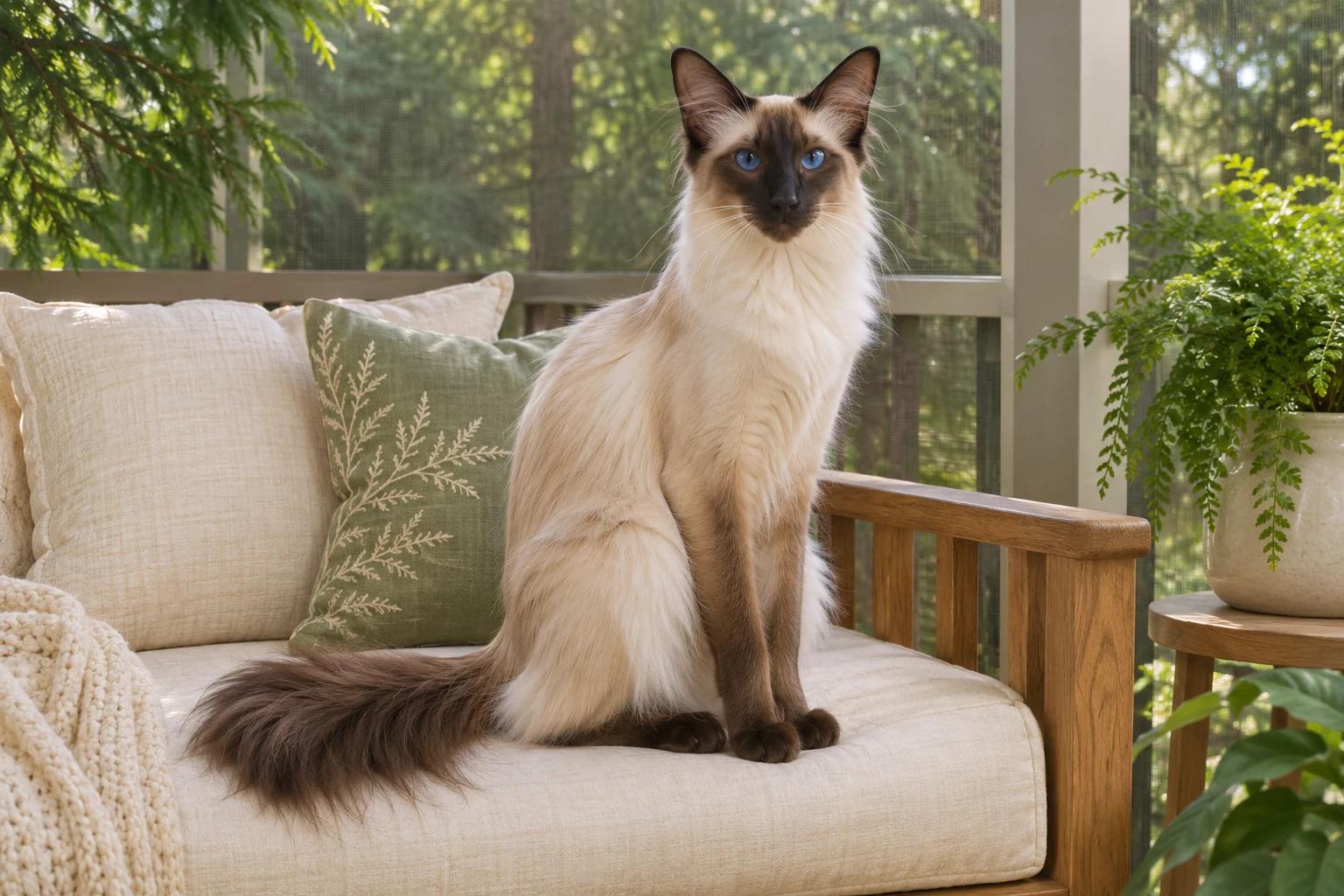
Balinese cat activity level is best addressed with several kinds of opportunity rather than one exhausting game. The current Balinese profile describes active play and an interest in fetching, while emphasizing voluntary participation. Your cat can investigate, move, learn and rest without having to demonstrate every activity associated with the breed.
Balinese cat activity level: offer variety, not a performance test
TICA's Balinese account describes an agile, athletic cat and lists teaser toys, climbing structures and fetching among possible activities. It also recognizes that an active cat may enjoy a lap or resting under the covers. Activity and affection are not opposite personality categories.
For an owner, that creates a useful menu rather than a compulsory checklist. A Balinese that likes pursuing a toy but does not bring it back can still enjoy a game with you. An animal that spends time resting has not failed to live up to an athletic description.
Start with a familiar interest. Games need not test new skills.
Give watching a place alongside movement
An elevated resting spot is not merely an exercise destination. Ohio State's perch guidance explains that cats use height to observe their surroundings and may appreciate views from more than one angle. A suitable piece of sturdy furniture near a window can serve a purpose as well as a dedicated cat structure.
Consider what the Balinese can actually see from the proposed location. A high surface facing a blank wall provides a different experience from a resting place with a view. Think about the animal's viewpoint rather than assessing the arrangement only from standing human height.
Ohio State also recommends considering access to views when furniture is rearranged. A room can remain attractive to a person while losing the route or outlook the cat previously used. Before moving a favored chair, notice what it contributes. Providing a replacement opportunity is more useful than assuming the cat will immediately find an equivalent position elsewhere in the room.
Keep the game catchable and the equipment intact
Cats Protection's play guidance supports very short games and recommends allowing a cat to catch a fishing-rod toy periodically. Stalking and catching are meaningful parts of play; perpetual frantic movement is not the only way to create interest.
For Balinese cat indoor play, use a toy suitable for the animal rather than fingers or toes as the target. A larger kicker toy can provide a different form of play from chasing an object, while keeping the person's body out of the game. This gives you options without asking the cat to respond to every toy identically.
Check toys for wear and do not leave the cat alone with items it could become tangled in or shred and eat. An energetic interaction can be brief and still worthwhile. Finish with equipment put away appropriately, rather than leaving a string toy accessible because the cat might want another turn later. Supervised play and unattended access are different arrangements.
Make a food puzzle achievable before making it difficult
VCA's food-enrichment guidance distinguishes simple puzzles from more complicated ones that may require demonstration. It also notes that puzzles can accommodate different food types. The objective is a manageable task, not a test of how long the cat will struggle before obtaining something.
When considering how to exercise a Balinese cat, a food puzzle offers a different kind of engagement from chasing. Ask your veterinarian which food and arrangement fit the individual, and use the appropriate part of the daily food allowance rather than automatically adding extra food for each activity.
Keep the first challenge easy enough that the cat can discover the relationship between its action and the result. Difficulty is not a badge of intelligence. A simple, understood device can provide a useful activity even if a more elaborate product exists. If you are considering a homemade design, VCA recommends checking its safety with your veterinarian before use rather than assuming every household container makes a suitable puzzle.
Arrange the room for the actual cat, not the breed photograph
The current adult size references are approximately 5–8 pounds for females and 8–12 pounds for males. Those ranges provide broad scale, but a photograph of a slender animal does not give the dimensions of its landing area or the load limit of a platform. Follow equipment instructions and check the individual rather than relying on a product's breed illustration.
A play area also has a human dimension. Leave enough room for the person operating a toy to move without colliding with a chair or pulling the toy through breakable objects. The route should be usable at the time of the game, not just when the room was first arranged. A bag placed across the floor can change a previously clear space.
Look at floor surfaces as well as distances. A route across a fixed rug differs from one across a loose mat that shifts when touched. Secure or remove unstable furnishings before beginning, and keep fragile objects out of the activity space. These are practical checks on your arrangement, not assumptions that every Balinese will move in the same way.
The cat quiz can help you think through broader ownership preferences. For a separate coat-care question, read the Balinese bath-decision guide; exercise planning does not establish a washing schedule.
FAQ
Must every Balinese retrieve toys?
A Balinese need not fetch: it is one possible interest, not a requirement for play or a measure of sufficient activity.
Does a breed weight range establish a platform's suitability?
A Balinese breed weight range cannot establish platform suitability. Compare the actual cat with stated dimensions and capacity. The illustration on a product is not a fit check.
Should I leave the same floor layout unchanged indefinitely?
Recheck a Balinese’s activity space as it is used rather than leaving its layout unchanged indefinitely. Bags, movable mats and other household objects can alter a previously clear activity area.
Sources behind this article
Article source checked: November 16, 2026. Source checked 2026-11-16
Keep reading

American Curl exercise
Read article →