Australian Mist cat temperament
Explore Australian Mist cat temperament, from kitten curiosity to adult company, with practical ways to respect individual preferences.
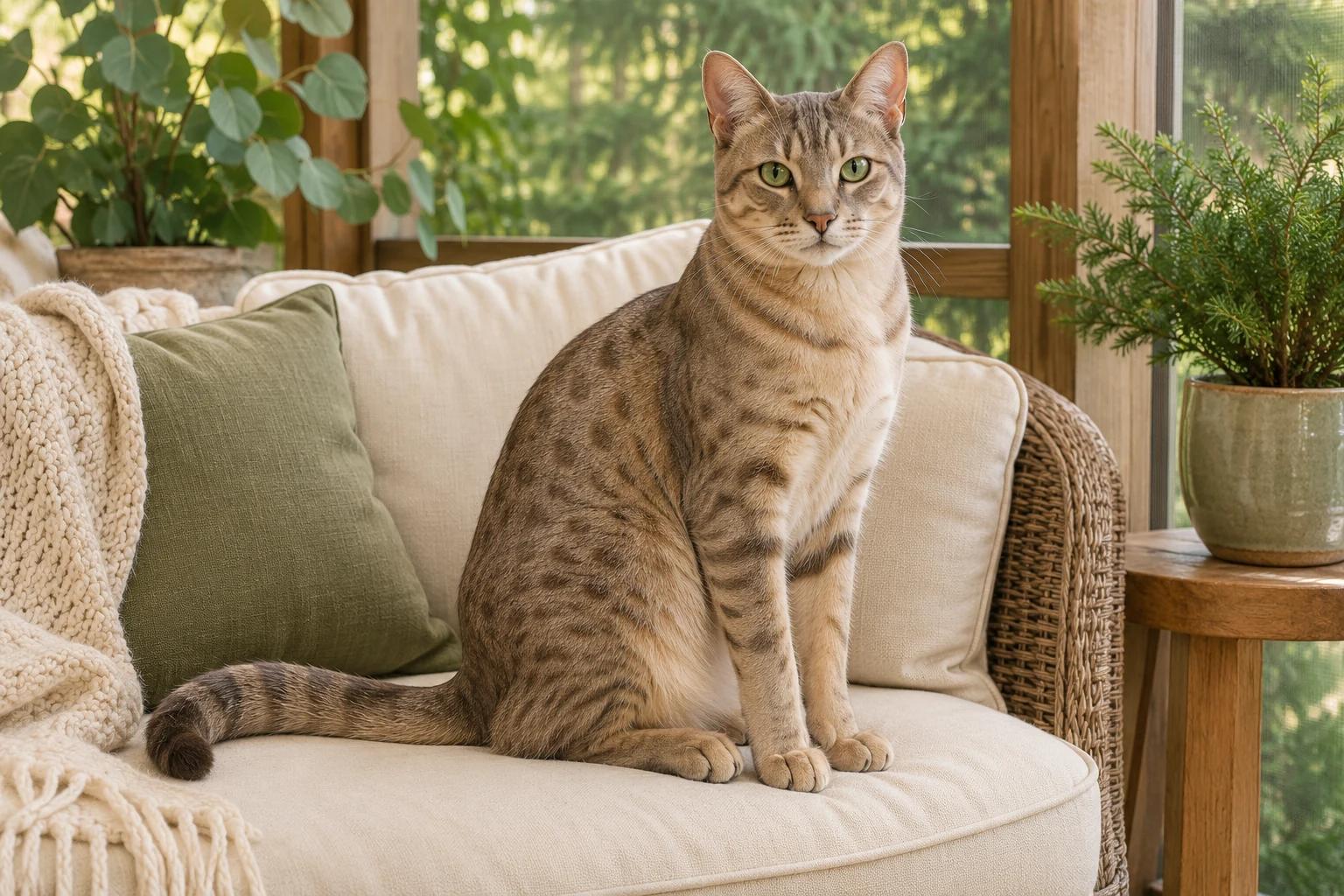
Australian Mist cat temperament is companionship-oriented, but individual history matters. The current Australian Mist profile describes regular human company, not an obligation for the cat to accept constant handling.
Australian Mist cat temperament through development
GCCF's breed account describes inquisitive youngsters developing into gentler adults. It does not establish a personality-change deadline.
Company should have more than one acceptable form
A cat may choose to approach, spend time nearby or move away. The MSD Veterinary Manual's social-behavior account explains that cats regulate social interaction partly through distance and affiliative behavior. It also makes an important distinction: an interaction is positive because the cat experiences it that way, not because the person intended it kindly.
For a companionship-oriented Mist, that distinction prevents affection from becoming an obligation. Being close enough to watch you can be worthwhile company even when the cat does not climb onto your lap. Likewise, a cat that enjoyed contact earlier need not welcome the same contact throughout the evening.
Respond to the actual invitation instead of deciding that the breed description overrides it. You can offer conversation or simply continue a quiet activity nearby without immediately adding touch. That leaves room for a relationship in which proximity and physical contact are related but not interchangeable. A cat's choice of distance is information, not a personal rejection or proof that it has the wrong temperament.
Let the cat choose what happens after an approach
The AAFP and ISFM environmental-needs guidance lists several forms of human interaction, including being played with, talked to, groomed, held and seated on a lap. Individual preferences differ. Its recommendation is to let the cat initiate and control contact rather than forcing it.
Apply that to an Australian Mist greeting a visitor. Approaching a new person need not be treated as permission to pick the cat up. Someone can offer a quiet opportunity to interact while leaving the cat free to decide whether to stay. A pleasant greeting does not need to become a demonstration of how much handling the animal will tolerate.
The same distinction applies within a familiar household. One person may be associated with a favorite game and another with quiet seated company. There is no requirement for everyone to create identical interactions. Make space for the relationship each person actually has with the cat, while giving the animal the same ability to decline. Familiarity should make communication easier, not make consent seem unnecessary.
Keep play available without demanding a performance
A calmer adult still needs opportunities appropriate to its interests. VCA's play-and-toys guidance explains that adult cats continue to benefit from play and that short bursts followed by rest are normal. An animal stopping after a few minutes has not necessarily rejected the toy.
Offer a suitable game when the cat is naturally interested, rather than waking it to prove that it can still be playful. Rotate available toys to preserve novelty instead of presenting every object at once. Supervise wand-style toys and put them away afterward.
For a Mist, this turns an age-related breed tendency into a flexible opportunity rather than a fixed exercise prescription. The quiet adult and the energetic youngster can both have play available, without being expected to respond identically. A session can be successful even when it is brief. Watch participation rather than comparing the cat with a dramatic online clip or insisting that each attempt last the same amount of time.
Read the breed description without turning it into a guarantee
Australian Mist cat personality is best discussed through concrete experiences. A cat accustomed to one familiar adult has not necessarily encountered a busy gathering. A friendly greeting in its own home and a first meeting in an unfamiliar room are different situations. Keep the setting attached to your interpretation of the behavior.
Australian Mist cat characteristics also include a medium build, with a current adult reference of 8–15 pounds, published as one combined range. Those numbers do not define temperament. A cat near the upper end is not automatically more assertive, and a lighter individual is not automatically more delicate in its social preferences. Physical scale and the preferred relationship with people should remain separate considerations.
Australian Mist cat behavior in a new household also depends on what the cat encounters there. The current profile recommends a quiet transition space and allowing the individual to control its distance. That is not a demand to produce immediate sociability. An unfamiliar home is a different situation from the familiar setting in which a caregiver described the animal.
For households with another cat, the resident-cat introduction guide covers that separate transition. The cat quiz can help you think about the kind of everyday companionship you are seeking without turning breed labels into assurances.
FAQ
Will a lively Australian Mist kitten become a quiet adult on a particular birthday?
Australian Mist kittens do not become quiet adults on a fixed birthday. Developmental tendencies are not schedules for individual personalities.
Does a friendly greeting in one setting predict every meeting?
An Australian Mist’s friendly greeting does not predict every meeting; familiar surroundings and unfamiliar rooms differ. Consider where and with whom the behavior occurred rather than treating one encounter as a complete personality assessment.
Does the adult weight range tell me which cat will welcome visitors?
The Australian Mist’s 8–15-pound adult range describes physical scale, not responses to visitors. It does not measure experience with visitors or predict the form of contact an individual will prefer.
Sources behind this article
- GCCF Australian Mist ↗
- MSD Veterinary Manual social behavior ↗
- AAFP ISFM environmental needs ↗
- VCA play and toys ↗
Article source checked: November 16, 2026. Source checked 2026-11-16
Keep reading
Australian Mist cat size
Read article →