Xoloitzcuintli temperament
Understand Xoloitzcuintli temperament through familiar relationships, puppy development, comfortable greetings and activities suited to the individual.
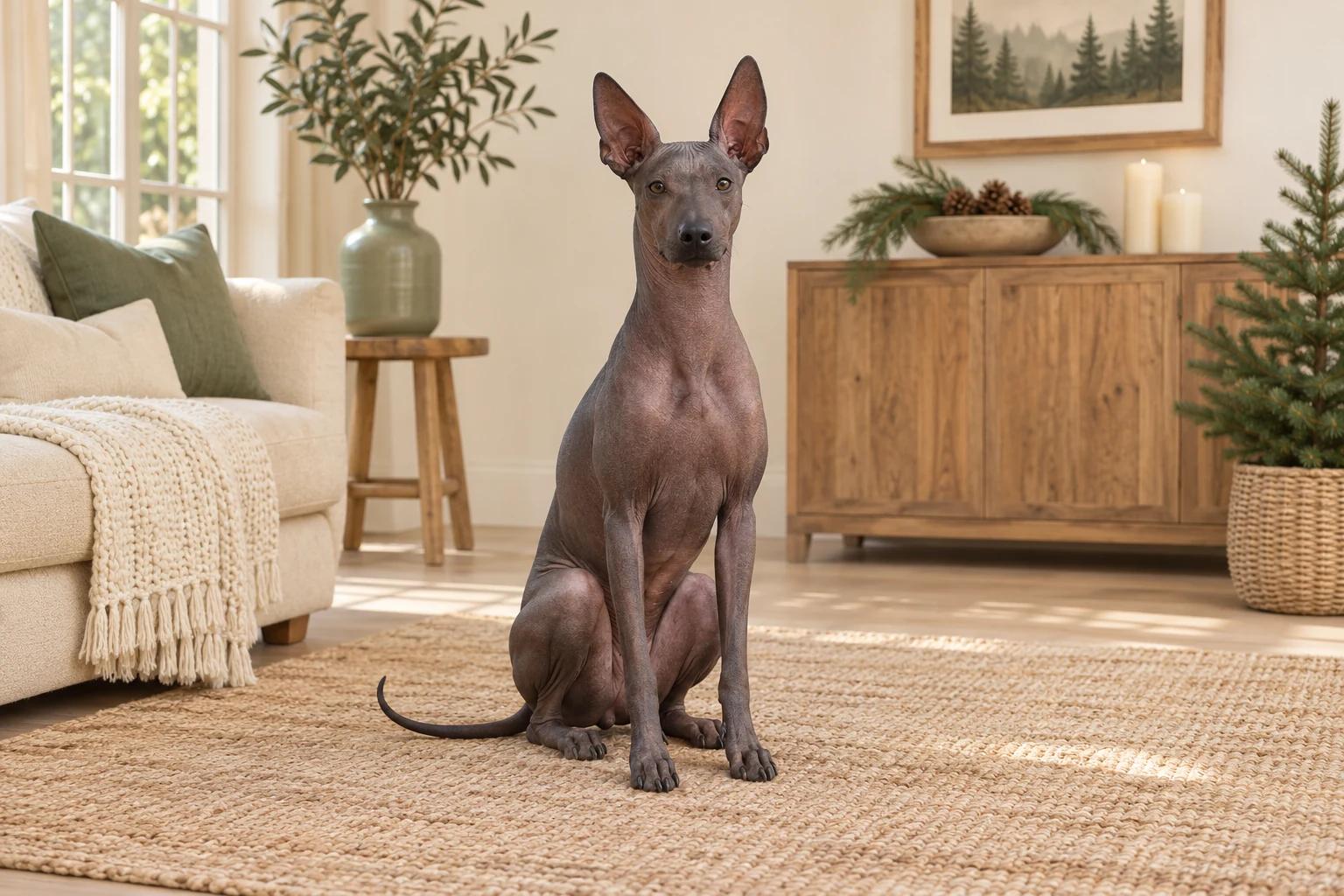
Xoloitzcuintli temperament is summarized in the current breed profile as alert, loyal and calm. Those words describe tendencies, not a promise that every encounter will be quiet or that a newly arrived dog immediately knows a household's routine. The Xolo's personality is best understood in several settings: with familiar people, during an activity and when something new enters its surroundings. One brief greeting cannot answer all three questions.
Xoloitzcuintli temperament: familiarity changes the relationship
The Xoloitzcuintli Club of America's account describes strong bonds with owners alongside greater reserve with strangers. It does not present the same level of affection toward familiar and unfamiliar people. That difference is important when a prospective owner expects an immediate demonstration of the relationship a dog has with its family.
A Xolo that is restrained in an initial meeting may behave quite differently during familiar shared time. Do not treat the absence of instant affection as proof that the dog cannot form a close relationship. Equally, a warm interaction with one known person does not establish that every visitor will receive the same greeting.
The club also describes inquisitive youngsters and the need for consistent education. A distinctive appearance does not remove ordinary puppy behavior. Before choosing a young Xolo, consider whether you enjoy the process of helping an inexperienced dog learn about a home. Admiring a composed adult is different from wanting to raise the puppy that may eventually develop into that companion. Age and familiarity both change what you are observing.
Calm adulthood does not erase playfulness
VCA's Xolo account distinguishes calmer adults from more rambunctious puppies, while noting that playfulness continues beyond puppyhood. It also recommends gentle, game-like teaching rather than harsh methods. A calm description should not be translated into a dog with no interest in activity or learning.
For an owner, this means that a lively youngster is not necessarily contradicting the breed's adult description. Nor should quiet behavior during one part of the day be mistaken for a lack of curiosity. Look at the range of behavior rather than selecting the single moment that best fits a label.
The same account warns that Xolos can climb and should not be left outdoors unsupervised merely because a fence is present. That is a concrete practical consideration for a dog whose intelligence may be more apparent in exploration than in a posed photograph. Supervised outdoor time is different from assuming that an enclosure makes every possible activity safe. A composed indoor companion can still be interested in what lies beyond the garden boundary.
Give unfamiliar people a clear greeting plan
Battersea's approach guidance begins with asking the owner before interacting. It advises against looming over a dog, staring or reaching straight over its head. A calm, sideways approach allows a less confrontational introduction, and the dog should be allowed to approach rather than being pursued.
For a Xolo attracting attention in public, this gives the owner a useful way to manage curiosity from strangers. An interesting appearance does not make the dog available for immediate touching. A person can learn about the breed without handling the animal at all.
If the dog welcomes contact, keep it brief and then pause. Battersea recommends watching whether the dog seeks more contact instead of continuing automatically. Turning away or appearing uncomfortable is a reason to stop. This is not a test of whether the Xolo is sufficiently friendly. It is a way to make the encounter understandable and to respect the individual response. A successful greeting can be quiet and short; it does not need to become prolonged petting or hugging.
Offer choices within an appropriate daily routine
Dogs Trust's welfare guidance includes mental activities such as puzzle feeders, toys, reward-based learning and food searches. It also emphasizes that dogs differ in what they enjoy. Some prefer an energetic shared game, while others spend more time exploring scents at an easier pace.
That distinction is useful when learning about Xoloitzcuintli personality. Rather than selecting one activity because it looks impressive, notice what engages this dog. A simple search for scattered food in a safe space offers a different experience from chasing a toy. Neither needs to be turned into a competitive performance.
Make room for undisturbed rest as well. The guidance recommends a comfortable, quiet resting place away from household bustle. A dog choosing that space is not failing to be affectionate. Shared life includes the opportunity to disengage and sleep. The aim is a day that offers appropriate interests and a genuine place to rest, not a schedule in which the dog must continually prove enthusiasm for whatever people happen to be doing.
Keep behavior separate from size and appearance
The current profile includes three Xolo height categories: toy, miniature and standard. Those categories describe stature, not a scale from easy to difficult personality. A smaller dog still has its own preferences and learned experience. A larger adult does not automatically require a more confrontational approach to communication.
The profile also records a strong interest in family interaction and normal vocal communication. These are useful starting points, but neither specifies what a particular bark means or how close the dog wants to sit. Learn the context of the individual behavior rather than assigning a fixed meaning from the breed name.
If you are exploring Xoloitzcuintli characteristics before choosing a companion, use the dog quiz to consider the broader commitment. The existing article on the coated Xolo variety explains an appearance question without making it a personality prediction. The dog beneath either appearance still deserves to be understood through its own life and experiences.
Frequently asked questions
Does Xoloitzcuintli behavior depend only on its size category?
No. Toy, miniature and standard describe height categories. They do not establish the individual's learned manners, comfort with unfamiliar situations or compatibility with a particular household.
Does the current profile describe a dog that never barks?
No. Vocal tendency sits in the middle of the current reference scale. Normal communication remains part of ownership; a breed descriptor such as calm is not a promise of silence.
Does the Xolo's appearance tell me whether it will suit another pet?
No. Appearance does not establish compatibility. The current profile treats other-animal relationships as individual questions, requiring attention to experience, introductions and the behavior of the animals involved.
Sources behind this article
- Xoloitzcuintli Club of America About Xolos ↗
- VCA Xoloitzcuintli ↗
- Battersea approaching a dog ↗
- Dogs Trust making your dog happy ↗
Article source checked: November 16, 2026. Source checked 2026-11-16
Keep reading

Airedale Terrier Temperament: What Everyday Life Can Feel Like
Read article →